We want to help you start/manage and grow your business using innovative strategies and implementation. We have a passion for helping businesses and companies of various sizes see the same success that we have achieved.
Our skillsets are wide and varied, from business strategy, marketing, to online strategy. An increasing number of companies are turning to the internet and online media as a means to maximising their marketing reach and exposure. This is special area of focus for us and we do more than simple SEO strategies.
Google’s technological edge has always come from its computational power.
This edge is no longer special. AWS, Microsoft, and other cloud services now give us access to essentially unlimited computing power on demand.
Generative Pre-trained Transformer 3 (GPT-3) technology is the largest most advanced text predictor ever. It will eventually be available as a commercial product.
We may see big players like Apple enter the search engine market.
Founder and CTO of LinkGraph gives you foresight into the sea of opportunities ahead.
The tech-world recently geeked out after its first glimpse into OpenAI’sGPT-3technology. Despite some kinks, the text predictor is already really good. Fromgenerating code to writingGoogleAds copy, toUI/UX design, the applications of GPT-3 have sparked the imaginations of web developers everywhere.
This changes everything.
With GPT-3, I built a Figma plugin to design for you.
But they should also be sparking the imaginations of search engine optimizers. In its debut week, we already witnessed a developerbuild a search engineon top of GPT-3. It can hardly rival Google’s product, but the potential is clearly there. OpenAI plans to turn GPT-3 into a commercial product next year, meaning any brand could use the technology to create their own search platform.
The implications would be significant for the SEO landscape. More brands innovating their own search engines would create new opportunities for digital marketers and the brands we help build. For Google, though, the potential is far more nerve-wracking. GPT-3 has shown that Google’s core technological advantages – natural language processing (NLP) and massive computing – are no longer unique and are essentially being commoditized.
GPT-3 challenges Google’s technological edge from all directions
Few have monetized NLP and machine learning as well as Google, but their technological edge has always been computational power. Google’s ability to crawl billions of pages a day, its massive data centers, and its extensive computing across that data, have cemented their status as the dominant search engine and digital advertising market leader.
But AWS, Microsoft Azure, and other cloud services now give us access to essentially unlimited computing power on demand. A decade ofMoore’s Lawhas also reduced the cost of this computing power by one-to-three orders of magnitude.
Additionally, open-source software and advances in research have made it easier for developers to access the latest breakthroughs in NLP and machine learning technology. Python, Natural Language Toolkit (NLTK), Pytorch, and Tensorflow are just a few that have granted developers access to their programming and software innovations.
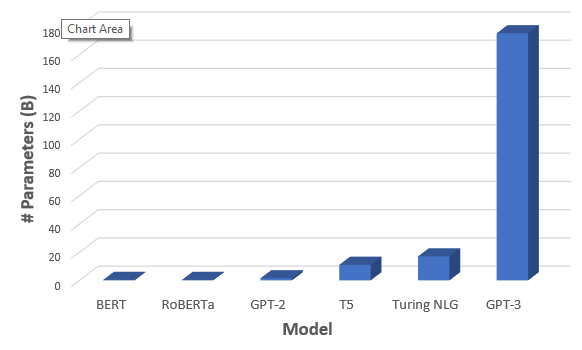
Yes, Google still has BERT, which shares similar architecture with GPT-3. But GPT-3 is slightly larger (by about 175-billion parameters). GPT-3 also doesn’t need nearly as large of a training data set asGoogle’s BERT.
Not only will GPT-3 add value to those businesses and applications that are already using AI andmachine learningwith a newer, larger, and significantly improved NLP model, it would also equip Google’s biggest Cloud competitors with the ability to pair that technology with their own computing power.
Other players will soon be able to build massive search engines like Google did
In order to build a search engine, you need to be able to retrieve many different types of information: Web results for one, but also maps, data, images, and videos. Google’s indexing power is what catapulted them to be the primary retriever of all web knowledge.
In addition to building that massive information retrieval system, Google monetized on those economic searches through advertising. But the majority of searches Google doesn’t actually earn any money on.
OpenAI built its own information retrieval system GPT-3 so that it could create superintelligence. If OpenAI wanted to, they could build a competitor to Google. But the hardest part would be bringing this to a massive audience. Bing’smarket shareis only 6.5% while Yahoo’s is 3.5%.
It’s been a long time since the search engine market was a realistic place to compete. But what if a GPT-3 commercial product equipped a new competitor with an equally-matched technological edge, market share, cloud service, and devoted customer-base to enter the search market?
Let’s say a competitor like Apple. They launched a newlyredesigned Apple Mapsearlier this year. They already announced they are indexing the web throughApplebot. When it comes to launching the next best search engine, Apple is well-positioned.
How could Apple change the SEO landscape with its own search engine?
Most likely, an Apple search engine would useranking factors similar to Google. The app store ecosystem would equip Apple with greater use ofin-app engagement data. We could also see a greater reliance on social signals from Facebook and Twitter.
All android devices currently ship with Chrome + Google Search as the default search OS. Apple’s devices ship with Safari and you can select your own preferred search OS. It could easily do what Google has done and default to its own search engine. With just one iPhone model launch, Apple could transition its massive customer-base away from Google through its technological edge and dominance with devices.
But what would be most troublesome for Google is how Apple could disrupt Google’s massive ads ecosystem. 71% ofGoogle’s revenuecomes from advertising. With Google Ads now beingthe most expensive(and competitive) place to advertise on the internet, many advertisers would welcome a disruption. It’s possible we could see billions of dollars of advertising revenue shift to Apple.
For SEOs and digital marketers, it’s fun to imagine. We could see entirely new markets for search, creating more need for our expertise and additional platforms our customers can use to grow. We’re not quite there yet, but SEOs and digital marketers should be prepared for what advancements like GPT-3 could potentially mean for our industry.
Manick Bhan is the founder and CTO of LinkGraph, an award-winning digital marketing and SEO agency that provides SEO, paid media, and content marketing services. He is also the founder and CEO of SearchAtlas, a software suite of free SEO tools. He is the former CEO of the ticket reselling app Rukkus.
We spend a lot of time discussing SEO tactics, but in a constantly changing industry and especially in times of uncertainty, the strategies agencies should employ in order to see success deserve more attention. In this popular (and still relevant) Whiteboard Friday, Russ Jones discusses four essential success tactics that'll ultimately increase your bottom line.
Russ also delved into the topic of profitability in his MozCon Virtual presentation this year. To watch his and our other amazing speaker presentations, you can purchase access to the 2020 video bundle here.
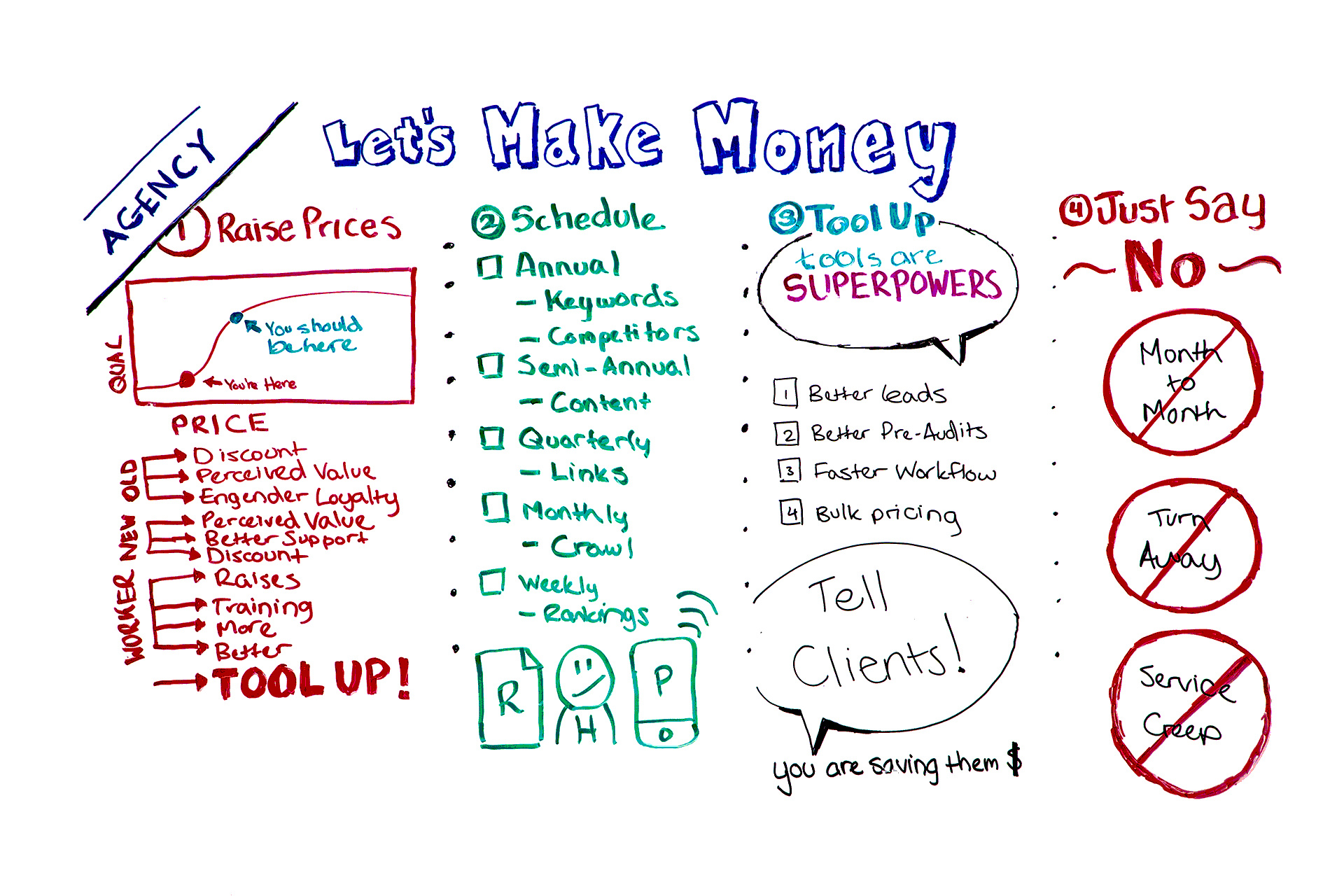
Click on the whiteboard image above to open a high-resolution version in a new tab!
Video Transcription
Howdy, Moz fans. I am Russ Jones, and I can't tell you how excited I am for my first Whiteboard Friday. I am Principal Search Scientist here at Moz. But before coming to Moz, for the 10 years prior to that, I was the Chief Technology Officer of a small SEO agency back in North Carolina. So I have a strong passion for agencies and consultants who are on the ground doing the work, helping websites rank better and helping build businesses.
So what I wanted to do today was spend a little bit of time talking about the lessons that I learned at an agency that admittedly I only learned through trial and error. But before we even go further, I just wanted to thank the folks at Hive Digital who I learned so much from, Jeff and Jake and Malcolm and Ryan, because the team effort over time is what ended up building an agency. Any agency that succeeds knows that that's part of it. So we'll start with that thank-you.
But what I really want to get into is that we spend a lot of time talking about SEO tactics, but not really about how to succeed in an industry that changes rapidly, in which there's almost no certification, and where it can be difficult to explain to customers exactly how they're going to be successful with what you offer. So what I'm going to do is break down four really important rules that I learned over the course of that 10 years. We're going to go through each one of them as quickly as possible, but at the same time, hopefully you'll walk away with some good ideas. Some of these are ones that it might at first feel a little bit awkward, but just follow me.
1. Raise prices
The first rule, number one in Let's Make Money is raise your prices. Now, I remember quite clearly two years in to my job at Hive Digital — it was called Virante then — and we were talking about raising prices. We were just looking at our customers, saying to ourselves, "There's no way they can afford it." But then luckily we had the foresight that there was more to raising prices than just charging your customers more.
How it benefits old customers
The first thing that just hit us automatically was... "Well, with our old customers, we can just discount them. It's not that bad. We're in the same place as we always were." But then it occurred to us, "Wait, wait, wait. If we discount our customers, then we're actually increasing our perceived value." Our existing customers now think, "Hey, they're actually selling something better that's more expensive, but I'm getting a deal," and by offering them that deal because of their loyalty, you engender more loyalty. So it can actually be good for old customers.
How it benefits new customers
Now, for new customers, once again, same sort of situation. You've increased the perceived value. So your customers who come to you think, "Oh, this company is professional. This company is willing to invest. This company is interested in providing the highest quality of services." In reality, because you've raised prices, you can. You can spend more time and money on each customer and actually do a better job. The third part is, "What's the worst that could happen?" If they say no, you offer them the discount. You're back where you started. You're in the same position that you were before.
How it benefits your workers
Now, here's where it really matters — your employees, your workers. If you are offering bottom line prices, you can't offer them raises, you can't offer them training, you can't hire them help, or you can't get better workers. But if you do, if you raise prices, the whole ecosystem that is your agency will do better.
How it improves your resources
Finally, and most importantly, which we'll talk a little bit more later, is that you can finally tool up. You can get the resources and capital that you need to actually succeed. I drew this kind of out.
If we have a graph of quality of services that you offer and the price that you sell at, most agencies think that they're offering great quality at a little price, but the reality is you're probably down here. You're probably under-selling your services and, because of that, you can't offer the best that you can.
You should be up here. You should be offering higher quality, your experts who spend time all day studying this, and raising prices allows you to do that.
2. Schedule
Now, raising prices is only part one. The second thing is discipline, and I am really horrible about this. The reality is that I'm the kind of guy who looks for the latest and greatest and just jumps into it, but schedule matters. As hard as it is to admit it, I learned this from the CPC folks because they know that they have to stay on top of it every day of the week.
Well, here's something that we kind of came up with as I was leaving the company, and that was to set all of our customers as much as possible into a schedule.
Annually: we would handle keywords and competitors doing complete analysis.
Semi-annually: Twice a year, we would do content analysis. What should you be writing about? What's changed in your industry? What are different keywords that you might be able to target now given additional resources?
Quarterly: You need to be looking at links. It's just a big enough issue that you've got to look at it every couple of months, a complete link analysis.
Monthly: You should be looking at your crawls. Moz will do that every week for you, but you should give your customers an idea, over the course of a month, what's changed.
Weekly: You should be doing rankings
But there are three things that, when you do all of these types of analysis, you need to keep in mind. Each one of them is a...
Report
Hours for consulting
Phone call
This might seem like a little bit of overkill. But of course, if one of these comes back and nothing changed, you don't need to do the phone call, but each one of these represents additional money in your pocket and importantly better service for your customers.
It might seem hard to believe that when you go to a customer and you tell them, "Look, nothing's changed," that you're actually giving them value, but the truth is that if you go to the dentist and he tells you, you don't have a cavity, that's good news. You shouldn't say to yourself at the end of the day, "Why'd I go to the dentist in the first place?" You should say, "I'm so glad I went to the dentist." By that same positive outlook, you should be selling to your customers over and over and over again, hoping to give them the clarity they need to succeed.
3. Tool up!
So number three, you're going to see this a lot in my videos because I just love SEO tools, but you've got to tool up. Once you've raised prices and you're making more money with your customers, you actually can. Tools are superpowers. Tools allow you to do things that humans just can't do. Like I can't figure out the link graph on my own. I need tools to do it. But tools can do so much more than just auditing existing clients. For example, they can give you...
Better leads:
You can use tools to find opportunities.Take for example the tools within Moz and you want to find other car dealerships in the area that are really good and have an opportunity to rank, but aren't doing as well as they should be in SERPs. You want to do this because you've already serviced successfully a different car dealership. Well, tools like Moz can do that. You don't just have to use Moz to help your clients. You can use them to help yourself.
Better pre-audits:
Nobody walks into a sales call blind. You know who the website is. So you just start with a great pre-audit.
Faster workflows:
Which means you make more money quicker. If you can do your keyword analysis annually in half the time because you have the right tool for it, then you're going to make far more money and be able to serve more customers.
Bulk pricing:
This one is just mind-blowingly simple. It's bulk pricing. Every tool out there, the more you buy from them, the lower the price is. I remember at my old company sitting down at one point and recognizing that every customer that came in the door would need to spend about $1,000 on individual accounts to match what they were getting through us by being able to take advantage of the bulk discounts that we were getting as an agency by buying these seats on behalf of all of our customers.
So tell your clients when you're talking to them on the phone, in the pitch be like, "Look, we use Moz, Majestic, Ahrefs, SEMrush," list off all of the competitors. "We do Screaming Frog." Just name them all and say, "If you wanted to go out and just get the data yourself from these tools, it would cost you more than we're actually charging you." The tools can sell themselves. You are saving them money.
4. Just say NO
Now, the last section, real quickly, are the things you've just got to learn to say no to. One of them has a little nuance to it. There's going to be some bite back in the comments, I'm pretty sure, but I want to be careful with it.
No month-to-month contracts
The first thing to say no to is month-to-month contracts.
If a customer comes to you and they say, "Look, we want to do SEO, but we want to be able to cancel every 30 days." the reality is this. They're not interested in investing in SEO. They're interested in dabbling in SEO. They're interested in experimenting with SEO. Well, that's not going to succeed. It's only going to take one competitor or two who actually invest in it to beat them out, and when they beat them out, you're going to look bad and they're going to cancel their account with you. So sit down with them and explain to them that it is a long-term strategy and it's just not worth it to your company to bring on customers who aren't interested in investing in SEO. Say it politely, but just turn it away.
Don't turn anything away
Now, notice that my next thing is don't turn anything away. So here's something careful. Here's the nuance. It's really important to learn to fire clients who are bad for your business, where you're losing money on them or they're just impolite, but that doesn't mean you have to turn them away. You just need to turn them in the right direction. That right direction might be tools themselves. You can say, "Look, you don't really need our consulting hours. You should go use these tools." Or you can turn them to other fledgling businesses, friends you have in the industry who might be struggling at this time.
I'll tell you a quick example. We don't have much time, but many, many years ago, we had a client that came to us. At our old company, we had a couple of rules about who we would work with. We chose not to work in the adult industry. But at the time, I had a friend in the industry. He lived outside of the United States, and he had fallen on hard times. He literally had his business taken away from him via a series of just really unscrupulous events. I picked up the phone and gave him a call. I didn't turn away the customer. I turned them over to this individual.
That very next year, he had ended up landing a new job at the top of one of the largest gambling organizations in the world. Well, frankly, they weren't on our list of people we couldn't work with. We landed the largest contract in the history of our company at that time, and it set our company straight for an entire year. It was just because instead of turning away the client, we turned them to a different direction. So you've got to say no to turning away everybody. They are opportunities. They might not be your opportunity, but they're someone's.
No service creep
The last one is service creep. Oh, man, this one is hard. A customer comes up to you and they list off three things that you offer that they want, and then they say, "Oh, yeah, we need social media management." Somebody else comes up to you, three things you want to offer, and they say, "Oh yeah, we need you to write content," and that's not something you do. You've just got to not do that. You've got to learn to shave off services that you can't offer. Instead, turn them over to people who can do them and do them very well.
What you're going to end up doing in your conversation, your sales pitch is, "Look, I'm going to be honest with you. We are great at some things, but this isn't our cup of tea. We know someone who's really great at it." That honesty, that candidness is just going to give them such a better relationship with you, and it's going to build a stronger relationship with those other specialty companies who are going to send business your way. So it's really important to learn to say no to say no service creep.
Well, anyway, there's a lot that we went over there. I hope it wasn't too much too fast, but hopefully we can talk more about it in the comments. I look forward to seeing you there. Thanks.
You'll uncover even more SEO goodness in the MozCon 2020 video bundle. At this year's special low price of $129, this is invaluable content you can access again and again throughout the year to inspire and ignite your SEO strategy:
21 full-length videos from some of the brightest minds in digital marketing
Instant downloads and streaming to your computer, tablet, or mobile device
Sign up for The Moz Top 10, a semimonthly mailer updating you on the top ten hottest pieces of SEO news, tips, and rad links uncovered by the Moz team. Think of it as your exclusive digest of stuff you don't have time to hunt down but want to read!
from The Moz Blog https://ift.tt/34lqcxJ
via IFTTT
As digital PRs we can often get stuck with our "campaign goggles" on, especially in the ideation and production stage of a creative campaign.
By this I mean, you have a preconceived idea of where you'd like your campaign to be featured, what kind of headlines you want it to achieve, and how people should read your data and story.
As we all know, we can't control the outcomes of a campaign, but we can certainly push them in the right direction.
To give your link building campaigns the best chance in the outreach stage, you need to make sure there is enough creative diversification during the production process, especially for data-led pieces and surveys. This opens up your "journalist pool" and gives you a ton more people to outreach to with a potential interest in your piece.
What is creative diversification?
Creative diversification is how you minimize the amount of risk in your link building campaign by ensuring your idea has enough breadth during the production process. It doesn't matter what format you’re using for each campaign — you always need to confirm it’s diverse enough to stand up in a changing news landscape. You want to develop an idea that can naturally explore multiple angles and sectors in the outreach phase. This flexibility needs to be set up before production, by exploring the potential outcomes and headlines you’re going after before you have them.
Find related topics
In the production stage, we obviously need to focus on our fundamental topic. This is often the domain's main reason for being. It could be finance, travel, fashion — you get the picture.
Then you want to start branching out and overlaying topics: finance + students, travel + safety, fashion + Elon Musk, and so on. You’re attempting to grab subtopics of interest.
Every link builder will have a different approach to discovering these topics, but the simplest way to get started is to grab a piece of paper and start scribbling ideas by word association. Just write as much as you can and you’ll find there’s lots of closely-related topic areas your content could delve into. (Tools like BuzzSumo would be invaluable here, but if you’re after a free alternative, I have been enjoying playing with AlsoAsked.com lately for related topic inspiration. Nothing is going to beat existing news content, though.)
It's also crucial to think about topic relevance, because if you question a tenuous link between your domain and topic matter, you can be certain journalists will, too. Link relevance is a whole other conversation to be had, but as long as it aligns with your client’s goals and you’re happy with showing them the link/coverage in full, you can’t go far wrong.
As a team at Root, we scrutinize our data points and approaches a lot in the production phase of each campaign and we find that championing personal expertise and curiosity often leads to some interesting statistics. My own passion for veganism gave us a unique angle which proved fruitful when we went out with a third round of outreach for our recent COVID-19 spending campaign.
Take off your campaign goggles
If the idea for your new campaign was born from your mind, you’re emotionally and personally invested whether you like it or not. You’ll need to put these feelings aside to engage with as many potential angles as possible from the start.
When I say you need to take off your campaign goggles, you need to (preferably with a colleague) tear apart the campaign and think about where you can add further value. It's best to approach this objectively, so if you can tackle a colleague’s campaign and vice-versa, even better.
Some link builders will look at their angles and opportunities only once the content has been created and consider it an outreach decision. Success is definitely possible this way, but you’re stopping yourself from being as successful as you might have been had you thoroughly drilled into your content before and during the production process.
Highlight the key areas and approaches you'd like to tackle beforehand and you can feed this into your outreach strategy later on.
Make sector-specific data for journalists
When creating media lists and discovering relevant journalists, link builders can often be encouraged to rush through and ignore the content itself. If you know what they’re writing about, both on Twitter and in publications, you can begin to think about what data you could craft specifically for them.
In the campaign I mention in this blog, we focused on side-hustle data related to the fundamental topic of how people are earning their money during the pandemic, which was directly influenced by journalists.
The journalist who covered this specific topic in USA Today fortunately tweeted a lot about the stories he was working on, so it made it incredibly easy for us to tailor some content toward his interest and later offer him the type of unique data he wanted.
Aside from keeping tabs on Twitter, you can also find out what they’re interested in through Google Discover and Reddit to understand what’s being talked about and what is topical.
I know many digital PRs review key publications directly on a regular basis and have big Feedly feeds or watch insight roundups on YouTube instead. Either way, thinking about what a journalist will need in the next few weeks is imperative to early planning and ensuring your campaign is diverse enough from the get-go.
Diversify outreach with hash URLs
Another way you can make certain your content is diversified and prepared for a breadth of outreach is through the use of URL fragments or "hash URLs". In the case of our coronavirus spending research campaign, we used article hooks on the page to provide anchor links from the table of contents at the top which then allowed us to offer another layer of personalization.
The key findings or headlines section in a table of contents is an essential piece to any long-form data campaign and makes it incredibly easy for journalists and readers to find the most relevant statistics to them in literally seconds.
If you’ve never implemented this yourself, there’s a simpler way than hooks — you just need to know your HTML basics. (Please excuse me if I butcher this description as a non-dev!) Place id="#subject" within the heading tag, so it would look like: <h2 id="#subject">.
In the example below, a BBC journalist used the URL with "#vegetarian" when referencing our statistics about plant-based food usage. This came from the ID tag and meant the journalist could link directly to the bits of research that was relevant to their article.
On top of that, we could send journalists semi-personalized links in our outreach, too. It’s a win-win and is best practice for users and search engine crawlers to navigate your long-form content anyway.
This is a literal manifestation of your creative diversification process early on, as it’s now been produced and each hash URL is an extra asset pointing journalists to the most relevant data for them.
Creative diversification in action
The campaign I’ve mentioned in this piece was a lengthy, yet simple, survey campaign for a fin-tech client asking Americans about their spending habits during the pandemic. We secured a range of coverage, but the three biggest placements we landed (BBC, CNBC, and USA Today) all covered different angles and data points from each other, but from this one survey, and that wasn’t an accident.
In the production stage, we knew we needed to focus on the campaign fundamentals: spending during the pandemic. Our related topics led us to grocery store spending and another leap encouraged us to look at food choices (were American’s eating more veg during lockdown? Hmm). These topics were still closely related to our core focus (finances) and therefore useful for our outreach in terms of securing relevant and high quality links.
When it came to the outreach strategy, we prioritized landing placements tied directly to the campaign fundamentals, then the related topics fed into the consecutive rounds which we chose depending on the strength of the data we received from the survey.
If you’re thinking in the production process that there’s too much going on with too many angles, you may have just created multiple mini content campaigns for yourself.
We’ve found time and time again that the simpler stories and slimmer, more targeted outreach emails will land placements way more often than bloated emails trying to offer up far too much content at once.
That’s not to say that you should automatically split up larger pieces of content, but your outreach should be the final step in diversifying your piece. A data analysis research piece that taps into multiple sectors should simply highlight the most relevant information to the journalist in bite-size sections. We gave grocery spend data to retail business journalists, vegan food consumption data to food writers, and side-hustle data to those writing on the latest employment trends.
The next time you’re creating a content campaign, have your team (even if that’s just you) ruthlessly find new sectors, journalists, and angles to target, to ensure your next piece is as diverse as possible. Creative diversification = more hooks and less risk.
To help us serve you better, please consider taking the 2020 Moz Blog Reader Survey, which asks about who you are, what challenges you face, and what you'd like to see more of on the Moz Blog.
Sign up for The Moz Top 10, a semimonthly mailer updating you on the top ten hottest pieces of SEO news, tips, and rad links uncovered by the Moz team. Think of it as your exclusive digest of stuff you don't have time to hunt down but want to read!
from The Moz Blog https://ift.tt/3hhcWy8
via IFTTT
Almost80% of shoppers do online researchbefore buying and almost70% of consumers click on a link that is on the first page of SERPs.
Built-in SEO tools in your point of sale systemare an excellent thing for retailers.
Wondering why SEO is key for retail business?
Content Media shares six SEO tips retailers can use to boost reach and sales.
An excellent way for you, as a retail business, to reach more customers is to havebuilt-in SEO tools in your point of sale system. However, if you don’t have that, you can follow these SEO tips we are giving in this article to boost your reach and sales.
In this article, we will talk about the importance of SEO for retailers and a few tips to optimize your SEO. So, let’s jump right in!
This content was created in partnership with whit Content Media.
The importanceofbuilt-in SEO tools in your point of sale system
Search engine optimization or SEO is the practice that makes a website or webpage rank higher in search engine results. There is much importance of SEO for retailers because we know from a few studies that almost80% of shoppers do online research before buying, and almost70% of consumers click on a link that is on the first page of SERPs. This means that when your website ranks well on the results page, you are more likely to reach consumers and boost your sales.
SEO is often a long and hard process that involves optimizing elements on your site or webpage to boost its chances of ranking high in search engines. Your website may offer hundreds of products for sale, maybe with a dedicated page of their own. However, consumers don’t land on the pages but look for a particular product with a specific design, color, shape, etc. It is crucial that you optimize your products for these features in order to rank on search engines. Todays’ POS systems offer in-built SEO tools in your point of sale system taking much of the burden off your shoulders. Such POS systems are definitely worth the investment of a retailer.
So, why do you really need SEO for your retail? Here, we discuss some benefits that you can get from an optimized website.
You get more clicks
Did you know that the first five websites on the first page of the results pagesget the majority of clicks? This is because viewers trust Google’s algorithm that ranks web pages and don’t want to scroll past the first few pages that may have the best content for their query.
This is why you need to rank high in search engines so that your website gets the most clicks.
You build credibility
In essence, when a search engine ranks a webpage on the first page, it is putting credibility on the webpage. As a result, viewers associate rankings with credibility. As your website starts ranking higher in search engines, it builds credibility and authority among your target audience.
Low marketing costs
Following SEO practices that get you higher rankings organically is likely to get shoppers in less amount than a marketing campaign. It is also said thatorganic search results get you more revenue than paid search. Therefore, better SEO gets you more benefits than you can imagine.
SEO tipsforretailers
There are more than one billion sites in the world. To make sure your website ranks higher and reaches a diverse audience, you need to follow good SEO practices. Here are a few tips that you can follow to optimize your retail website.
1. Make useofrelevant keywords
Keywords are specific words that search engine users type when searching for a particular item. In regard to retail, there may be various keywords that your target audience may be searching for. By using these useful keywords in your content, you can reach these audiences and boost your sales.
There are various ways you can find relevant keywords for your website. One way is to use a keyword tool, such as KeywordsFX, or Google Ad’s Keyword Tool. These will aid you in identifying keywords that your target audience uses to find the products you offer.
You want to put relevant keywords in your pages’ URL, copy, product details, etc. to maximize your reach.
2. Produce more pages
A website that has more web pages tends to rank higher than websites that have fewer pages. As a retailer, you have the advantage of putting more web pages in the form of various sections. Moreover, you can put up blogs, product descriptions, and testimonials from your customers to increase your webpages. Keeping a website with fresh content can do wonders for your SEO.
However, it is important to note that you don’t just add pages just for the sake of adding more pages. Quality of web pages matters too in search engine rankings. Your web pages need to provide useful information to visitors that will make them stay for longer on your site and may even turn to valuable customers.
3. Create shareable content
When you create engaging content that your viewers share across several platforms, you are essentially driving traffic to your website. For this reason, create your social media handles and put up interesting content that your target audience gets attracted to and shares across channels. You may even incorporate ‘share’ buttons on each of your webpages to prompt viewers to share. This allows more reach to your websites, products, and services.
4. Optimizetheimages
Did you know that you can add little descriptions on the images you share and optimize your reach?
Keywords can also be included in the alt text and file name of every product photo on your website, as well as non-product images. This enables search engines to determine what your photo is showing, evidently improving your search engine rankings.
They know what’s there,wrapping up
SEO plays a very crucial role in getting more reach and credibility. For a retailer, optimizing your website can help you get more customers and build trust among your audience. In this article, we showcased the importance of SEO in retail and gave a few tips for boosting your SEO rankings. If you havein-built SEO tools in your point of sale system, you won’t need to worry about a thing. However, you can achieve a boost in SEO through using relevant keywords in your content, producing more pages on your website, creating content that gets shared across various channels, and optimizing the pictures you put up on your webpages.
Search marketing is evolving at lightning speed alongside the consumer.
One company’s challenge can be another’s opportunity.
Activating search and market insights has become mission-critical for brands.
Brands need to stay on top of what’s happening with both the consumer and the SERP.
Creating and optimizing content that enhances a consumer’s experience is key.
Jim Yu shares five search opportunities you’ll want to have your eye on as you strategize for the rest of 2020 and beyond.
Late in 2019 and just around the new year, the anticipated SEO trends for the coming year focused on voice search, featured snippets, BERT, experiential content, and new networks like TikTok. Who could have guessed that midway through 2020, that things would have changed so rapidly?
The marketing calendar planned out 12 months ahead is shot, and some brands have had to pivot the entire business, offering new pandemic-inspired products and services, while others are still trying to navigate how to do business in keeping with the social distancing and contact-free needs of increasingly stressed consumers. Stimulus funding, unemployment, remote work challenges, childcare/schooling and more are all wreaking havoc with consumer behavior.
Of course, as with all change in the search world, one person’s challenge is another’s opportunity. You can bet that at least some competitors are going to rely on their traditional, time-consuming decision-making methods, leaving a lane wide open for agile and innovative first-movers.
Who are having to learn their market all over again? Perhaps this is why search interest in SEO itself, which was largely stagnant from mid-2017 to early this year, has ballooned. In fact,searches for SEO are at a five-year high. Companies need to know—how can I get back in front of the customers most in need of products and services like ours?
Check out these five search opportunities you’ll want to have your eye on as you strategize for the rest of 2020 and beyond.
1. Rebuilding your understanding of key markets– consumer-first marketing
Prior to the pandemic, the percentage of CPG purchases made online versus at brick-and-mortar stores was already at 11% and on a growth trajectory. Now, markets are rapidly shifting not only to online buying and e-commerce but to hybrid models such as buy online pickup in-store (BOPIS), order in-app for contactless delivery (think UberEats, GrubHub), subscription-based (HelloFresh), and others.
If you’ve tried purchasing clothes in-store lately, it can be a stressful and not at all rewarding experience. With in-store capacity limits, mask and social distancing requirements, directional arrows to guide traffic, and no changerooms in many places, ordering online has become more attractive. The risk inherent to purchasing online is that an item may not fit—well, now you may not be able to try it on anyway. Might as well stay home and try it on when it arrives.
All of this change is costing brands a lot as more staff are needed for increased sanitization, partitions and other safety barriers are installed, hand sanitizer is provided, and more. What’s more, COVID highlighted serious shortcomings in global supply chains that provide many types of goods to Americans from overseas. Companies are having to rethink every aspect of the business through this new lens of rising costs and the on-location experience not being what it was just a few months ago.
Search insights can be helpful here as you try to navigate the new market. We’re seeing that it’s not a temporary shift; analysts and experts now speak of COVID-19 restrictions in terms of months and seasons rather than days or weeks. Having your ear to the ground, so to speak, is more important than ever.
2. Staying on top of search trends in your vertical – keeping ahead of the competition
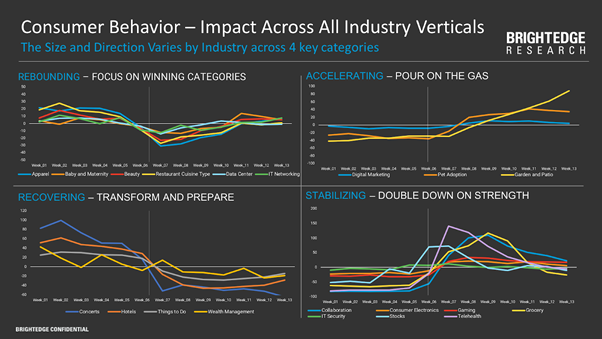
We studied the impact of COVID on search behavior by vertical and found that businesses have been similarly affected across four broad categories.
Apparel retailers, baby and maternity cellars, beauty brands, and data centers are among the first business is rebounding from the impact of COVID. There was an initial shock in these markets as lockdown took effect and the worst of the economic uncertainty took hold. However, people continue to need these products and services and they are readily available via ecommerce, BOPIS, and more.
Some verticals actually accelerated. Digital marketing, pet adoption, and garden and patio goods are all among this category. As social events werecanceled, loneliness set in and pet adoption became a logical solution. Face with spending more time at home, people began investing in improving their outdoor living spaces.
In the stabilizing category, we saw consumer electronics, gaming, grocery, and telehealth explode in popularity near the beginning of the pandemic. As people learn to live with the uncertainty of what has become quite a lengthy issue, these industries are stabilizing and those companies involved need to really build on their strengths to stand out.
Of course, some industries took a real hit and it could be months or even years before they recover. Airlines, hotels, concert venues, and the related product and service providers there—these brands need to transform and prepare to weather these conditions for some time.
Whatever your vertical, it is critical that you understand what people are searching for right now and that your content is optimized for those terms. In banking, for example, searches for drive-thru ATMs have become incredibly popular. For groceries, people want to know if they can buy online and pick up in-store. Searchers are looking for contactless paymentand delivery from restaurants and meal providers.
Spend time on research and check out the attributes available to your business category in Google My Business, and simply spend a bit of time searching your competitors to see how they’re adapting.
3. Reconsidering consumers’ content needs – optimizing for experiences
As McKinseyputs it, we have “covered a decade in days” as far as the adoption of digital goes. COVID-19 has caused a surge in ecommerce, declines in discretionary spending, reduced shopping frequency and a shift to shopping closer to home as consumers have sought to limit the number of trips they make to brick and mortar stores. Consumer satisfaction and ongoing viral infection rates will continue to cause dramatic fluctuations in consumer behavior.
As Kelly Askew, Managing Director of Accenture Strategy for Canada, recently told Retail Insider,
“People are saying they expect that those new behaviors are going to continue into the foreseeable future. We think that those behaviors may persist as long as a decade. The crisis is causing consumers to consider the impact of their shopping choices more closely when it comes to things like health and the environment.”
When it comes to the impact on how people search, we’ve seen that consumers’ appetite for information is as voracious as ever. One of the first behavioral changes we noted due to COVID-19 was an intense focus on quality information. Consumers are becoming more and more aware of the dangers of misinformation and bias on the web. When sharing out COVID-related information, brands need to cite and link to reputable, top-quality sources. Make it clear to readers (and to Google) that your company is committed to that expertise, authority, and trust that the search engine wants to see in the results it prioritizes for searchers.
Personalization is more important than ever. Dynamic content can help you mirror consumer intent when they are searching for or exploring your site for just the right solution for their unique needs.
4. Staying on top of search engine updates– adapting to the SERP
Probably the lowest hanging fruit in the search world is simply paying attention to what it is that search engines are looking for and focussing on delivering there. Updates and new features can tell us a great deal about how to optimize content. The whole concept of entities, for example, gives us a peek behind Google’s curtain at what it wants to see.
Google needs to be able to understand how different entities are related. Through RankBrain, it decides how important each signal that factors into that relationship really is. Google is getting more sophisticated in its ranking algorithm but at the end of the day, this is nothing new or earth-shattering for brands. It has always been the search marketer’s job to help the search engine understand why any particularwebpage is a better answer to any given query than another.
There are multiple ways to demonstrate to Google how your page and your company as an entity relates to your target market searcher’s query. And again, these aren’t necessarily new.
You are going to write high-quality, focussed content. You are going to:
Link to reputablesources andshare your own expertise in an effort to try to get other reputable publishers to link to you. And again, these aren’t necessarily new
Write high-quality, focussed content.
Link to reputable sources and try to get other reputable publishers to link to you
Use the proper schemamarkup
Going to optimize your images properly to facilitate accessibility and also hope the search engines understand the content of those graphics
Mobile continues to be increasingly important, especially as emerging markets come online with a large proportion of the population being mobile-only. Knowing this, brands need to be looking at an even more mobile-centric future in 2021 and beyond. Mobile is no longer just alternative web design for the desktop website. Mobile is an entire experience with its own customer journey, content needs, and rich search results.
We need to be looking to voice, too, as consumers become more reliant on their voice-enabled and IoT devices. Again, we are not just adapting content for being read out loud. We are seeing entirely different types of queries when people use voice search. Content for voice search results needs to take into account the zero interface nature of the searcher. How can you deliver an exceptional experience to someone without a screen?
Brands need to be developing the strategies and at least have these issues on the horizon. You may be in crisis mode at the moment, but that is not a place you can stay forever.
5. Leveraging technology – empowering the AI assist
While many firms are now using AI-enabled tools in some way, new applications and possibilities are still developing every day. Artificial intelligence enables SEOs to not only automate tasks but to derive greater insight, make smarter decisions, and deliver on consumer needs in near to real-time at scale.
Content optimization, competitive research, SERPs analysis, keyword research, and more can all be made more efficient and effective when powered by AI. Look for solutions that provide intelligent automation and enable human SEOs on the team to focus on the more creative aspects of each campaign. It’s not about replacing people, but augmenting their performance and giving them better data and more accurate insights on which to base their decisions.
SEO will lead the waythrough COVID recovery for businesses of all kinds. Ecommerce, BOPIS, local business discovery, and evaluation—whatever the product or service, and whatever theservice delivery model, consumers take to search engines to find the information needed to make their purchasing decisions. If anything, this trend has picked up as a result of COVID, and consumers’ need for content will continue to grow as the Coronavirus continues to impact our way of life.
Those in position to be agile and focused on getting in front of the most current opportunities in search will win the clicks—and the lion’s share of new business.
Jim Yu is the founder and CEO of BrightEdge, the leading enterprise SEO and content performance platform.
Earlier this year (15 years after starting Distilled in 2005), we spun out a new company called SearchPilot to focus on our SEO A/B testing and meta-CMS technology (previously known as Distilled ODN), and merged the consulting and conferences part of the business with Brainlabs.
I’m now CEO of SearchPilot (which is primarily owned by the shareholders of Distilled), and am also SEO Partner at Brainlabs, so… I’m sorry everyone, but I’m very much staying in the SEO industry.
As such, it feels a bit like the end of a chapter for me rather than the end of the book, but it has still had me looking back over what’s changed and what hasn’t over the last 15 years I’ve been in the industry.
I can’t lay claim to being one of the first generation of SEO experts, but having been building websites since around 1996 and having seen the growth of Google from the beginning, I feel like maybe I’m second generation, and maybe I have some interesting stories to share with those who are newer to the game.
I’ve racked my brain to try and remember what felt significant at the time, and also looked back over the big trends through my time in the industry, to put together what I think makes an interesting reading list that most people working on the web today would do well to know about.
The big eras of search
I joked at the beginning of a presentation I gave in 2018 that the big eras of search oscillated between directives from the search engines and search engines rapidly backing away from those directives when they saw what webmasters actually did:
While that slide was a bit tongue-in-cheek, I do think that there’s something to thinking about the eras like:
Build websites: Do you have a website? Would you like a website? It’s hard to believe now, but in the early days of the web, a lot of folks needed to be persuaded to get their business online at all.
Keywords: Basic information retrieval became adversarial information retrieval as webmasters realized that they could game the system with keyword stuffing, hidden text, and more.
Links: As the scale of the web grew beyond user-curated directories, link-based algorithms for search began to dominate.
Not those links: Link-based algorithms began to give way to adversarial link-based algorithms as webmasters swapped, bought, and manipulated links across the web graph.
Content for the long tail: Alongside this era, the length of the long tail began to be better-understood by both webmasters and by Google themselves — and it was in the interest of both parties to create massive amounts of (often obscure) content and get it indexed for when it was needed.
Not that content: Perhaps predictably (see the trend here?), the average quality of content returned in search results dropped dramatically, and so we see the first machine learning ranking factors in the form of attempts to assess “quality” (alongside relevance and website authority).
Machine learning: Arguably everything from that point onwards has been an adventure into machine learning and artificial intelligence, and has also taken place during the careers of most marketers working in SEO today. So, while I love writing about that stuff, I’ll return to it another day.
History of SEO: crucial moments
Although I’m sure that there are interesting stories to be told about the pre-Google era of SEO, I’m not the right person to tell them (if you have a great resource, please do drop it in the comments), so let’s start early in the Google journey:
Google’s foundational technology
Even if you’re coming into SEO in 2020, in a world of machine-learned ranking factors, I’d still recommend going back and reading the surprisingly accessible early academic work:
If you weren’t using the web back then, it’s probably hard to imagine what a step-change improvement Google’s PageRank-based algorithm was over the “state-of-the-art” at the time (and it’s hard to remember, even for those of us that were):
Google’s IPO
In more “things that are hard to remember clearly,” at the time of Google’s IPO in 2004, very few people expected Google to become one of the most profitable companies ever. In the early days, the founders had talked of their disdain for advertising, and had experimented with keyword-based adverts somewhat reluctantly. Because of this attitude, even within the company, most employees didn’t know what a rocket ship they were building.
From this era, I’d recommend reading the founders’ IPO letter (see this great article from Danny Sullivan — who’s ironically now @SearchLiaison at Google):
“Our search results are the best we know how to produce. They are unbiased and objective, and we do not accept payment for them or for inclusion or more frequent updating.”
“Because we do not charge merchants for inclusion in Froogle [now Google shopping], our users can browse product categories or conduct product searches with confidence that the results we provide are relevant and unbiased.” — S1 Filing
In addition, In the Plex is an enjoyable book published in 2011 by Steven Levy. It tells the story of what then-CEO Eric Schmidt called (around the time of the IPO) “the hiding strategy”:
“Those who knew the secret … were instructed quite firmly to keep their mouths shut about it.”
“What Google was hiding was how it had cracked the code to making money on the Internet.”
Luckily for Google, for users, and even for organic search marketers, it turned out that this wasn’t actually incompatible with their pure ideals from the pre-IPO days because, as Levy recounts, “in repeated tests, searchers were happier with pages with ads than those where they were suppressed”. Phew!
Applied Semantics technology was integrated with their own contextual ad technology to form what became AdSense. Although the revenue from AdSense has always been dwarfed by AdWords (now just “Google Ads”), its importance in the history of SEO is hard to understate.
By democratizing the monetization of content on the web and enabling everyone to get paid for producing obscure content, it funded the creation of absurd amounts of that content.
Most of this content would have never been seen if it weren’t for the existence of a search engine that excelled in its ability to deliver great results for long tail searches, even if those searches were incredibly infrequent or had never been seen before.
In this way, Google’s search engine (and search advertising business) formed a powerful flywheel with its AdSense business, enabling the funding of the content creation it needed to differentiate itself with the largest and most complete index of the web.
As with so many chapters in the story, though, it also created a monster in the form of low quality or even auto-generated content that would ultimately lead to PR crises and massive efforts to fix.
The first forms of spam on the internet were various forms of messages, which hit the mainstream as email spam. During the early 2000s, Google started talking about the problem they’d ultimately term “web spam” (the earliest mention I’ve seen of link spam is in an Amit Singhal presentation from 2005 entitled Challenges in running a Commercial Web Search Engine [PDF]).
I suspect that even people who start in SEO today might’ve heard of Matt Cutts — the first head of webspam — as he’s still referenced often despite not having worked at Google since 2014. I enjoyed this 2015 presentation that talks about his career trajectory at Google.
Search quality era
Over time, as a result of the opposing nature of webmasters trying to make money versus Google (and others) trying to make the best search engine they could, pure web spam wasn’t the only quality problem Google was facing. The cat-and-mouse game of spotting manipulation — particularly of on-page content, external links, and anchor text) — would be a defining feature of the next decade-plus of search.
It was after Singhal’s presentation above that Eric Schmidt (then Google’s CEO) said, “Brands are the solution, not the problem… Brands are how you sort out the cesspool”.
Those who are newer to the industry will likely have experienced some Google updates (such as recent “core updates”) first-hand, and have quite likely heard of a few specific older updates. But “Vince”, which came after “Florida” (the first major confirmed Google update), and rolled out shortly after Schmidt’s pronouncements on brand, was a particularly notable one for favoring big brands. If you haven’t followed all the history, you can read up on key past updates here:
A real reputational threat
As I mentioned above in the AdSense section, there were strong incentives for webmasters to create tons of content, thus targeting the blossoming long tail of search. If you had a strong enough domain, Google would crawl and index immense numbers of pages, and for obscure enough queries, any matching content would potentially rank. This triggered the rapid growth of so-called “content farms” that mined keyword data from anywhere they could, and spun out low-quality keyword-matching content. At the same time, websites were succeeding by allowing large databases of content to get indexed even as very thin pages, or by allowing huge numbers of pages of user-generated content to get indexed.
This was a real reputational threat to Google, and broke out of the search and SEO echo chamber. It had become such a bugbear of communities like Hacker News and StackOverflow, that Matt Cutts submitted a personal update to the Hacker News community when Google launched an update targeted at fixing one specific symptom — namely that scraper websites were routinely outranking the original content they were copying.
Shortly afterwards, Google rolled out the update initially named the “farmer update”. After it launched, we learned it had been made possible because of a breakthrough by an engineer called Panda, hence it was called the “big Panda” update internally at Google, and since then the SEO community has mainly called it the Panda update.
I gave a presentation at SearchLove London in 2014 where I talked about the unbelievable growth and scale of mobile and about how late we were to realizing quite how seriously Google was taking this. I highlighted the surprise many felt hearing that Google was designing mobile first:
“Towards the end of last year we launched some pretty big design improvements for search on mobile and tablet devices. Today we’ve carried over several of those changes to the desktop experience.” — Jon Wiley (lead engineer for Google Search speaking on Google+, which means there’s nowhere to link to as a perfect reference for the quote but it’s referenced here as well as in my presentation).
This surprise came despite the fact that, by the time I gave this presentation in 2014, we knew that mobile search had begun to cannibalize desktop search (and we’d seen the first drop in desktop search volumes):
And it came even though people were starting to say that the first year of Google making the majority of its revenue on mobile was less than two years away:
Writing this in 2020, it feels as though we have fully internalized how big a deal mobile is, but it’s interesting to remember that it took a while for it to sink in.
Machine learning becomes the norm
Since the Panda update, machine learning was mentioned more and more in the official communications from Google about algorithm updates, and it was implicated in even more. We know that, historically, there had been resistance from some quarters (including from Singhal) towards using machine learning in the core algorithm due to the way it prevented human engineers from explaining the results. In 2015, Sundar Pichai took over as CEO, moved Singhal aside (though this may have been for other reasons), and installed AI / ML fans in key roles.
It goes full-circle
Back before the Florida update (in fact, until Google rolled out an update they called Fritz in the summer of 2003), search results used to shuffle regularly in a process nicknamed the Google Dance:
Most things have been moving more real-time ever since, but recent “Core Updates” appear to have brought back this kind of dynamic where changes happen on Google’s schedule rather than based on the timelines of website changes. I’ve speculated that this is because “core updates” are really Google retraining a massive deep learning model that is very customized to the shape of the web at the time. Whatever the cause, our experience working with a wide range of clients is consistent with the official line from Google that:
Broad core updates tend to happen every few months. Content that was impacted by one might not recover — assuming improvements have been made — until the next broad core update is released.
Tying recent trends and discoveries like this back to ancient history like the Google Dance is just one of the ways in which knowing the history of SEO is “useful”.
If you’re interested in all this
I hope this journey through my memories has been interesting. For those of you who also worked in the industry through these years, what did I miss? What are the really big milestones you remember? Drop them in the comments below or hit me up on Twitter.
If you liked this walk down memory lane, you might also like my presentation From the Horse’s Mouth, where I attempt to use official and unofficial Google statements to unpack what is really going on behind the scenes, and try to give some tips for doing the same yourself:
To help us serve you better, please consider taking the 2020 Moz Blog Reader Survey, which asks about who you are, what challenges you face, and what you'd like to see more of on the Moz Blog.
Sign up for The Moz Top 10, a semimonthly mailer updating you on the top ten hottest pieces of SEO news, tips, and rad links uncovered by the Moz team. Think of it as your exclusive digest of stuff you don't have time to hunt down but want to read!
from The Moz Blog https://ift.tt/3iMLZ5t
via IFTTT