We want to help you start/manage and grow your business using innovative strategies and implementation. We have a passion for helping businesses and companies of various sizes see the same success that we have achieved.
Our skillsets are wide and varied, from business strategy, marketing, to online strategy. An increasing number of companies are turning to the internet and online media as a means to maximising their marketing reach and exposure. This is special area of focus for us and we do more than simple SEO strategies.
We all know how effective link building efforts can be, but it can be an intimidating, frustrating process — and sometimes even a chore. In this popular Whiteboard Friday originally published in 2017, Rand Fishkin builds out a framework you can still use today to streamline and simplify the link building process for you, your teammates, and yes, even your interns.
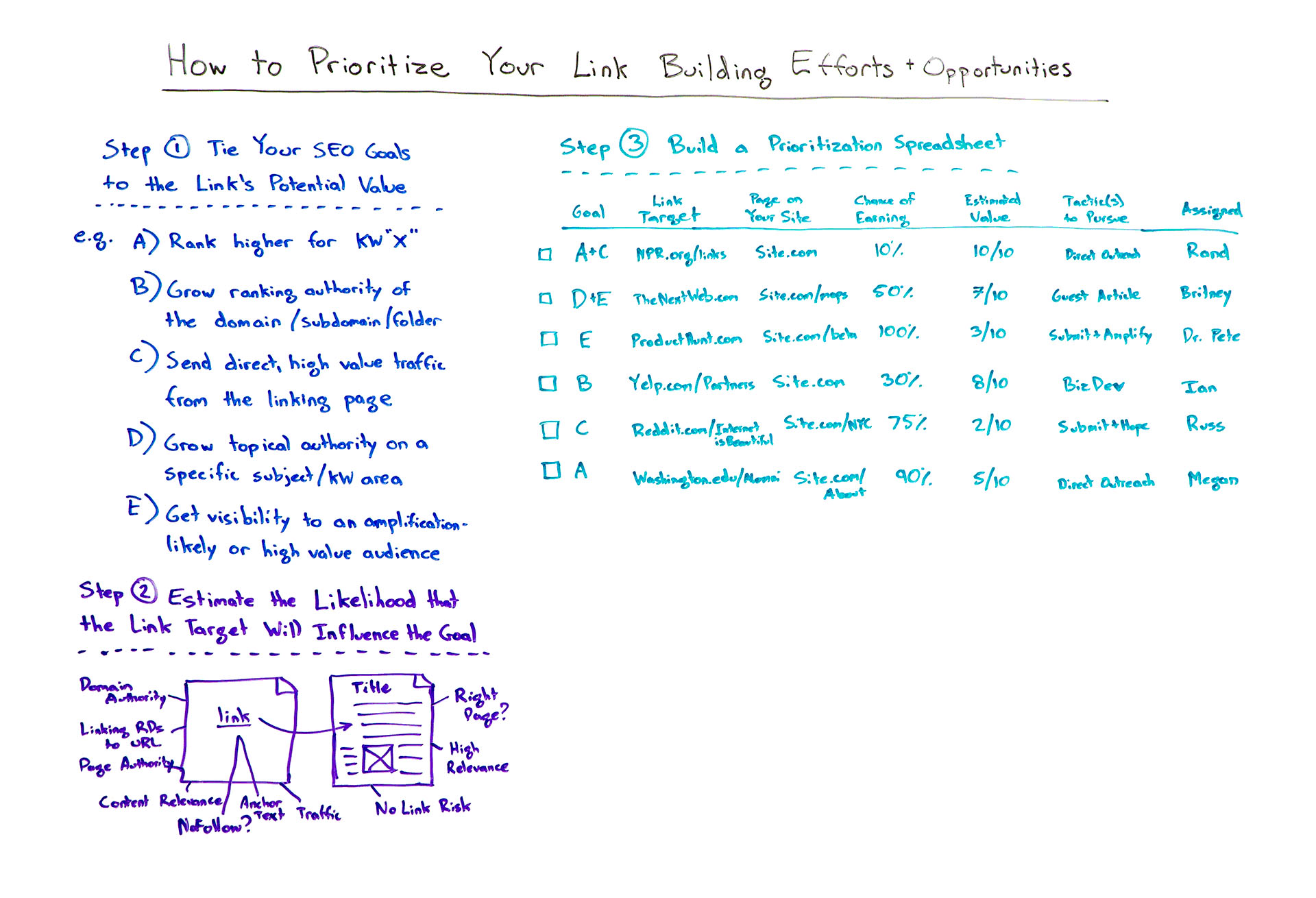
Click on the whiteboard image above to open a high-resolution version in a new tab!
Video Transcription
Howdy, Moz fans, and welcome to another edition of Whiteboard Friday. As you can see, I'm missing my moustache, but never mind. We've got tons of important things to get through, and so we'll leave the facial hair to the inevitable comments.
I want to talk today about how to prioritize your link building efforts and opportunities. I think this comes as a big challenge for many marketers and SEOs because link building can just seem so daunting. So it's tough to know how to get started, and then it's tough to know once you've gotten into the practice of link building, how do you build up a consistent, useful system to do it? That's what I want to walk you through today.
Step 1: Tie your goals to the link's potential value
So first off, step one. What I'm going to ask you to do is tie your SEO goals to the reasons that you're building links. So you have some reason that you want links. It is almost certainly to accomplish one of these five things. There might be other things on the list too, but it's almost always one of these areas.
A)Rank higher for keyword X. You're trying to get links that point to a particular page on your site, that contain a particular anchor text, so that you can rank better for that. Makes total sense. There we go.
B)You want to grow the ranking authority of a particular domain, your website, or maybe a subdomain on your website, or a subfolder of that website. Google does sort of have some separate considerations for different folders and subdomains. So you might be trying to earn links to those different sections to help grow those. Pretty similar to (A), but not necessarily as much of a need to get the direct link to the exact URL.
C) Sending real high-value traffic from the ranking page. So maybe it's the case that this link you're going after is no followed or it doesn't pass ranking influence, for some reason — it's JavaScript or it's an advertising link or whatever it is — but it does pass real visitors who may buy from you, or amplify you, or be helpful to achieving your other business goals.
D) Growing topical authority. So this is essentially saying, "Hey, around this subject area or keyword area, I know that my website needs some more authority. I'm not very influential in this space yet, at least not from Google's perspective. If I can get some of these links, I can help to prove to Google and, potentially, to some of these visitors, as well, that I have some subject matter authority in this space."
E) I want to get some visibility to an amplification-likely or a high-value audience. So this would be things like a lot of social media sites, a lot of submission type sites, places like a Product Hunt or a Reddit, where you're trying to get in front of an audience, that then might come to your site and be likely to amplify it if they love what they see.
Okay. So these are our goals.
Step 2: Estimate the likelihood that the link target will influence that goal
Second, I'm going to ask you to estimate the likelihood that the link target will pass value to the page or to the section of your site. This relies on a bunch of different judgments.
You can choose whether you want to wrap these all up in sort of a single number that you estimate, maybe like a 0 to 10, where 0 is not at all valuable, and 10 is super, super valuable. Or you could even take a bunch of these metrics and actually use them directly, so things like domain authority, or linking root domains to the URL, or page authority, the content relevance.
You could be asking:
Is this a nofollowed or a followed link?
Is it passing the anchor text that I'm looking for or anchor text that I control or influence at all?
Is it going to send me direct traffic?
If the answers to these are allpositive, that's going to bump that up, and you might say, "Wow, this is high authority. It's passing great anchor text. It's sending me good traffic. It's a followed link. The relevance is high. I'm going to give this a 10."
Or that might not be the case. This might be low authority. Maybe it is followed, but the relevance is not quite there. You don't control the anchor text, and so anchor text is just the name of your brand, or it just says "site" or something like that. It's not going to send much traffic. Maybe that's more like a three.
Then you're going to ask a couple of questions about the page that they're linking to or your website.
Is that the right page on your site? If so, that's going to bump up this number. If it's not, it might bring it down a little bit.
Does it have high relevance? If not, you may need to make some modifications or change the link path.
Is there any link risk around this? So if this is a — let's put it delicately — potentially valuable, but also potentially risky page, you might want to reduce the value in there.
I'll leave it up to you to determine how much link risk you're willing to take in your link building profile. Personally, I'm willing to accept none at all.
Step 3: Build a prioritization spreadsheet
Then step three, you build a prioritization spreadsheet that looks something like this. So you have which goal or goals are being accomplished by acquiring this link. You have the target and the page on your site. You've got your chance of earning that link. That's going to be something you estimate, and over time you'll get better and better at this estimation. Same with the value. We talked about using a number out of 10 over here. You can do that in this column, or you could just take a bunch of these metrics and shove them all into the spreadsheet if you prefer.
Then you have the tactic you're going to pursue. So this is direct outreach, this one's submit and hope that it does well, and who it's assigned to. Maybe it's only you because you're the only link builder, or maybe you have a number of people in your organization, or PR people who are going to do outreach, or someone, a founder or an executive who has a connection to some of these folks, and they're going to do the outreach, whatever the case.
Then you can start to prioritize. You can build that prioritization by doing one of a couple things. You could take some amalgamation of these numbers, so like a high chance of earning and a high estimated value. We'll do some simple multiplication, and we'll make that our prioritization. Or you might give different goals. Like you might say, "Hey, you know what? (A) is worth a lot more to me right now than (C). So, therefore, I'm going to rank the ones that are the (A) goal much higher up." That is a fine way to go about this as well. Then you can sort your spreadsheet in this fashion and go down the list. Start at the top, work your way down, and start checking off links as you get them or don't get them. That's a pretty high percentage, I'm doing real well here. But you get the idea.
This turns link building from this sort of questionable, frustrating, what should I do next, am I following the right path, into a simple process that not only can you follow, but you can train other people to follow. This is really important, because link building is an essential part of SEO, still a very valuable part of SEO, but it's also a slog. So, to the degree that you can leverage other help in your organization, hire an intern and help train them up, work with your PR teams and have them understand it, have multiple people in the organization all sharing this spreadsheet, all understanding what needs to be done next, that is a huge help.
I look forward to hearing about your link building prioritization, goals, what you've seen work well, what metrics you've used. We will see you again next week for another edition of Whiteboard Friday. Take care.
To help us serve you better, please consider taking the 2020 Moz Blog Reader Survey, which asks about who you are, what challenges you face, and what you'd like to see more of on the Moz Blog.
Sign up for The Moz Top 10, a semimonthly mailer updating you on the top ten hottest pieces of SEO news, tips, and rad links uncovered by the Moz team. Think of it as your exclusive digest of stuff you don't have time to hunt down but want to read!
from The Moz Blog https://ift.tt/2FpTZew
via IFTTT
Unlike paid media, earned media lacks the tools to form trustworthy predictions about the outcomes, which can make potential SEO customers indecisive.
A quick look at the typical story of how the pitching process works and the top reasons that make customers indecisive about an SEO proposal.
SEOmonitor looks into all the aspects of pitching an SEO proposal, the key components, and how to help your customers say a loud yes instead of a silent no.
Unlike paid media, earned media lacks the tools to form trustworthy predictions about the outcomes, which can make potential SEO customers indecisive.Let’s take a typical story of how the SEO proposal and pitching process works.
Sarah, the CEO of a successful SEO agency, gets introduced to the CEO of another successful ecommerce company through a common friend.
She rallies her team and meets the client over Zoom. They have a wonderful conversation, and both of them are excited to start a great partnership.
Filled with optimism, Sarah assigns her best colleagues to craft an insightful SEO proposal. They analyze the competitors, do the keyword research, take the organic opportunity into account, and form a unique strategy on how they can reach impressive results.
The day of the presentation comes, and the ecommerce team gathers around, continuously nodding along with each slide. By the end of it, everyone feels excellent. Sarah is thrilled.
Checking emails stopped being a chore for Sarah. She quickly scans all of them, looking for confirmation on starting the project.
She does this daily for almost two weeks and, with each day, her confidence drops. There is no answer from the potential customer.
She feels awkward* to follow-up. What could she ask? Why don’t they at least say if they want to pursue the SEO campaign or not? What is with this “silent no”?
What could be the reason that makes customers get indecisive?
If you’ve pitched a few clients already, you’ve probably experienced a similar situation.
It feels like a win, but then communication gets postponed. It’s not clear if you should follow-up or not. And even if you were to follow-up, what would you ask?
They haven’t raised any particular concerns or downright rejected the SEO proposal. There has to be something that brought them to your agency in the first place.
They’ve invested the time for the meetings and maybe even shared their analytics account. So there’s a hint of trust-building up so far.
What if the dilemma stems from them forming trust based on “gut feeling” in the meetings, but lacking enough knowledge to judge whether the projected results will, in the end, be achieved.
They want to make sure they make the best rational decision – but they can’t.
Explaining the reasoning behind each data point and action in your SEO proposal, and arguing from first principles, should leave less room for doubt and more for critical thinking.
Let’s look through the steps that can go into an SEO proposal and how to bring clarity and convey trust using granular data along the way.
What goes into an SEO proposal?
1. Show a deep understanding of the industry
Keyword research
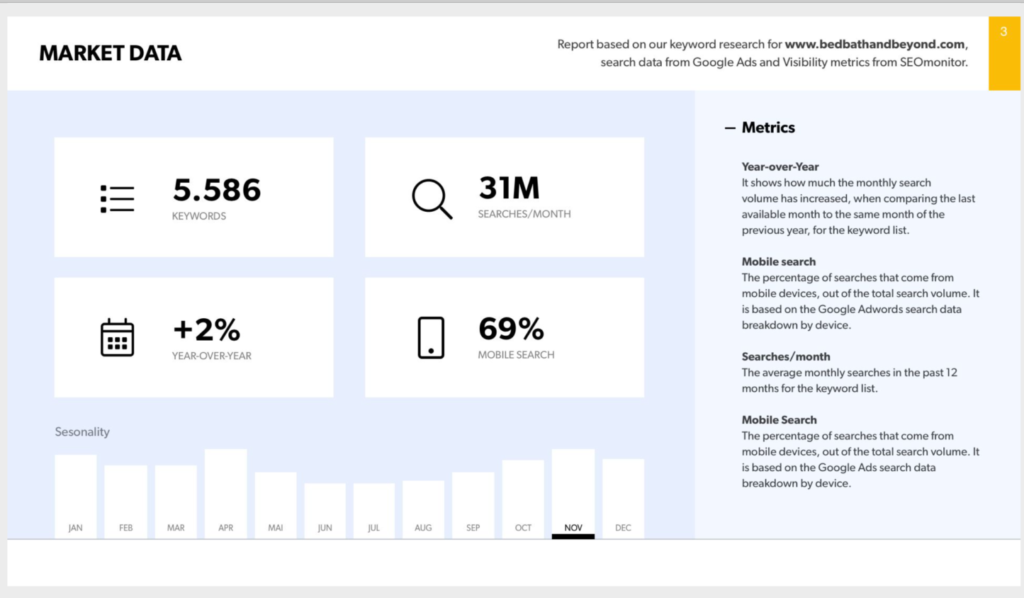
Keyword researchis the first step into better getting to know your customer and their industry.
The entire quality of the pitch depends on choosing the right keywords and being able to explain the principles behind your decision.
Coupled with your expertise of choosing precisely the ones that you know are valuable for optimizing, you’re building the keyword portfolio. But this may prove challenging for your customer.
Sometimes, business owners would have a different way of describing their business. So they could mistake queries for whichever words they would want their brand to be associated with.
You can help your customers focus on the end-users’ search habits in your SEO proposal by describing why it doesn’t make sense to improve visibility for queries that are navigational keywords and trigger site links. Then, follow-up with why you grouped the ones that set off the same search results and are part of the same topic, for more understanding.
Competitor overview
Customers might think of their competitors as being other companies selling similar services and products, regardless of their organic visibility. They might even disagree that a particular website or company is in their industry, but you have data on your side. You’ve selected only the companies that get the most impressions for the selected group of keywords – and it’s all easily verifiable by searching on Google.
The differentvisibility scoresset the stage for what the opportunity will be. While it’s impossible to predict what the future will hold, the present results are precise.
If a competitor has already achieved success, it shows there’s a substantial opportunity.
2. Establish the truth on the current SEO performance by splitting the organic traffic in brand and non-brand
The outcome of SEO is the increase in organic traffic. This makes many people turn towards the organic traffic figure whenever they want to measure SEO performance.
The total number of organic traffic is composed of both brand and non-brand organic visits. Still, it is only thenon-brand trafficthat connects to and is dependent on, search engine optimization.
Your customer might intuitively realize this, but they didn’t have the tools to be able to study the data. If you split the two, you focus the evaluation process on SEO. It, also, shows that you would not take credit for marketing activities that were already going on, and so removes another fear that could make the customer doubtful.
Plus, it might be the first time the customer can put their finger on how much their branding drives their income, a question they have probably struggled with for a long time.
3. Present a realistic forecast that can be understood and verified
Estimating impact in terms of clicks and conversions instead of rankings
From a customer perspective, all of the improvements in visibility have just one final goal – an increase in their business performance.
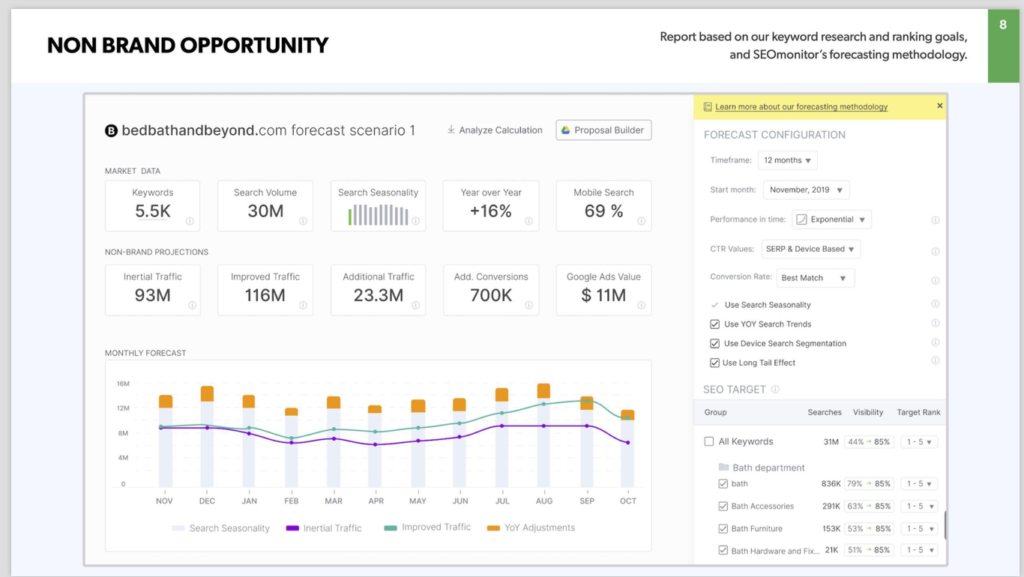
Clicks, ecommerce transactions, or goals are the way businesses keep track of them. By transposing better rankings to clicks and conversions, you tie the SEO campaign to the reality of running a business.
Decoding the impact of rank changes into clicks and conversions can look like a simple formula for a customer at first.
Still, when taking into account search volumes, year over year trends that influence the past data, and dynamic changing CTRs, you show much work and thought goes into the process.
But to do that, you need to get into an even lower layer — the way Google displays results for each keyword and how changes in search features influence click-through rates.
Not only that, but the advent of mobile brings even more pieces to the puzzle.
The “ten blue links” have diminished in favor of a mix between search features and organic results. For example, a search for “hotels in Paris” would trigger Google’s hotel widget and at least two ads. It takes more than three full scrolls to get to the first organic result.
By using a variable CTR model for each SERP, you remove the possibility that the methodology could be considered oversimplified and expose the customer to the complexities of modern organic optimizations.
By adding monthly swings in search volume and year-over-year trends, you set the building blocks for a data-driven, comprehensive forecast.
Highlight how their traffic would look like with and without the SEO campaign
Unless your customers have just launched their website, they already rank in search engines.
By going the extra mile and first creating and presenting a forecast based on their current traffic and the search trends that might influence them, you lay out a foundation of transparency and easily researchable assumptions.
Highlighting the difference between existing, projected, and additional traffic and conversions you remove one last piece of doubt – What might happen if I won’t go through with the SEO campaign?
Setting expectations and aligning SEO with the customer’s business projection
While some customers know that SEO is more of a marathon than a sprint, for others, it can be their first foray in attempting to improve visibility.
By acknowledging that the first months would bring less impact, but it picks up as the campaign progresses, you are transparent from the start.
A 12-month forecast allows customers to be able to take their sales projections and fit them on top of the SEO opportunity.
Instead of treating SEO as an independent tactic, they can now imagine the campaign as an essential activity to their day-to-day business operations.
Including seasonality allows for better inventory planning and proves, once more, that you’re committed to their long term success.
They also get to learn about consumers’ habits and maybe, in the future, rely even more on search data when making a business decision.
4. Compare the SEO budget to the equivalent in PPC
Is the SEO campaign worth it?
This question might go through someone’s mind when having to make the final decision.
By bringing an external source of truth in the form of how much it would cost to run a paid search campaign on the exact keyword portfolio, you highlight how valuable it is for other companies to grab the first results.
It allows the customer to perform their independent research and build more trust in the projected outcome. Not only that, but they now have a point of reference for your pricing as well.
5. Convey transparency by discussing performance tracking
As you have now navigated the ins and outs of the forecast, there’s still one more thing that may get the customer stuck in a loop.
Can they trust your agency on delivery? Would they be able to check the progress by themselves?
They can’t just load up their analytics account and see the impact – the results are a mix between branded and non-branded keywords.
You could provide a detailed explanation of how reporting will run in a relationship with the set goal and what goes into the metrics that describe their visibility.
Taking it a step further and including the objective in the contract can remove any fear they still have.
It’s bold, but isn’t it worth it to have your agency’s day-to-day operations aligned with your customer’s results?
How to help your customers say a loud yes instead of a silent no?
Remove doubts that can form in their mind, by explaining each hypothesis and backing it up with evidence, going through the following:
Show a deep understanding of the industry
Establish the truth on their current SEO performance by splitting brand and non-brand traffic
Present a realistic forecast that can be understood and verified
Compare the SEO budget to the equivalent in PPC
Convey transparency by discussing performance tracking
Meticulously going through all of these steps is hard. We get that. That’s why we’ve launched a new version of our “Search Awards” winning SEO forecasting module.
It helps you along each of these actions, except for one. The hangover you get after celebrating your 10th closed deal in a single month.
Our forecasting methodology has been successfully used for more than four years, by hundreds of clients, to set realistic objectives and improve their pitches. That’s why we’ve gone a step further.
We created anSEO proposal builderthat leverages data from SEOmonitor, with the simplicity of Google Slides, and gives real-world examples from other SEO agencies around the world, in an intuitive drag-and-drop interface.
But that’s only a part of what we do. We’ve designed SEOmonitor to help you acquire, manage, and retain more customers for your agency.
Join us, and hundreds of SEO agencies clients, in the journey of bringing more transparency and measurability to the SEO industry.Click herefor a trial that doesn’t ask you for a credit card, but gives you full access to the platform.
Top tip: How to follow-up without the awkwardness
Instead of just asking busy customers if they had time to review your proposal, why not take a bit of time to go through their existing organic industry landscape and look for significant changes that they may not even know about – Yet!
WithSignals, you can easily spot those insights that can help you re-open the conversation with your indecisive customers.
Crawl budget is an area that remains underrated in SEO.
If you’re running a large-scale website, crawl budget is something that site runner can, and should, be optimized for SEO.
April Brown talks about the basics of crawl budgeting, why it matters, and how you can optimize it for SEO.
Crawl budget is one of the most underrated concepts in SEO. Although most people might have heard of crawl budgeting, they might have considered using it, to begin with, or even think about it, when it comes to SEO. While some experts will tell you to ignore crawl rate, in truth, if you’re running a large-scale website, crawl budget is something that site runner can — and should — be optimized for SEO.
In this article, we’ll talk about the basics of crawl budgeting, why it matters, and how you can optimize it for SEO.
What is the crawl budget?
“A crawl budget is responsible for influencing crawl frequency,”
Michael Railsback, marketer at 1Day2Write and NextCoursework defined, further adding,
“And, it affects how quickly your updated content gets to the index since Google’s robots will scan your pages for updates and collect information, which will ultimately determine your position in search rankings. As a result, it should prevent Google from overcrowding your server, and have it crawl at a normal frequency.”
Why does a crawl budget matter?
Since Google is always assessing parameters to decide which of your pages should be ranked in searches and how fast to do so, you should optimize your crawl budget to achieve upscale online visibility. However, the number of pages your domain accommodates should never exceed your crawl budget, or else all pages over that limit will go unnoticed in search.
So, if you want to expand your online platform in the future, then keep reading.
How to optimize crawl budget
While there are still super heavy-duty things that many site runners might not think about, we’re here to unmask them for your benefit. With that said, here are six ways to enable crawl budget optimization, thus letting you watch out for things that might negatively affect your site.
1. Simplify your site’s architecture
Your website should be structured layer by layer, in the following order:
The homepage
Categories/tags
Content pages
Afterward, review your site structure, before you organize pages around topics, and use internal links to guide crawlers.
2. Ensure that important pages are crawlable, not blocked
The .htaccess and robots.txt should not block your site’s important pages; and bots should be able to access CSS and Javascript files. However, in the same token, you should block content that you don’t want popping up in search results. Here are some of the best candidates for blocking:
Pages with duplicated content
“Under construction” areas of your site
Dynamically generated URLs
However, search engine spiders don’t always respect the instructions contained in robots.txt. Although a page may be blocked in robots.txt, Google doesn’t cache it, but may occasionally hit it.
Instead, use robots.txt to save up your crawl budget and block individual pages you don’t consider important. Or, if you don’t want Google to hit it, use metatags.
3. Beware of redirect chains
A common-sense approach to ensuring healthy website health, you must avoid having redirect chains on your entire domain. Yes, avoid the 301 and 302 redirects at all costs! If you start accumulating a bunch of those, they can definitely hurt your crawl limit, to a point where crawlers will eventually stop crawling without getting to the page you need indexed.
So, keep in mind that one or two redirects here and there might not hurt much, but don’t let that number grow.
4. Prevent 404 and 410 error pages
In truth, 404 and 410 pages can eat into your crawl budget. Plus, these pages can also hurt your user experience. So, what can you do?
Fix all 4xx and 5xx status codes. Doing this will ensure that your crawl budget isn’t eaten up. And, fixing these codes can ensure that users get a good experience on your site.
Website audit tools like SE Ranking and Screaming Frog are effective for optimizing crawl budget.
5. Update, update, update
“It’s important to take care of your XML sitemap by updating it every so often”, says Jai Tardent, a business analyst at Australia2write and Britstudent. “When you update your sitemap, bots will have a much better and easier time understanding where the internal links lead.”
In addition, as you update, use only the URLs that your sitemap is familiar with. And, the URLs should correspond to the newest uploaded version of robots.txt.
6. Manage your URL parameters
If your content management system generates a lot of dynamic URLs, they’ll eventually lead to one and the same page. However, by default, search engine bots will treat these URLs as separate pages, thus wasting your crawl budget and, potentially, creating content duplication concerns.
Therefore, manage your URL parameters, so that they don’t create duplicates and confuse search engine bots. In your Google Search Console account, go to “Crawl,” and then “URL Parameters.”
Conclusion
So, if you’re still not sold on the idea that crawl budget optimization is important for your website, please understand that it is because it helps your site not only get recognized in search results but also helps you prevent users from being led to a dead-end rather than your page.
We hope that this guide will help you optimize your crawl budget and improve your SEO in no time at all!
April Brown blogs atThesis Writing ServiceandWrite My Coursework. She also edits atOriginwritings.com. As a freelance writer, she specializes in marketing and graphic design. In her spare time, she loves reading and traveling.
In creating a Google My Business listing for your local business, making a data-based decision is one of the most important steps you’ll be taking. Just how influential are the categories you select?
Our recent State of the Local SEO Industry 2020 survey found that, out of all factors, GMB elements (which include categories) have the greatest impact on local pack rankings. Choose wisely, and these elements help ensure Google views you as a candidate for possible inclusion as a result for a set of search phrases. Choose wrongly and you can exclude yourself from this vital visibility.
Google categories can also play a role in determining which features will be available to you in your Google Business Profile/Google listing. For example, if you’re categorized as a “hotel”, you won’t be able to use Google Posts. If you’re categorized as an educational institution, you won’t be able to receive reviews. Meanwhile, if you’re categorizing your business in the auto dealership space, you’ll be allowed to have multiple listings for your departments and the car makes you vend.
Categories impact the attributes that will be associated with your business, the menus you can use, whether booking buttons are available to you, and whether you have primary or secondary hours of operation displayed.
In short, your choice of your primary and secondary categories contributes a lot to Google’s understanding and handling of your business. With so much riding on proper categorization, let’s empower you to research your options like a pro today!
And, as Google says, you can change and add more categories later. Once you have access to your GMB dashboard, you’ll find your categories by clicking on the “Info” tab in the left menu and looking right below your business name, where the pencil icon will let you edit your categories:
You are allowed to select up to 10 categories. Your primary category is believed to have the greatest influence on your local rankings, and must be chosen with extra care:
You can edit your categories in the GMB dashboard any time you want to, with the understanding that doing so can substantially alter the rankings you’re experiencing for various search phrases.
How to choose Google categories
Here’s your step-by-step workflow for picking the Google categories that are best for your business, with the help of some great tools.
1) Determine your most important search phrases
First, create a list that includes:
The type of business you operate (e.g. “supermarket” “medical center” “restaurant”) and its variants. For example, if you’re an attorney, list out the subtypes associated with your firm, such a “personal injury lawyer” or “tax attorney”. If you own a restaurant, include whether it’s an “Italian restaurant”, a “family restaurant” and other qualifiers. A supermarket might also be a “grocery store” or “natural foods store”.
The full list of goods and services you offer. Your HVAC company offers heater repair, air conditioner repair, etc. Your landscaping company offers tree service, landscape design, yard work, etc. Your clothing store offers men’s clothing, shoes, jewelry, etc.
Next, take your list of keywords and enter them into your choice of free or paid keyword research tools to discover which terms have the highest potential search volume. For example, Moz’s Keyword Suggestions tool within Moz Keyword Explorer can help you determine the difference in search volume between two terms like “Mexican restaurant” vs. “taco shop”:
Note down the search volume for each term on your list.
Finally, refine your list down to a smaller set of terms that combine the highest search volume with being most relevant and important for your company. In most cases, this is the list you’ll move ahead with, although there are some cases in which you would choose to target lower volume search phrases because they are either a) less competitive, or b) a more exact description of what your business is.
2) Determine which categories your market competitors are using for your most important search phrases
Now, take your refined list of search phrases over to Google and begin searching for them in your local market. Your local market is made up of your customers’ locations in relationship to your business location. This could only be as large as your neighborhood, or it could include a whole city or several adjacent cities, depending on:
Your business model
The distance from which customers are willing to travel to get to your business
The distance from which Google believes customers are willing to travel to get to your business
For example, a coffee shop might have quite a small local market if most of its customers arrive looking for a quick, convenient cup of coffee. Meanwhile, an amusement park might have a much larger local market because people are willing to go a greater distance to visit it. Google’s local results increasingly reflect their understanding of intent differently for different business models.
Here’s a screenshot of the market an Internet searcher in the North Beach district of San Francisco might see if they are looking for “pizza near me”:
Meanwhile, a searcher in California looking for a “sports arena” could be shown a market that encompasses more than half the state:
Now, make a list of all the competitors you discovered in your market while searching from the location of your business.
Next, be sure you’re using the Chrome browser and head over to Chrome webstore to download the awesome, free, new extension called GMBspy. Developed by George Nenni of Generations Digital, turning this extension on enables you to go to Google Maps, search for your market competitors and see their categories, like this:
You can look up competitors one by one, or just mouse around on the map to see the GMBspy extension data pop up. Google doesn’t automatically reveal all the categories a business is using and so this little tool saves so much time, and a lot of fiddling around with HTML to access that data. What a great development!
Note down all of the categories your market competitors are using. Pay special attention to the categories being used by the business ranking #1 for each of your refined search phrases.
3) Get category suggestions and leave no stone unturned
Your market might be full of highly active competitors who have wisely chosen the best categories, or it could be a less sophisticated scenario in which other companies are overlooking opportunities you might be able to discover.
Hop on over to PlePer’s GMB Category Helper and type in your business name and up to three comma separated search phrases. If you’ve not yet opened for business, you can just enter the street address of your proposed location instead of a business name. Then, go get a cup of tea or do a little exercise for five minutes and come back for this amazing data:
Based on your lat-long coordinates, PlePer shows you your current categories, the categories being used in your area, a list of category suggestions, and other useful information. Quite cool! The free version of this tool lets you do three such searches per day. Jot down any notable findings that were absent from using GMBspy.
It’s updated at least every 3 days, which is great because Google continuously adds and subtracts categories. Just select your language and country and hit the “fetch” button. This tool can be especially useful if you offer an unusual good or service and aren’t sure whether a category exists for it. Note down anything you feel might be relevant.
Finally, within the GMB dashboard, Google will also sometimes make suggestions about additional categories you might want to consider adding, like this:
In the above screenshot, you can see that our categorizing Moz as a software company is causing Google to suggest that we might also want to select “accounting software company”. In this case, the suggestion is irrelevant for Moz’s business model, but it’s a good idea to see if Google is making any valuable suggestions for your company.
You’ve now got all the data you need to make a selection, based on the categories that are applicable to your popular search phrases and that are being used (or overlooked) by your top market competitors. Well done!
Let’s boost your confidence about Google categories with a few more tips before you fill in your choices in the GMB dashboard. Answers to these FAQs could help you out with common predicaments:
1) How many GMB categories should I choose?
My best answer is: as many as are truly relevant to your business. Never add categories that don’t relate to your business. For example, if you’re marketing a pizza place, you obviously shouldn’t add hair salon as a category, or it can totally confuse Google, your customers, and even harm your rankings.
So long as each category is applicable, you should be fine. In the past, there has been much discussion about whether category dilution (choosing too many categories) could hurt your rankings.Local SEO Colan Neilsen’s recent study demonstrated the opposite — that adding more, relevant categories can positively impact your your visibility, rather than undermine it.
This is a good time to note that the Guidelines for representing your business on Google’s section on categories can be a bit confusing. It contains outdated information pertaining to a bygone era (pre-2013) in which businesses were allowed to custom create categories.
I don’t know why Google has never updated this section to remove the text about writing categories that describe what your business “is” rather than what your business “has”, since you’re automatically confined to choosing only Google’s own pre-approved categories, but, the odd state of this area of the guidelines has personally made me take the other recommendations in it with a grain of salt. For example, Google’s insistence that you should use as few categories as possible is somewhat dubious, though their recommendation that you only pick relevant categories makes perfect sense.
My advice is to experiment with any relevant category and see where it gets you in terms of visibility.
2) What should I do if Google doesn’t have a category I need?
Google has well over 3,000 categories for the US alone, and while this large index covers many business models, it’s not uncommon to find that something you offer isn’t represented. Sterling Sky founder, Joy Hawkins, recently highlighted a case in which a business owner went about requesting a new category from Google the right way, with abundant evidence of why a new option should be added. If a missing category is holding your business back, I recommend studying that GMB help forum thread and then creating one of your own, making the most convincing argument you can about why Google needs to include your category wish.
If, however, you can’t get Google to act on your request, your next best bet is to choose the category that most closely represents what your business is, and then use the business description field, images, and Google Posts to add more nuanced information about your goods and services.
3) How can I know if I’ve chosen the right categories?
This question most commonly arises in troubleshooting ranking failures. You think you’ve done all you can to rank for a particular search phrase in Google local packs/finders/maps, but you’re just not there. While there can be scores of factors contributing to that, it’s always smart to re-check that you haven’t excluded yourself by selecting the wrong category.
Go back to the map and fire up GMBspy again to see which categories the top ranking businesses are using. Do your categories match, or are you missing something?
Also, pay attention to your GMB Insights, Google Analytics and any other analysis software you’re using whenever you add or subtract a category from your GMB listing. If you see a sudden drop in any metric dating to changing your categories, you may have made a poor category alteration choice you will need to correct.
Finally, be aware that you’re not the only one controlling your categories. If you experience a drop in rankings and notice that your categories have been mysteriously altered, it could be stemming from a third-party edit or bad data out there on the local web. Local SEO Nikki Brown tells a scary story about a client whose rankings went from 1st to 31st due to an unexpected edit of their primary category, emphasizing the importance of making a category audit part of any rankings-related troubleshooting you engage in.
4) How should I use categories for a multi-entity business model?
Google’s guidelines allow some business models to have more than one listings for the same physical location of a business. These special scenarios include:
Multi-department models, like a medical center with distinct departments for radiology, pediatrics, and emergency services
Multi-practitioner models, like a real estate office with multiple agents, or a legal firm with multiple attorneys
Multi-brand models, specific to the automotive industry, in which Google allows separate listings for dealerships that vend different makes of vehicles.
The guidelines recommend that each forward-facing department of a multi-department model should have distinct categories, and it’s considered a local SEO best practice to do the same for multi-practitioner scenarios, too. Diversifying your categories for multi-entity listings can sometimes lessen Google filtering some of your listings out of their results because you no longer have more than one entity competing for the same category terms.
A good way to think about category diversification for multi-entity models is that Google’s permission to have more than one listing is giving you the opportunity to increase the number of categories your overall brand can select. Instead of just having 10 categories, your total company could theoretically target 20, 30, 40, etc., substantially improving your potential visibility across a far wider array of search phrases.
5) When and why might I choose a less popular category?
There are scenarios in which you might encounter a set of local rankings you’re having extra trouble breaking into. For example, your physical location might put you just outside the map radius Google appears to be drawing for that search phrase, or your competitors may be discouragingly strong or dense on the ground.
In cases like this, you might want to experiment with going after a category that could be described as low hanging fruit —- something your keyword research and competitive audit showed you fewer people are searching for and fewer brands are employing. The foundational goal of managing Google My Business listings is to drive conversions/transactions for your company. If geography or competition are making it hard for you to win maximum revenue from a most popular category, you might find you can make up some of the difference by choosing a number of less popular categories that enable you to rank more easily or over a larger area of the map.
6) What about choosing categories beyond Google?
There’s a whole world of business listings beyond Google, and each directory or platform has its own system of categorization. Moz Local customers enjoy the tremendous convenience of selecting categories in the dashboard that automatically map to relevant categories across our partner network, but if you’re managing your listings manually, you will need to see what’s available on each site as you go.
To sum up
Your business will be best served by allocating time for the research and implementation phase of filling in the categories on your GMB listings. Don’t rush, be methodical, and you’ll have the satisfaction of knowing you put in the work to make the best category choices. And check back periodically to see if new categories have become available that could win you new local SERP visibility and increased transactions.
Sign up for The Moz Top 10, a semimonthly mailer updating you on the top ten hottest pieces of SEO news, tips, and rad links uncovered by the Moz team. Think of it as your exclusive digest of stuff you don't have time to hunt down but want to read!
from The Moz Blog https://ift.tt/3bDBRcW
via IFTTT
Google Search Console is by far the most used device in the SEO’s toolkit. Not only does it provide us with the closest understanding we can have of Googlebot’s behavior and perception of our domain properties (in terms of indexability, site usability, and more), but it also allows us to assess the search KPIs that we work so rigorously to improve. GSC is free, secure, easy to implement, and it’s home to the purest form of your search performance KPI data. Sounds perfect, right?
However, the lack of capability for analyzing those KPIs on larger scales means we can often miss crucial points that indicate our pages’ true performance. Being limited to 1,000 rows of data per request and restricted filtering makes data refinement and growth discovery tedious (or close to impossible).
SEOs love Google Search Console — it has the perfect data — but sadly, it’s not the perfect tool for interpreting that data.
FYI: there’s an API
In order to start getting as much out of GSC as possible, one option is to use an API that increases the request amount to 25,000 lines per pull. The wonderful Aleyda Solis built an actionable Google Data Studio report using an API that’s very easy to set up and configure to your needs.
You can also use something out of the box. In this post, the examples use Ryte Search Success because it makes it much easier, faster, and more efficient to work with that kind of data at scale.
We use Search Success for multiple projects on a daily basis, whether we’re assisting a client with a specific topic or we’re carrying out optimizations for our own domains. So, naturally we come across many patterns that give a higher indication of what’s taking place on the SERPs.
However you use GSC search performance data, you can turn it into a masterpiece that ensures you get the most out of your search performance metrics! To help you get started with that, I’ll demonstrate some advanced and, frankly, exciting patterns that I’ve come across often while analyzing search performance data.
So, without further ado, let’s get to it.
Core Updates got you down?
When we analyze core updates, it always looks the same. Below you can see one of the clearest examples of a core update. On May 6, 2020, there is a dramatic fall in impressions and clicks, but what is really important to focus on is the steep drop in the number of ranking keywords.
The amount of ranking keywords is an important KPI, because it helps you determine if a site is steadily increasing its reach and content relevancy. Additionally, you can relate it with search volumes and trends over time.
Within this project, we found hundreds of cases that look exactly like the examples below: lucrative terms were climbing up pages two and three (while Google perceives ranking relevance) before finally making it up to the top 10 to be tested.
There is a corresponding uplift in impressions, yet the click-through-rate for this important keyword remained at a measly 0.2%. Out of 125K searches, the page only received 273 clicks. That’s clearly not enough for this domain to stay in the top 10, so during the Core Update rollout, Google demoted these significant underperformers.
The next example is very similar, yet we see a higher altitude on page one due to the fact that there’s a lower amount of impressions. Google will likely aim to get statistically relevant results, so the fewer impressions a keyword has, the longer the tests need to occur. As you can see, 41 clicks out of 69K impressions shows that no searcher was clicking through to the site via this commercial keyword, and thus they fell back to pages two and three.
This is a typical Core Update pattern that we’ve witnessed hundreds of times. It shows us that Google is clearly looking for these patterns, too, in order to find what might be irrelevant for their users, and what can kiss goodbye to page one after an update.
Aim to pass those “Top 10 Tests” with flying colors
We can never know for sure when Google will roll out a Core Update, nor can we ever be fully confident of what results in a demotion. However, we should always try to rapidly detect these telltale signs and react before a Core Update has even been thought of.
Make sure you have a process in place that deals with discovering subpar CTRs, and leverage tactics like snippet copy testing and Rich Results or Featured Snippet generation, which will aim to exceed Google’s CTR expectations and secure your top 10 positions.
Of course, we also witness these classic “Top 10 Tests” outside of Google’s Core Updates!
This next example is from our own beloved en.ryte.com subdomain, which aims to drive leads to our services and is home to our vast online marketing wiki and magazine, so it naturally earns traffic for many informational-intent queries.
Here is the ranking performance for the keyword “bing” which is a typical navigational query with tons of impressions (that’s quite a few Google users that are searching for Bing!). We can view the top 10 tests clearly when the light blue spikes show a corresponding uplift in impressions.
Whereas that looks like a juicy amount of impressions to lure over to our site, in reality nobody is clicking through to us because searchers want to navigate to bing.com and not to our informational Wiki article. This is a clear case of split searcher intent, where Google may surface varying intent documents to try and cater to those outside of their assumptions. Of course, the CTR of 0% proves that this page has no value for anyone, and we were demoted.
Interestingly enough, this position loss cost us a heck load of impressions. This caused a huge drop in “visibility” and therefore made it look like we had dramatically been hit by the January Core Update. Upon closer inspection, we found that we had just lost this and similar navigational queries like “gmail” that made the overall KPI drop seem worse than it was. Due to the lack of impact this will have on our engaged clicks, these are dropped rankings that we certainly won’t lose sleep over.
Aiming to rank high for these high search volume terms with an intent you’re unable to cater to is only useful for optimizing for “visibility indexes”. Ask yourself if it’s worth your precious time to focus on these, because of course you’re not going to bring valuable clicks to your pages with them.
Don’t waste time chasing high volume queries that won’t benefit your business goals
In my SEO career, I’ve sometimes gone down the wrong path of spending time optimizing for juicy-looking keywords with oodles of search volume. More often than not, these rankings yielded little value in terms of traffic quality simply because I wasn’t assessing the searcher intent properly.
These days, before investing my time, I try to better interpret which of those terms will bring my business value. Will the keyword bring me any clicks? Will those clickers remain on my website to achieve something significant (i.e. is there a relevant goal in mind?), or am I chasing these rankings for the sake of a vanity metric? Always evaluate what impact this high ranking will bring your business, and adjust your strategies accordingly.
The next example is for the term “SERP”, which is highly informational and likely only carried out to learn what the acronym stands for. For such a query, we wouldn’t expect an overwhelming number of clicks, yet we attempted to utilize better snippet copy in order to turn answer intent into research intent, and therefore drive more visits.
However, it didn’t exactly work out. We got pre-qualified on page two, then tested on page one (you can see the corresponding uplift in impressions below), but we failed to meet the expectations with a poor CTR of 0.1%, and were dropped back down.
Again, we weren’t sobbing into our fine Bavarian beers about the loss. There are plenty more worthwhile, traffic-driving topics out there that deserve our attention.
Always be on the lookout for those CTR underperformers
Something that we were glad to act on was the “meta keywords'' wiki article. Before we have a moment of silence for the fact that “meta keywords” is still heavily searched for, notice how we dramatically jumped up from page four to page one at the very left side of the chart. We were unaware of this keyword’s movement, and therefore its plain snippet was seldomly clicked and we fell back down.
After some months, the page one ranking resurfaced, and this time we took action after coming across it in our CTR Underperformer Report. The snippet was addressed to target that of the searcher’s intent, and the page was enhanced in parallel to give a better direct answer to the main focus questions.
Not only did this have a positive impact on our CTR, but we even gained the Featured Snippet. It’s super important to identify these top 10 tests in time, so that you can still act and do something to remain prominent in the top 10.
We identified this and many other undernourished queries using the CTR Underperformer Report. It maps out all the CTRs from queries, and reports on where we would have expected a higher number of clicks for that keyword’s intent, impressions, and position (much like Google’s models likely aim to do, too). We use this report extensively to identify cases where we deserve more traffic, and in order to ensure we stay in the top 10 or get pushed up even higher.
Quantify the importance of Featured Snippets
Speaking of Featured Snippets, the diagram below demonstrates what it can look like when you’re lucky enough to be in the placement vs. when you don’t have it. The keyword “reset iphone” from a client’s tech blog had a CTR of 20% with the Featured Snippet, while without the Featured Snippet it was at a sad 3%. It can be game changing to win a relevant Featured Snippet due to the major impact it can have on your incoming traffic.
Featured Snippets can sometimes have a bad reputation, due to the risk that they could drive a lower CTR than a standard result, especially when triggered for queries with higher informational intent. Try to remember that Featured Snippets can display your brand more prominently, and can be a great sign of trust to the average searcher. Even if users were satisfied on the SERP, the Featured Snippet can therefore provide worthwhile secondary benefits such as better brand awareness and potentially higher conversions via that trust factor.
Want to find some quick Featured Snippet opportunities for which you need only repurpose existing content? Filter your GSC queries using question and comparison modifiers to find those Featured-Snippet-worthy keywords you can go out and steal quickly.
You’re top 10 material — now what?
Another one of our keywords, “Web Architecture”, is a great example of why it’s so crucial to keep discovering new topics as well as underperforming content. We found this specific term was struggling a while ago during ongoing topic research and set out to apply enhancements to push its ranking up to the top 10. You can see the telltale cases of Google figuring out the purpose, quality, and relevance of this freshly renewed document while it climbs up to page one.
We fared well in each of our tests. For example, at positions 10-8, we managed to get a 5.7% CTR. which is good for such a spot.
After passing that test, we got moved up higher to positions 4-7, where we struck a successful 13% CTR. A couple of weeks later we reached an average position of 3.2 with a tasty CTR of 18.7%, and after some time we even bagged the Featured Snippet.
This took just three months from identifying the opportunity to climbing the ranks and getting the Featured Snippet.
Of course, it’s not just about CTR, it’s about the long click: Google’s main metric that’s indicative of a site providing the best possible result for their search users. How many long clicks are there in comparison to medium clicks, to short clicks, and how often are you the last click to demonstrate that search intent is successfully fulfilled? We checked in Google Analytics and out of 30K impressions, people spend an average of five minutes on this page, so it’s a great example of a positive long click.
Optimize answers, not just pages
It’s not about pages, it’s about individual pieces of information and their corresponding answers that set out to satisfy queries.
In the next diagram, you can actually see Google adjusting the keywords that specific pages are ranking for. This URL ranks for a whopping 1,548 keywords, but pulling a couple of the significant ones for a detailed individual analysis helps us track Google’s decision making a lot better.
When comparing these two keywords, you can see that Google promoted the stronger performer on page one, and then pushed the weaker one down. The strong difference in CTR was caused by the fact that the snippet was only really geared towards a portion of its ranking keywords, which led to Google adjusting the rankings. It’s not always about a snippet being bad, but about other snippets being better, and whether the query might deserve a better piece of information in place of the snippet.
Remember, website quality and technical SEO are still critical
One thing we always like to stress is that you shouldn’t always judge your data too quickly, because there could be underlying technical errors that are getting you down (such as botched migrations, mixed ranking signals, blocked assets, and so on).
The case below illustrates perfectly why it’s so much better to analyze this data with a tool like Ryte, because with GSC you will see only a small portion of what’s taking place, and with a very top-level view. You want to be able to compare individual pages that are ranking for your keyword to reveal what’s actually at the root of the problem.
You’re probably quite shocked by this dramatic drop, because before the dip this was a high-performing keyword with a great CTR and a long reign in position one.
This keyword was in position one with a CTR of 90%, but then the domain added a noindex directive to the page (facepalm). So, Google replaced that number one ranking URL with their subdomain, which was already ranking number two. However, the subdomain homepage wasn’t the ideal location for the query, as searchers couldn’t find the correct information right away.
But it got even worse, because then they decided to 301 redirect that subdomain homepage to the top level domain homepage, so now Google was forced to initially rank a generic page that clearly didn’t have the correct information to satisfy that specific query. As you can see, they then fell completely from that top position, as it was irrelevant, and Google couldn’t retrieve the correct page for the job.
Something similar happened in this next example. The result in position one for a very juicy term with a fantastic CTR suddenly returned a 404, so Google started to rank a different page from that same domain instead, which was associated with a slightly similar but inexact topic. This again wasn’t the correct fit for the query, so the overall performance declined.
This is why it’s so important to look not just at the overall data, but to dig deeper — especially if there’s multiple pages ranking for a keyword — so that you can see exactly what’s happening.
Got spam?
The final point is not exactly a pattern to consider, but more a wise lesson to wrap up everything I’ve explored in this post.
At scale, Google is testing pages in the top 10 results in order to find the best placement based on that performance. With this in mind, why can’t we ask people to go to the SERPs, click on our results, and reap the tasty benefits of that improved position? Or better yet, why don’t we automate this continually for all of our top-10-tested queries?
Of course, this approach is heavily spammy, against guidelines, and something against which Google can easily safeguard. You don’t have to test this either, because Marcus (being the inquisitive SEO he is!) already did.
One of his own domains on job advertisements ranks for the focus keyword of “job adverts”, and as you can imagine, this is a highly competitive term that requires a lot of effort to score. It was ranking at position 6.6 and had a decent CTR, but he wanted to optimize it even further and climb those SERPs to position one.
He artificially cranked up his CTR using clever methods that ended up earning a “very credible” 36% CTR in position nine. Soon in position 10, he had a CTR of 56.6%, at which point Google started to catch wind of the spammy manipulation and punted him down the SERPs. Lesson learned.
Of course, this was an experiment to understand at which point Google would detect spammy behavior. I wouldn’t encourage carrying out such tactics for personal gain, because it’s in the best interests of your website’s health and status to focus on the quality of your clicks. Even if this test was working well and rankings improved, over time your visitors may not resonate with your content, and Google might recall that that lower position was initially in place for a reason. It’s an ongoing cycle.
I encourage you to reach your results organically. Leverage the power of snippet optimization in parallel with ongoing domain and content improvements to not only increase the quantity and quality of your clicks, but the very experiences on your website that make an impact to your long-term SEO and business growth.
Conclusion
To summarize, don’t forget that GSC search performance data gives you the best insight into your website’s true performance. Rank trackers are ideal for competitor research and SERP snapshots, but the position data is only one absolute ranking from one set variable like location and device. Use your own GSC data for intrinsic pattern analyses, diagnostics, and growth discovery.
But with great data, comes great responsibilities. Make sure you’re finding and understanding the patterns you need to be aware of, such as struggling top 10 tests, underperforming snippets, technical faults, and anything else that deprives you of the success you work so hard to achieve.
Ready for more?
You'll uncover even more SEO goodness from Izzi and our other MozCon speakers in the MozCon 2020 video bundle. At this year's special low price of $129, this is invaluable content you can access again and again throughout the year to inspire and ignite your SEO strategy:
21 full-length videos from some of the brightest minds in digital marketing
Instant downloads and streaming to your computer, tablet, or mobile device
Sign up for The Moz Top 10, a semimonthly mailer updating you on the top ten hottest pieces of SEO news, tips, and rad links uncovered by the Moz team. Think of it as your exclusive digest of stuff you don't have time to hunt down but want to read!
from The Moz Blog https://ift.tt/3ianfo0
via IFTTT
The fact alone that the search engine giant has deemed site speed important should be enough for you to make it a priority.
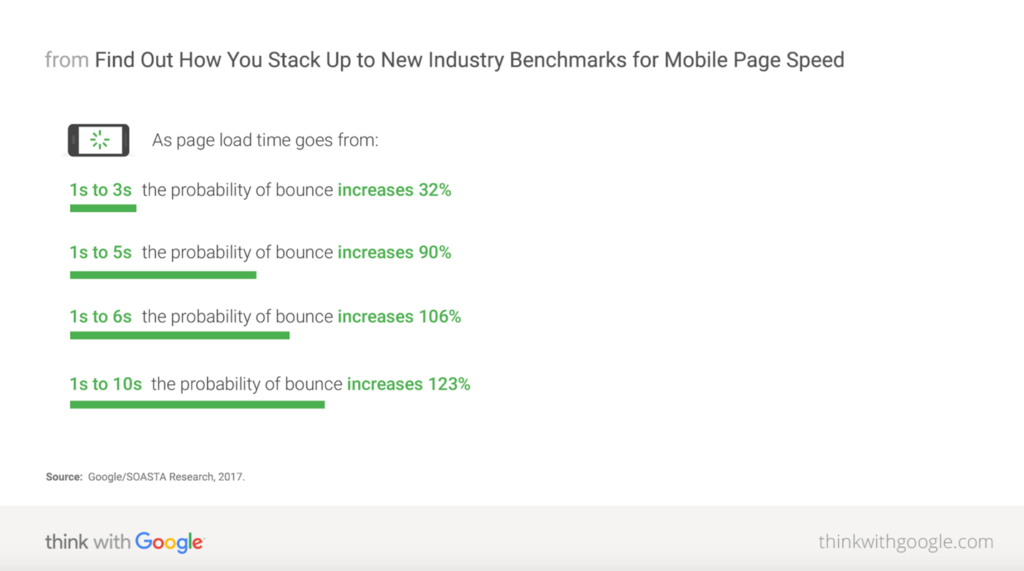
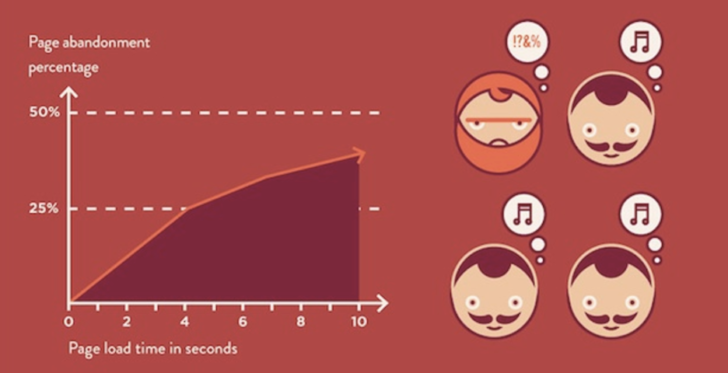
As your page load speed increases second-by-second, the bounce rate also increases a lot.
It’s challenging enough to craft a call-to-action that convinces your site visitors to buy your product or services without adding any additional hurdles.
Sprinkle in a bit of slow page load time, and you could be missing out on a ton of revenue.
A walk through how to identify your site speed issues and fix them.
Google has confirmed site speed as one of the 200+ factors that Google uses to determine your website’s position in search. The fact alone that the search engine giant has deemed site speed important should be enough for you to make it a priority. Beyond that, however, there are other reasons you should place a focus on the speed of your site.
Let’s look at a couple of other critical reasons why you need to focus on your site’s speed for the success of your SEO efforts and the success of your business.
Keep visitors on your site
In a recent report, Google noted that 53% of mobile users will leave a site if it takes more than three seconds to load. That’s where we’re at in this world in regard to our attention spans. Think about all the traffic you could lose if over half of the visitors to your site leave simply because they don’t have the patience to stick around longer than three seconds for your site to load.
And with every second it takes for the pages on your site to load, the chances that your visitors will bounce increases. Take a look at this chart from the same study. It shows that, as your page load speed increases second-by-second, the bounce rate also increases, a lot.
Reducing your site’s bounce rate is a focus for virtually every site owner or it should be anyway. So, make sure to pay attention to site speed to avoid issues in this area.
Stop losing business
It’s challenging enough to craft a call-to-action that convinces your site visitors to buy your product or services without adding any additional hurdles. Sprinkle in a bit of slow page load time, and you could be missing out on a ton of revenue.
In fact, in 2012, Fast Company had conducted a study showing that even a one-second increase in page load time could cost Amazon $1.6 billion in lost revenue. Granted, your business likely doesn’t bring in the same revenue as Amazon, but you can still work the formula backward from Amazon’s actual revenue, determine what percentage that loss accounts for and then apply that to your revenue.
Whatever that number is, I can guarantee you it’s not a number you want to lose when it comes to revenue. No business wants to lose revenue, no matter how large or small.
What causes slow site speed and how do you fix the issues?
You get the importance by now of making sure your site loads quickly. So, now let’s look at a few reasons why your site might be bogged down.
1. Large media files
Videos, images, graphics, and other large media files can take up a lot of space. When a visitor hits your site, your site begins to serve up images, graphics, videos, and other media files that are supposed to exist on the page on which the visitor lands. If the files are super huge, this can slow down the speed of your site.
The fix
Host your video files elsewhere. Rather than hosting them on the site, host them in places like YouTube, Vimeo, and other such services. Then, embed the videos on your site. That way, visitors can still play the video right there on your page, but they won’t deal with any lag in load time. Regarding optimizing your images, try to use file types like JPEG, PNG, and GIF. These tend to load much more quickly than less optimized file types.
2. Avoid slow hosting services
While you may be tempted to cut costs in an area like website hosting, I strongly advise against doing so. There are some affordable hosting options that do offer decent site speed, but often the cheap, cost-saving hosting services come with slow page load speeds.
The fix
First, look to avoid shared servers if you want your site to load fast. Shared servers are ok for smaller sites, but if you want to avoid the lag time, opt for another type of hosting. There are a variety of options here depending upon your site and your particular needs. So, do your research and figure out what the best option for hosting is for your site.
3. Not picking the right CMS
There are tons of great CMS options for creating your website. Options such as Joomla, WordPress, Wix, and others are higher quality options and often help with your site’s load speed. There are less reliable CMS options, however, which can slow your site down.
The fix
WordPress is my personal preference for all the great plugins and other available tools at your disposal to help you boost your site’s performance. Avoid some of the lesser-known options, especially those with reputations for being highly unreliable. Focus instead on more proven options. If you’ve never heard of a particular CMS, do some digging, look at reviews, ask your peers, and make the best choice for your business.
4. Having too many redirects
Redirects are an easy way to point site visitors away from content like a 404 page and toward relevant content that actually exists and might meet their needs. The problem is, if you have too many redirects on your site, you can start to aggravate your site visitors. Think about the extra second or two a redirected link causes as it finds the new content. Those seconds could lose a visitor’s attention.
The fix
I’m not saying don’t use redirects. They are a highly useful tool. That said, try to use them sparingly. Also, try to limit multiple levels of redirects which can add even more seconds on to the page load time.
5. Too much code
Too much code can bog down your site. Javascript, CSS, and HTML can all include unnecessary code that can lead to your site slowing down.
The fix
Cut down on any unnecessary characters like commas and spaces. This alone can help speed up your site. Also, get a skilled developer to look at your code. There are potentially a lot of lines of code on your site that are unnecessary. One example of how this can happen is when someone copies and pastes something from a Word Document right into your site. This can add lots of lines of unnecessary code. In this instance, it’s best to instead copy and paste the text into a text editor, then bring the copy into your site.
These are just a handful of the many things that can slow down your site. Start here, as each of the above can have a significant impact. Then take it a step further and bring in an expert to dig through your site and analyze any other issues that might be impacting your site’s load time.
Wrapping things up
You’ve seen the evidence. Now I highly recommend digging around and checking out the page speed on your own website. Fortunately, that task is simple. Here are a few great tools to easily check the load speed of your website.
Google’s Pagespeed insights
YSlow
Pingdom
Uptrends
Dotcom-Monitor
I can’t stress enough how important it is to focus on the speed of your website. Why put your site at risk of turning visitors away and missing out on revenue critical to the growth of your business. Even if you run a blog and don’t sell services or products directly on your site, your revenue likely comes through Google AdSense clicks or affiliate marketing, thus you still need to rely on high traffic levels and people sticking around your site.
So, no matter what niche you are in, get focused on site speed now, and address the issue before it becomes a major problem.
Anthony is the Founder of AnthonyGaenzle.com a marketing and business blog. He also serves as the Head of Marketing and Business Development at Granite Creative Group, a full-service marketing firm. He is a storyteller, strategist, and eternal student of marketing and business strategy.