Innovate not imitate!

Innovate not imitate!
Interested in the latest Growth hacks?

Welcome to our blog

Interested in the latest Growth hacks?

Welcome to our blog!

We want to help you start/manage and grow your business using innovative strategies and implementation. We have a passion for helping businesses and companies of various sizes see the same success that we have achieved.

Our skillsets are wide and varied, from business strategy, marketing, to online strategy. An increasing number of companies are turning to the internet and online media as a means to maximising their marketing reach and exposure. This is special area of focus for us and we do more than simple SEO strategies.

See our website for more: www.innovatetoaccelerate.com

Thursday, 9 July 2020

Five Google Trends charts that show the impact of COVID-19

30-second summary:

  • The world is now starting to open back up and we are marketers are adjusting to how we can be effective in this new reality.
  • Search data can help inform the strategic decisions around store locations, hours, payment methods and so much more so that your business can make smarter and more informed decisions on how to be successful.
  • As marketers struggle to grasp the magnitude of changes, Jason Tabeling highlights five Google Trends that can serve as immediate insights.

We all already know that the impact that COVID-19 is having on the world. We have all been under stay-at-home orders for about 90 days. The world is now starting to open back up and we are marketers are adjusting to how we can be effective in this new reality. It’s really hard to grasp the magnitude of changes that are occurring around us right now and it will take some time and perspective for us to truly understand. Search data is a powerful tool that can help us understand how consumers are feeling and reacting to situations. Here are five Google Trend charts that I think help us zoom out a bit and understand some trends that I believe will change the way we operate forever.

1. Retail vs Digital businesses

The world of traditional retail is changing forever. Here is a comparison between Instacart and Whole Foods. Now I know you can say Whole Foods is really Amazon and ecommerce, but that’s sort of the point. Every business is a digital business even if those particularly aren’t owned directly by Amazon. Quickly each business has had to move to a digital model and as you can see from this chart Instacart had a massive surge, has since tailed off, but has significantly closed the gap on Whole Foods. Instacart and other like businesses (Ex. Chewy or Doordash) now have a customer base that is much more comfortable in a digital world and won’t be going back.

Google Trends - Retail vs business

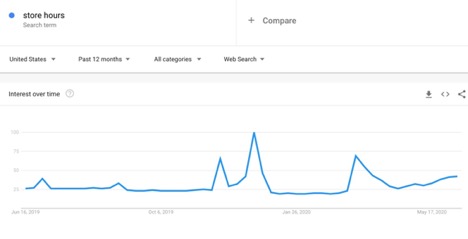
2. Store hours

If and when a store is open is a big deal during COVID-19. Many stores, restaurants, and other businesses were forced closed. Some were deemed essential, and as states re-open are deciding when they should open. This leaves consumers searching to find out how their favorite shops are responding.

For businesses and marketers, this makes keeping your Google My Business (GMB) and other Location Data Management sources (Facebook, Yelp, Apple Maps) up to date. Knowing consumers are seeking information and relying on this information to take action is key. Google has even created new tags like, “Temporarily Closed” to help businesses communicate with their customers easier. Making sure this data is accurate and up to date has always been important and is just magnified by the uncertainty this situation has created for all businesses and consumers.

Google Trends - Store Hours

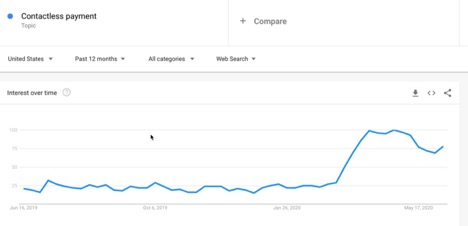
3. “Contactless”

Check a Google Trends chart for anything “contactless” and you will see a very similar graph. The growth of all things contactless has spiked, delivery, payments, and pickup. This further accelerates the digital revolution. Cash has always been dirty, and in these times people are especially cautious. According to Times article paper money can transport a live flu virus for up to 17 days. This data point, plus all the CDC and WHO recommendations make anything contactless of interest for consumers.Google Trends - Contactless

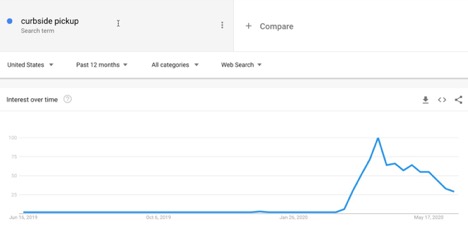
4. “Curbside”

Curbside is very similar to “Contactless.” Both demonstrate the new ways consumers want to interact with brands. Having this type of pickup option allows consumers the ability to shop with their favorite brands, but not take the incremental risk of going inside the store. Consumers are looking for ways to continue with some sort of normal behavior, get out of their house, and not have to wait for shipping.

Best Buy for example had a curbside pickup at 100 stores in December and quickly accelerated to all 1,200 stores during the pandemic. Much like Contactless, curbside wasn’t even a term consumers were using until recently and we don’t expect it to go away any time soon.

Google Trends - Curbside pickup

5. Remote work

The way people approach their jobs has been forever changed. As you can see from the chart below remote work has been steadily growing since 2004, but has reached a peak over the last few months. This is especially interesting when comparing it to unemployment searches, which is a very sad side effect of the economy shut down. I’m hopeful that for those of us in digital marketing we can see this as a growth opportunity for talent across the country and world to work together to help make marketing stronger for these brands. To help them drive into a digital age that was a differentiator just 90 days ago, and has now been rushed into mandatory status for survival.

Conclusion

So much of our world has been changed forever. It is our job as marketers to help leverage the tools at our disposal. This is especially true for search engine marketing. Where we have the ability to understand how customers are thinking about our brands and the experiences they expect from us just be understanding how they search. This data is not only helpful for search campaigns but business strategy as well. Search data can help inform the strategic decisions around store locations, hours, payment methods and so much more so that your business can make smarter and more informed decisions on how to be successful.

The post Five Google Trends charts that show the impact of COVID-19 appeared first on Search Engine Watch.


from SEO – Search Engine Watch https://ift.tt/2ZUiQ0l
via IFTTT

Tuesday, 7 July 2020

If you think you’re link building, you’re doing it wrong

30-second summary:

  • Founder and CEO of Organic Growth, Kevin Carney interviewed 39 marketing professionals about their link building practices.
  • He has brilliantly condensed all these thoughts and highlighted a group of eight which is much more strategic about their link building.
  • More insights on what makes them unique and the most preferred link building platforms across the globe.

The hyperbolic title of this article is a conclusion I’ve come to after interviewing 39 people – with titles ranging from Marketing Specialist, Outreach Team Lead, Head of Content, to VP of SEO & Analytics, about their link building practices.

Of the 39 people, 23 work for agencies, 16 work for brands, and out of that group of 39, there are eight who do link building better, by approaching it differently.

So, what do they do that’s different?

First, lets please notice that this is an almost perfect 20/80 Pareto principle split, so kudos to Vilfredo Pareto, who first noticed how common this split is, way back in 1896.

The group of eight have the following in common:

1. It’s not about link building, it’s about something else

The best way I can think to describe this, is these people don’t do link building per se, they do some higher-level activity, which they take VERY seriously, and which includes the intention to attract high-quality links.

While their primary focus is on the higher-level activity, they are very aware of the importance of attracting links, and how their higher-level activity helps them do that.

2. It’s important in its own right

Did I mention they take this VERY seriously? The higher-level activity they do is not something they attend to when they can, it’s not something they “get to”. It is one of their highest marketing priorities. They devote resources to it, and in most cases wish they could devote more.

I think it’s also worth noting that of the group of eight, five are brands and three are agencies.

Examples of their higher-level activities

Below I identify the group of eight and provide a summary of what they do, and how they do it.

1. Matt Zajechowski of Digital Third Coast

Matt Zajechowski is an Outreach Team Lead and Content Marketing Promotions Specialist at Digital Third Coast, a Chicago based digital marketing agency. They work to position their clients as experts through digital public relations, and yes, I know everyone says that.

Early in the interview, Matt said,

“We do a lot of content-based linked building.”

But their idea of content is more involved than what others do.

They employ a primary tool of data-driven stories and articles, where the data comes from surveys involving 1,000 to 3,000 people. They don’t conduct the surveys themselves, but rather make use of online survey platforms such as SurveyMonkey and Amazon Mechanical Turk. These surveys run over the course of weeks and in some cases a few months.

The survey results provide patterns, trends, and stories with which to create highly unique content that provides insights not available elsewhere. The design of their surveys takes into account what articles are already published on the topic in question, as they work to avoid publishing something already covered by someone else.

As you can imagine, these articles make excellent link bait. Not because they are link bait per se, but because they’re good.

Their link building philosophy is that truly unique content, based on large sets of data that provide interesting insights, not only makes initial link building easier but soon attracts links without continued effort on their part.

2. Steve James, Freelance Marketing Consultant

Steve James is a freelance marketing consultant in Vancouver, British Columbia. Steve focuses on helping small, medium, and enterprise businesses.

What Steve does differently is to not focus on “what” to do, but rather to focus on “who” might be interested.

Steve said something I found to be a very interesting perspective:

“You need links to show you’re known by the right people.”

I can best illustrate his approach by sharing a story he told me to explain his approach.

Steve had a client who was a tailor who sold custom made suits. Rather than focus on building links to the tailor’s website per se, Steve thought about who cares about suits at all, let alone custom made suits.

Obviously, people who wear suits. So, who wears suits? Well, the mayor and the members of the City Council wear suits. The next question is, what can he do to get them to notice the tailor?

This resulted in content being published on the tailor’s website that was effectively written for the mayor and other city dignitaries and promoted to them.

This resulted in links from the city government website, and the mayor’s blogs. Being a local business, that was enough to lift the tailor’s website onto the first page of Google.

This led to a whole new market of online prospects, people who follow the Council members, and business professionals that wear suits.

Steve’s link building philosophy is not that he does a set of things related to building links, but he does whatever is appropriate to attract the attention of the right people.

3. Olga Mykhoparkina of Chanty

Olga Mykhoparkina former Chief Marketing Officer at Better Proposals Chanty, a software company that provides a team messaging tool similar to Slack and MS Team. They’re based in Zurich and Kharkiv, Ukraine. Their approach is public relations, where link building is a side effect of that.

Olga told me,

“We don’t really do anything to just get backlinks….. Links that we get are more of a side effect”.

Their larger effort is “to be known”, not to build links per se.

She then described how their main focus is on maintaining contact with journalists and answering questions of interest to these journalists.

They have people who monitor journalist requests on platforms such as HARO, SourceBottle, and JournoRequest, read every request and respond to every relevant inquiry. Any question they can answer, they do answer.

This is resulting in 20 to 50 quality backlinks per month, some from websites as authoritative as Forbes, American Express, and Business Insider.

This public relations work requires two full-time people.

Their link building philosophy is that by helping journalists, they greatly improve their exposure and their backlink profile.

4. Jamie Kehoe of Venturi

Jamie Kehoe, Former Content Manager at Venturi, an IT recruitment agency located in Manchester, England mentioned that their approach is community management, which helps them greatly with link building.

What encapsulates that idea is Jamie’s statement of,

“We’ve been nurturing this community…..”

A Slack channel is the hub of their community discussions, and their community management also includes content on their blog and a weekly podcast, Venturi’s Voice.

The discussions within their community are focused on teams; recruiting, building, nurturing, managing, and so on.

The podcast gives them unique content not available elsewhere, and each episode is an interview with someone solving problems in interesting ways.

The community management activities, including producing the podcast, are done by multiple people and works out to about two full-time equivalents.

Their link building philosophy involves generating unique interesting content to answer questions their community is asking.

5. Cécilien Dambon of Venngage

Cécilien Dambon is International Growth Manager at Venngage provides a software tool for making infographics and is based in Toronto, Ontario.

An interesting comment Cécilien said is,

“You send the same email to 100 people and you get a 3% conversion rate, and you send that same email super customized to ten people and you get the same result.”

So they focus on relationship building, and yes, I know everyone says that.

At Venngage this shows up as ten people in Venngage marketing maintaining a close relationship with people outside of Venngage with whom they do co-marketing. Co-marketing being a corporate buzzword for helping people who are also helping you.

They are proactive about doing favors for their friends without an expectation of payback for each and every favor.

Of course, there are limits. If someone they co-market with accepts favors and never returns them, that relationship is allowed to wither and is replaced with one that is more mutually beneficial.

This is not a dedicated function with Venngage marketing per se but by virtue of ten people maintaining co-marketing relationships with (give or take) 10 people each, their co-marketing network is strong.

Then when they need favors, they have a network of friends to ask for help.

Their link building philosophy can be summed up in that Beatles lyric: “With a little help from my friends”.

6. Miles Smith of Imaginasium

Miles Smith is Director of Digital & Inbound/Content Marketing at Imaginasium, an agency located in Green Bay, Wisconsin, specializing in helping manufacturing businesses.

Their focus is best summed up in the word “alignment”.

Miles said two things to me that I found to be of great interest:

Marketing is not simply creating demand for what is. It involves changing the business to best meet what demand exists.

Everything is link building, and links indicate the right people know about you.

Item two above is similar to the focus Steve James has on “who” rather than “what” and drives what content they publish, to whom they promote it, and how they promote it to them.

Their focus on “everything is link building” is the principle around which they organize their work.

While from this point on, things do look tactical for a while email outreach jumpstarts their link building, the alignment they worked on earlier helps their link building occur on its own faster, as they have less “content promotion inertia” to overcome.

As they’re an agency, the level of staffing required to make this happens depends upon what their client is paying for, but generally, for a client who takes this seriously, one to two full-time equivalents, consisting of bits and pieces of various team members (in-house and outsourced), are involved in this work.

Their link building philosophy is it’s important to be known by the right people.

7. Chris Eckstrum of Housecall Pro

Chris Eckstrum, former Manager of SEO at Housecall Pro, a company that provides software to tradespeople to help them run more efficient businesses. They’re located in San Diego, California.

They also focus on community management.

The hub of their community is two Facebook groups they own and manage. One is for home service professionals, the other is for women service professionals.

The groups are closed, in the sense that people need to ask to join and Housecall Pro vets them to make sure they are tradespeople, but the group is not limited to Housecall Pro customers. Any tradesperson can join.

Chris told me the discussions within the group provide them with content ideas as well as content amplification and links, as much of their content comes from discussions and interviews with group members, and all content is then shared with the group.

Their management of the groups is very active. They engage frequently with members.

Link building occurs primarily by members of their community directly linking to their content, as well as members of their community promoting the content with others.

Managing those two Facebook groups is a full-time job for two people.

Their link building philosophy is; links come fairly naturally from managing and nurturing their online communities.

8. Araks Nalbandyan of 10Web Inc

Araks Nalbandyan is the Director of Digital Marketing at 10Web an agency that builds, manages, and hosts WordPress websites. They’re based in Newark, Delaware.

They are the exception within this group of eight, as they do what the rest of us do, but more so, and better, which primarily means with a high degree of personalization.

Their primary link building strategy is content promotion via email.

By “more so”, I mean they have two people doing it full time, and by “better” I mean that every pitch is highly personalized. They do not send mass emails.

The degree to which this is true is illustrated by how Araks described the training of the people who do link building. The very first pitch they compose can take four hours to draft. Over time, they get better at it, and four months later they’re able to craft a highly customized pitch in 20 minutes.

What they’re doing is highly customized email pitches at volume, which I am differentiating from the sending of mass email, which is generally very slightly customized by the use of templates.

The other thing they do differently from the bulk of us is they actually and rigorously track their outreach attempts and results, and adjust based on that feedback. They do this in part with the reporting capability of the email product they use (Lemlist), and in part by dumping data from various sources into Google Data Studio and generating information from the data.

She said one that really caught my attention,

“The main reason I separate the Content Promotion (from other link building tactics) is because of the open rate, the click-through rate, and the answer rate of those kinds of emails are super high. One of our campaigns reached an open rate of about 78%, which was huge, and we got a lot of responses and a lot of links from that.”

Their link building philosophy has two prongs:

  1. Highly personalized email pitches are worth the effort.
  2. You can’t manage what you don’t measure.

The rest of us are focused on the tactical aspects of link building

Which it appears, is not an effective way to build links at scale. The other 31 people I interviewed aren’t doing link building wrong per se, they’re just being less effective. Their efforts build links, but not on the same scale.

From talking with this group of people, the “issue” if that’s the right word, is their link building approach is much more tactical, and not as strategic as the group of eight listed above.

The group of eight is much more strategic about their link building (by considering it to be part of a higher-level activity) and much more tactical about their higher-level activity, which is what they attend to in their daily to-do lists.

And I appreciate their contribution to this article

For the record, the group of people I interviewed above and beyond the group of eight is:

Agencies

  • Olivier Mamet of Sandbox, located in Mauritius
  • Nick Bennett of Growmeo Marketing, in Phoenix, Arizona
  • Brooks Manley of Egenius, in Greenville, South Carolina
  • Sam White of New Dimension Marketing & Research, in Encinitas, California
  • Greg Heilers of Jolly Content, in Walnut Creek, California
  • Djordje Milicevic of StableWP, in Toronto, Ontario
  • Syed Irfan Ajmal of SyedIrfanAjmal.com, in Peshawar, Pakistan
  • Kyle Douglass of Revium, in Melbourne, Australia
  • Andy Nathan of Smart at the Start, in Chicago, Illinois
  • Jonathan Aufrey of Growth Hackers, in Taipei, Taiwan
  • Amine Rahal of IronMonk Solutions, in Toronto, Ontario
  • Markelle Harden of Knowmad Digital Marketing, in Fort Mill, South Carolina
  • David Kranker of David Kranker Creative, in Grand Rapids, Michigan
  • Kyle Kasharian of 9Saill, in Fairfield, New Jersey
  • Dean Cacippo of One Click SEO, in New Orleans, Louisiana
  • Cory Hedgepeth of Direct Online Marketing, in Wexford, Pennsylvania
  • Jonathan Gorham of Engine Scout, in South Yarra, Australia
  • Irena Zobniów of Insightland.org, in Wroclaw, Poland
  • Celest Huffman of Rocket Web, in Nashville, Tennessee

Brands

  • Shejraj Singh of YoStarter, in Punjab, India
  • Michael Anderson of Geolango Maps, in Pleasanton, California
  • Slisha Kankariya of With Clarity, in New York City
  • Christina Sanders of Lucidpress, in Salt Lake City, Utah
  • Erin Osterhaus of CORT, in Austin, Texas
  • Patrick Whatman of Spendesk, in Paris, France
  • Matt Bassos of Vuly Play, in Brisbane, Australia
  • Dana Roth of FortVision, in Tel Aviv, Israel
  • Quincy Smith of Ampjar, in Shanghai, China
  • Taavi Rebane of Messente Communications, in Tartu, Estonia
  • Praveen Malik of PMbyPM, in Delhi, India
  • Jakub Kliszczk of CrazyCall, of Wroclaw, Poland

The software tools used

I thought it would be interesting to know what software tools are used for their link building activities, so I asked and compiled this list.

In the spirit of full disclosure, these are the tools people thought to mention to me when I asked, and I tried not to ask leading questions. As such, it’s possible some people simply didn’t feel that a tool such as Google Sheets was worthy of mention, whereas others did.

What surprised me is that neither Majestic SEO nor Google Custom Search Queries get much respect.

Below is a list of each software tool, and the number of people who said they use it.

  • Ahrefs: 27
  • SEMRush: 21
  • Google Sheets: 15
  • BuzzStream: 8
  • io: 8
  • MozPro: 6
  • Screaming Frog: 5
  • Mailshake: 4
  • VoilaNorbert: 4
  • Google Custom Search Queries: 3
  • MajesticSEO: 3
  • HubSpot: 2
  • MozBar: 2
  • SimilarWeb: 2
  • Trello: 2
  • Answer the Public: 1
  • Asana: 1
  • Boomerang: 1
  • Cision: 1
  • Cora: 1
  • Google Calendar: 1
  • io: 1
  • LemList: 1
  • Link Prospector: 1
  • com: 1
  • PitchBox: 1
  • io: 1
  • Scrapebox: 1
  • SEO Power Suite: 1
  • SEOquake: 1
  • org: 1
  • Spyfu: 1
  • Ubersuggest: 1

The tactics employed

I also asked people about their link building tactics, but since seeing that the difference that makes the difference is not one’s tactical approach to link building, but rather one’s tactical approach to their higher-level activity, I fear I would be leading you astray by publishing this list.

In spite of the fact that I met everyone but one person through HARO, I was surprised to discover how many people consider HARO to be a valuable link building tactic. It was the third most popular tactic, by a long shot.

Below are the top three, and the number of people who stated they use it.

  • Content promotion via email: 24
  • Guest blogging: 23
  • HARO: 18

The fourth most popular tactic was used by only 8 people.

In closing

Link building at scale requires resources. Some companies, even some larger companies, do not devote the one or two full-time equivalents required to do it effectively.

If, due to resource constraints, you can’t be one of the top tier link building players, the way you emulate them is:

Devote bits of pieces of lots of people to make up as many full-time equivalents as you can. Since your more successful competitors are devoting appropriate resources, you’ve got to compensate or be left behind.

Prioritize that work as important enough to get to, even if that requires something else to be less important, and yes, I know that is easier said than done.

While each email might start with a template, make each email highly personalized to the person you’re sending it to. Based on the people I spoke to for this article, fewer highly personalized emails have greater success than mass emails where the personalization is just what’s done in the template.

Kevin Carney is the Founder and CEO of the boutique link building agency Organic Growth.

The post If you think you’re link building, you’re doing it wrong appeared first on Search Engine Watch.


from SEO – Search Engine Watch https://ift.tt/325JZ3t
via IFTTT

How to Bring Your Best Self to the Online Conference Season

Posted by cheryldraper

Conference season is here! Of course, this year it looks a bit different. Instead of signing in at the front table and snagging seats next to some new pals, you’ll be setting up your computer as the main stage.

For some, this is going to be a major learning curve. Virtual events can be tougher to follow and engage with. To help you out, we’ve compiled a list of best practices to show up ready and take on any online event you choose to attend this year.

Don't forget, if you haven't yet, there is still time to purchase your MozCon Virtual ticket!

Join us for MozCon Virtual!

Set your intention

To get the most out of your online event, you need to go in with an intention. That way you’ll be more likely to gain something from the experience.

Ask yourself, what are you hoping to achieve? Some examples could be:

  • Gain a business opportunity
  • Learn more about how to recover from the latest algorithm update
  • Find ways to increase efficiency within your SEO processes
  • Feel more confident selling your services

Schedule accordingly

Many events will provide you with schedules ahead of time — look at them! (Pssst...if you haven’t yet, now is the perfect time to check out the agenda for MozCon Virtual.)

These schedules can help you go into the conference with a clear idea of how you’re going to spend your time. Going in with a plan will allow you to focus on the content of the event and your intentions each day, as opposed to wasting time frantically trying to decide what sessions you’re going to attend.

Choosing your sessions

Once you know what your intentions are and you have the event schedule, determine what will be the most beneficial content for you. This can be especially helpful when the event has multiple tracks, very few break times, etc.

Choosing your sessions may come down to a process of elimination, and it’s much easier to eliminate sessions when you have some sort of goal in mind.

Things to consider when choosing your sessions are:

  • The topic
  • The speaker
  • The time
  • The availability of on-demand videos post-conference

Your intention may be to broaden your horizons this year, so instead of opting to see presentations with the same topics or speakers that you saw last year, you may see someone new discussing something you find interesting but haven’t had time to explore. You may have a tight schedule and not be able to make anything past 3pm. If some of the sessions will be available after the conference, it may be worth checking out topics you wouldn’t have otherwise.

Know when to take a break

When you’re planning out your schedule, you need to make sure you build in time for breaks. This means time to eat, time to decompress, time to refill your coffee cup, and time to do work or home stuff.

Conferences usually have a lot of breaks and that’s for good reason. Ideally, you’re going to be learning a lot. But if you try to learn it all at once without giving your brain a break, very little of it will stick.

So, be sure to listen to your body. If you start to feel foggy or overwhelmed, take a break, grab some water, and move around a bit.

Build in networking time

Something else you want to account for when planning your virtual event agenda is when you’re going to network. Some conferences will have time to network built in, but others won’t.

You’ll want to dedicate time to get to know the other attendees by joining conversations and adding people on social media. This will look a bit different in the virtual space, as you won’t be meeting for coffee or chatting in the lobby, but try to stay creative! Zoom chats and video calls are a great way to connect with new or old friends.

Check out our recent blog on networking online like a champ for more tips.

Recap at the end of the day

At the end of each day, take some time to reflect. Think back to what your intention was, what you did throughout the day to fulfill that intention, and what you can put into action moving forward.

This is a great exercise to ensure you’re making the most out of the event. Far too often, we take in all of the information and do nothing with it! That’s why we like to suggest creating at least three action items at the end of each day.

Gather the essentials

Okay, it’s the first day of the conference and you’re about to jump in front of the computer. BUT! Before you do that, you need to make sure you have everything you need to be successful.

Get a clean notebook or start a fresh doc

Having a clean slate for notes will help you stay focused while attending any conference (virtual or otherwise). So grab a new, crisp notebook or create a new document file on your computer before you get started.

If you decide to go the computer route, be sure you close all other tabs and turn off notifications! You want to be sure that your attention stays on the conference.

Taking notes during a virtual conference

With that new notebook or document of yours, you’ll want to take the most effective notes possible. With that in mind, here are a few things to take note of:

  • What you learned
  • How can you apply it
  • What can you share with your team

To ensure that you’re on track to capture each of these things, when you go into each session, write your intention for the session at the top of your notes page. Then, divide your pages by “what I learned,” “how to apply,” and “what to share.” This will keep your notes nice and organized and give you a visual cue on whether or not you’re getting what you expected out of the session. It will also make your end-of-day recap much easier.

When it comes to virtual events, one of the biggest benefits is that you often get the slide decks and video bundles afterward. We suggest finding out whether the event you’re attending offers those things before you start taking notes, as it may lighten your note-taking burden a bit.

Have some snacks, water, and coffee (or tea)

Perhaps the most important things to have during a virtual conference are the snacks and drinks! As you know, at MozCon, we take this part very seriously, so we expect nothing less if you attend our virtual event.

Brain food can help you stay focused. Some of our favorite snacks are granola bars, nuts, veggies, and of course, donuts. However, you have full control over the spread this year.

Be sure to also have plenty of water and your favorite caffeinated beverage as well!

Show up

You’re ready to go! All that’s left is showing up. With virtual events, this can be hard to do. Especially if you know that the content is going to be available after the event is over. But there is so much to be gained by being a part of the live event and the conversations happening around it.

So show up, and show out!

PS: If you’re looking for a virtual event to attend this year, Roger is still hoping to give you a virtual hug at MozCon Virtual 2020.

Join us for MozCon Virtual!


Sign up for The Moz Top 10, a semimonthly mailer updating you on the top ten hottest pieces of SEO news, tips, and rad links uncovered by the Moz team. Think of it as your exclusive digest of stuff you don't have time to hunt down but want to read!


from The Moz Blog https://ift.tt/3iJRKlx
via IFTTT

Monday, 6 July 2020

How to increase organic traffic: 14 Practical tips

30-second summary:

  • Organic traffic is the best shareware way to attract visitors who already want to make a deal. You should conduct a good SEO analysis and take care of the quality of your site to increase it.
  • You can get more organic visits if you develop a strategy, eliminate technical errors of your site, use its good mobile version, make correct external and internal optimization, optimize URLs, update the site content regularly, develop a blog with unique content, analyze competitors, and promote your site through social networks, press releases, newsjacking, emails, and messengers.
  • The correct implementation of the above-mentioned tasks will provide a long-lasting result for you.

Ordinary users trust SERP more than advertising and links marked as “ads”. Correctly performed optimization, troubleshooting and the use of promising channels will quickly bring a good result.

14 Practical tips to increase organic traffic

You can get organic visits using a set of working methods, tools, and recommendations. The best 14 ways are summarized in the review below. 

1. Developing a strategy to increase organic traffic

The solution to any problem begins with the development of a strategy to leave room for financial and time planning. Strategy development is carried out in stages:

  • You should set goals and objectives at first
  • Then, identify weaknesses using a comprehensive site audit and analyze the competitive environment
  • As the next step, you can eliminate identified errors and problems
  • Also, you need to select priority methods to attract organic traffic and increase the position of the site in SERP
  • Then, map the work and budget, prepare a content plan (golden rule for a content plan – 60/30/10 – third-party content 60%, unique content 30%, advertising 10%)
  • If you need, you should select specialists and form technical tasks
  • As the last step, perform tasks, analyze results using Google Analytics

Attracting organic traffic is a rather lengthy process that distinguishes it from contextual advertising. Ads start working immediately after launch. However, organic traffic will work for a long time without any additional investments. 

2. Elimination of technical errors of the site

You can identify and eliminate technical errors of the site using the following methods:

  • Surface self-check
  • Comprehensive site audit with the help of professionals
  • Usage of paid and free services. It’s an optimal solution for those who want to get a quick result with minimal financial investments. Services allow you to identify SEO errors and ones in other key positions. The best of them are Semrush, Ahrefs, and SEOptimizer

You should eliminate identified errors by yourself or with the help of professionals. It’ll make your website more attractive to users and search engines. After the site audit, you can get rid of duplicates, speed up the download of the site, identify affiliates, and solve other problems. 

3. Mobile version of the site

More than 65% of internet users prefer to select and order products from mobile devices. You can’t lose such a huge audience and should take care of your site mobile version. It allows you to increase target audience coverage several times, increase sales and subscriptions. You can create a separate mobile version or use an adaptive design of your main site. In the last case, there will be an automatic adjustment to the screens of different devices. 

4. Correct external and internal website optimization

External optimization

It’s aimed to obtain links from third-party sites. External links that aren’t protected from indexing transfer a part of a donor weight to the acceptor site. When working on building an external link mass, you should consider:

  • Donor site trust, spam level of backlinks. The first index should be high, the second one – low
  • Rules of posting links. It’s recommended to surround them with content
  • Donor site topics (should be related)
  • Frequency of placement. You should increase the link juice gradually. It’s especially important for young sites that have a low level of trust in search engines. A sharp increase can lead to the pessimization of the acceptor site

Internal optimization

It helps to make the site relevant to those queries you carry out the promotion. It consists of:

  • Keyword list collection
  • Keywords grouping
  • Preparing and publishing content optimized with LSI and SEO
  • Formation and optimization of meta tags: title and description, headings and subheadings, image tags
  • Creation of robots.txt files and sitemap.xml (if it’s not generated automatically)
  • Interlinking and other related work

It’s important to ensure that meta tags and content are supplemented with relevant keywords but are not spammed. Otherwise, you can fall under search engine filters.

5. URLs optimization

You can complement URLs with keywords. It makes them more understandable for website visitors. When optimizing URLs, it’s recommended:

  • Use from three to five relevant words, longer links will be cut off in the SERP
  • Use hyphens rather than underscores
  • Take into account spam indicators. Keywords from URLs are added to the overall frequency on the page

Optimized URLs look more attractive so visitors click on them more likely. 

6. Regular content updates

Content updates are a rather important factor which influences on ranking. We speak about updating previously posted materials as well as publishing new ones. It helps to keep pace, increase credibility, have a positive effect on indexing. 

You should carry out updates regularly following the content plan. It allows you to work with new keywords and attract organic traffic from search engines. 

7. Blogging

A blog is a valuable resource necessary for attracting organic traffic not only for commercial but also for information requests. We used to carefully choose the goods before the deal. A blog with interesting and relevant content increases chances that after reading the review, the visitor will perform the target action.

On the blog, you can publish news, information materials, as well as infographics, video reviews – everything that can attract attention and encourage visitors to make a deal. When writing articles for a blog, you can use the links to the catalog. So that the client can immediately buy the product they like without spending time searching the site.

8. Expertise and uniqueness of the content

Usage of non-unique content is a deliberately losing thing. As a result of it, you can get a claim from the copyright holder. Therefore, it’s necessary to create and optimize your content that will provide organic visits. This rule applies not only to texts but also to photos, pictures, videos. In the case of publishing someone else’s content, you must obtain the permission of the copyright holder and give a link to the source.

There is one more caveat – expertise, which plays an important role in ranking issues. Search engines don’t focus on quality optimization but on the semantic uniqueness and benefit that the content of the site can bring to the visitor. The content should answer the question that the user enters in the search bar. If the materials contain outdated, uninteresting, or knowingly untruthful data, the visitor will leave the site. An increasing number of failures will hurt ranking.

9. Promotion in social networks

Social networks are an effective tool with which you can manage opinions and drive traffic to your website. You can create a group for communication with potential customers and publish their announcements, information about promotions, discounts, updates of the assortment, and other content that encourages them to click on the link. Before starting the campaign on social networks, you need to analyze groups of your competitors, look at the situation with ordinary user’s eyes. If the posts are interesting, the subscribers will start to like and share them. This will provide additional free advertising and reach.

10. Competitive analysis

To be the first, you should know what is happening in the competition. To solve this problem, you need to use an audit which will help:

  • Define a keywords cluster
  • Keep abreast of all events, updates and new products introduced by competitors
  • Form advertising budgets and solve other strategic tasks

For audit, you can use online services, questionnaires, secret shoppers, newsletter subscription, analysis of social networks groups, and other tools. You can use the information you’ve got to improve and optimize your website.

11. Press releases on third party resources

Regular publication of press releases on popular sites will help to solve several problems. The first one is traffic attraction, the second – external optimization. News sites visitors click the links willingly. The only negative aspect is that it’s difficult to place such publications. You should make the most of your efforts to get a positive result in outreach and lead generating.

12. Using newsjacking

Newsjacking is one of the varieties of guerrilla marketing that provides unobtrusive advertising. The latter is served against the background of an important event not being a priority. The plus is that users will often visit the site using both search queries and aggregators or news portals. The main rule is to link the offer with a really interesting and important event. Otherwise, the tool will not work. 

13. Email marketing setup

From year to year, newsletters demonstrate their effectiveness. They allow you not only to communicate with customers but also to receive visits to the site. To configure the newsletter, you must have your contact base. To collect the latter, you need to place a simple registration or subscription form on the site consisting of a minimum number of lines. After that, you can establish communication with customers, notifying them of promotions, catalog updates, and other important events.

14. Mailing in messengers

Mailing in messengers is similar to emails. However, messages in Facebook Messenger, Snapchat, or WhatsApp have a higher percentage of opening. A smartphone is always near the person, such messages are more familiar and convenient. Therefore, you should not ignore the potential of this channel. Before starting such mailing, it’s necessary to ask the client whether he/she doesn’t mind receiving advertising materials. Otherwise, the sender (you) may be blocked.

To round up

Correct external and internal optimization, work in social networks and messengers, competitive analysis, technical errors eliminating, and usability improving is priority tasks to increase organic traffic. You can perform some tasks on your own. Other ones will have to be entrusted to professionals. The correct implementation of these tasks will provide a long-lasting result, an increase in organic traffic, sales, and an influx of hot customers.

The post How to increase organic traffic: 14 Practical tips appeared first on Search Engine Watch.


from SEO – Search Engine Watch https://ift.tt/3iyPVaT
via IFTTT

Friday, 3 July 2020

Interview with Lior Davidovitch, the founder of PUBLC

30-second summary:

  • The worldwide web is a clear reflection of all the shifts 2020 has brought and as businesses and marketers crunch majority of their budgets and pivot strategies.
  • In light of the current scenario businesses, digital marketers, and content creators continue to face some key problems around digital ad revenue, ad blocking, and more.
  • We caught up with Lior Davidovitch, the founder of PUBLC, an innovative search engine that reinvents user experience and technology.
  • PUBLC is a new search engine built by everyone, for everyone, that aspires to create an equally distributed web economy using blockchain token economics.
  • Read on to discover insights on how PUBLC serves a more equally distributed web economy using blockchain and token economics, generating a new and native revenue stream for online publishers.

The worldwide web is a clear reflection of all the shifts 2020 has brought and as businesses and marketers crunch majority of their budgets and pivot strategies, these remain some key problems of today’s digital space:

  • Digital ad revenue has taken a hit due to ad blockers.
  • Online publishers struggle to find a native revenue model as an alternative to ad-based models, which only grows bigger now with the COVID-19 impact on the advertising industry. Digital ad revenue is declining, as use of adblockers is increasing
  • Google and Facebook duopoly dominate over 60% of global ad revenue.

We caught up with Lior Davidovitch, the founder of PUBLC, a search engine that aims to reward the entire web ecosystem by creating an innovative, more equally distributed web economy using blockchain and token economics, generating a new and native revenue stream for online publishers.

Q1. Can you tell us about your background and journey towards becoming the founder of PUBLC?

I was always one of those kids that constantly thought of different business ideas and tried to invent things. The original idea for PUBLC started over 15 years ago when I was frustrated with the existing search engines. I always thought that people know best and there should be a way to add the human element to search for a better-organized web. Back then I had mocked up a few presentations and a family friend even connected me to a VC, but I was so young and had no idea what I was doing. Later in university, I wasn’t keen on academia and dropped out to start my journey as a start-up entrepreneur. In the beginning, I was just playing around with different ideas, and eventually, I saw that I’m always going back to the same original idea of creating a new search engine. I started completely from scratch, learning everything in the process, making mistakes, learning again, and building PUBLC layer by layer.

Q2. What was the biggest challenge you faced while setting up PUBLC? How did you solve it?

Just saying that you want to create a new search engine is a huge challenge by itself, doing it the way PUBLC does, creating a new search engine that completely reinvents the user experience and technology with a token-based business model is an even bigger challenge! If you add new and complicated technologies like blockchain and AI to the mix, the challenge becomes even bigger. Plus, the fact that you’re doing it as a small self-funded startup makes it almost impossible! But eventually, we did it step by step, layer by layer and built this platform that’s backed with AI and a blockchain financial infrastructure.

Q3. Can you give us a brief insight into PUBLC and your token economy?

PUBLC is a new type of search engine built by everyone, for everyone, that aspires to create an equally distributed web economy using blockchain token economics. You can think of PUBLC as a mix between Google and Wikipedia, where we combine human intelligence with artificial intelligence (AI) enabling users to categorize the content and “teach” PUBLC how to better organize the web, creating a new search experience, while also rewarding the users for participating in the process.

With regards to the token economics, on the one hand, our token, PUBLX, is granted by PUBLC as a reward to its community that contributes to PUBLC. On the other hand, the tokens are used as the only form of payment for PUBLC’s business services used by advertisers on the platform. This balance between supply and demand is what establishes the token value.

Token earners, be it publishers, brands, influencers, or content categorizers, can either use their token rewards to pay for any of our business services or exchange them on cryptocurrency exchanges, where the tokens can be bought by advertisers. So, we encourage everyone to checkout PUBLC and discover how they could earn PUBLX tokens.

Q5. How can businesses use PUBLC? Any tips on how they can get started with PUBLC?

PUBLC was built with all the different actors of the web ecosystem in mind, as we believe PUBLC is a platform that is meant to serve everyone and reward them for the value they create. Businesses as online publishers, brands, and celebrities benefit from PUBLC as it gives them exposure to new audiences, drives traffic to their websites, and earns them revenue for every time a user clicks on their content and views it. Businesses can get started on PUBLC by submitting their website, categorizing their content, and curating their pages. Our job is to support all those people and help them better achieve their goals, so feel free to reach out to us, we would love to hear from you!

Q6. Would video content be sourced from platforms like YouTube?

Yes! PUBLC curates and displays video content that users upload on YouTube and other such sites. You’ll be surprised to know that we even reward sites like YouTube as they also provide value to the ecosystem for hosting all that content.

Q7. What are your future plans for PUBLC? Will you venture into the digital advertising aspect as well? If yes, we’re assuming it will be in-ecosystem currency of PUBLX tokens?

Besides inventing a new user experience and technology we also had to invent a new revenue model connected to our token economy – and that’s crucial to the success of the platform – having those PUBLX tokens that are given to everyone for their contribution have real-life value. In order to do that we built a new set of business services such as, promoted content, brand awareness, ecommerce, and more, which offer advertisers a new way to enhance their brand awareness or conversions in a native and organic way within the platform without compromising PUBLC’s user experience for the users. 

Our business services work differently than the way it’s done on traditional search engines, and it rethinks this traditional advertising model of just promoting ads over search queries. The usual method is good but it could be different. We put more focus on content and the user experience because when you get ads, whether it’s on Google, Facebook, or any other platform – as a user that harms your experience. We aim to deliver our business services in a very native and organic way that doesn’t harm the user experience. For example, PUBLC offers promoted content that is real, in the form of videos, articles, and other multimedia. These could be campaigns that not only provide advertisers with the worth of their money but also engage and add value for the users. Furthermore, we incorporate PUBLC’s community in the approval of ads, having them take part in flagging spam and fraud, and helping shape PUBLC revenue model.

Q8. Do you use citations? How does the web validate your resources?

We’re focused more on the human element of search. People add domains and content URLs which are then approved by our community, and only then are indexed and crawled, making our sources more credible. There are many parameters that our algorithm evaluates in order to rank content, to give you a better idea I’ll share the three main key elements:

  1. Relevancy: How the content is relevant to the search query or the topic that is searched
  2. Popularity: How many PUBLC users saw and clicked on the content
  3. Content age: How old is it, when was it published

Users are the first gatekeepers of which content gets indexed on the PUBLC search engine. 

Q9. How does PUBLC’s search engine combine human intelligence and AI? Is it curated by people? How do you counter aspects of “subjectivity” and “bias”?

As I’ve mentioned before, I strongly believe that people know best. They would know best about what topic(s) the is content related to or which search queries best describe the content. This is unlike how typical search engines work by mainly analyzing the text of the content. Having users add and categorize content on PUBLC works on a micro-scale for that specific content. However, when you add machine learning and AI to that you can adapt on a much larger scale, learn better about content categorization and indexing in a more precise, user-friendly, and genuine manner. Our search engine intends to broaden users’ horizons by reaching new content that they didn’t even know existed.

Yes, giving too much power to people could bring bias. But I’d like to refer to PUBLC on the lines of Wikipedia where you have a large group of people editing a specific piece of content that could be very controversial, and they still find a way to do it. On PUBLC we have an entire system of a reputation for users and publishers so they’re always building their own reputation simultaneously. 

For example, a user could build their reputation on the PUBLC platform for any niche, let’s assume, blockchain. Now if this user claims something about blockchain, the system considers their subject matter expertise and deems their claim right for crawling, categorizing, and indexing. 

We have everything validated by the users of the community. I think users very quickly know spam when they see it, so they wouldn’t approve spam-like content with the risk of lowering their reputation. We built this set of rules to incentivize people to do good and if they don’t play by the rules, they’re just going to lose.

Q10. Could you give us a small brief on how you’re dealing with privacy? Is there anything else that you’d like people to know about in terms of data privacy?

Privacy is one of PUBLC’s core, crucial elements. In fact, that’s the big problem with the web that we also saw fit to address. Platforms like Facebook and the others make their business out of the users’ data, and in a way compromises their privacy. That’s why there’s a huge loss of trust for users. One of our ambitions and aims is to use blockchain to enable users to have the best, most personal user experience while having 100% privacy. We are now building this element, and plan to have all of our users’ personal data stored on the blockchain and accessed only by them ensuring them with complete control over their data that’s also kept anonymous.

Users would have their own PUBLC IDs but there would be no way that I, the platform, or any of us could access that information. If a user personally chooses to share their information with advertisers and publishers to help them understand the user profile or engagement with their content – that too would be completely anonymized. 

Since it’s still the users’ data giving value to a business they would also be rewarded for it. This way we help users earn some of the revenue made through that data. But again, it would be completely anonymized data ensuring that businesses can’t trace a user to their real-life entity. That’s one of the great potentials that blockchain gives is the bandwidth to build platforms that are more focused on the privacy elements.

Q11. What are your predictions for search and SEO in 2020?

As I’m sure you can already guess, I believe search and SEO will be more focused on the human element, and that we will continue to see improvements in understanding the user’s intent. I think we will also see SEO become more accessible to the creators, and more straightforward, without harming the creativity and user experience of the content. Doing so by making tools to create the best optimization and content categorization. One of the biggest problems I see today is that creative content creators are forced to focus their efforts on SEO rather than on creating better content. I hope that with PUBLC, creators could focus on creating creative content while having the tools to actively influence their content’s SEO, without having the two contradict one another. For me, the prediction would be – better user experience, better content, and hopefully a better web.

The post Interview with Lior Davidovitch, the founder of PUBLC appeared first on Search Engine Watch.


from SEO – Search Engine Watch https://ift.tt/2Zz7NcX
via IFTTT

Page Speed Optimization: Metrics, Tools, and How to Improve — Best of Whiteboard Friday

Posted by BritneyMuller

Page speed has always been a crucial part of SEO work, and as more companies make the shift to online operations, optimization becomes more important than ever. However, it's a complex subject that tends to be very technical. What are the most crucial things to understand about your site's page speed, and how can you begin to improve? To help you answer these questions, we're sharing this popular episode of Whiteboard Friday (originally published in February 2019) where Britney Muller goes over what you need to know to get started.

Click on the whiteboard image above to open a high resolution version in a new tab!

Video Transcription

Hey, Moz fans. Welcome to another edition of Whiteboard Friday. Today we're going over all things page speed and really getting to the bottom of why it's so important for you to be thinking about and working on as you do your work.

At the very fundamental level I'm going to briefly explain just how a web page is loaded. That way we can sort of wrap our heads around why all this matters.

How a webpage is loaded

A user goes to a browser, puts in your website, and there is a DNS request. This points at your domain name provider, so maybe GoDaddy, and this points to your server where your files are located, and this is where it gets interesting. So the DOM starts to load all of your HTML, your CSS, and your JavaScript. But very rarely does this one pull all of the needed scripts or needed code to render or load a web page.

Typically the DOM will need to request additional resources from your server to make everything happen, and this is where things start to really slow down your site. Having that sort of background knowledge I hope will help in us being able to triage some of these issues.

Issues that could be slowing down your site

What are some of the most common culprits?

  1. First and foremost is images. Large images are the biggest culprit of slow loading web pages.
  2. Hosting can cause issues.
  3. Plugins, apps, and widgets, basically any third-party script as well can slow down load time.
  4. Your theme and any large files beyond that can really slow things down as well.
  5. Redirects, the number of hops needed to get to a web page will slow things down.
  6. Then JavaScript, which we'll get into in a second.

But all of these things can be a culprit. So we're going to go over some resources, some of the metrics and what they mean, and then what are some of the ways that you can improve your page speed today.

Page speed tools and resources

The primary resources I have listed here are Google tools and Google suggested insights. I think what's really interesting about these is we get to see what their concerns are as far as page speed goes and really start to see the shift towards the user. We should be thinking about that anyway. But first and foremost, how is this affecting people that come to your site, and then secondly, how can we also get the dual benefit of Google perceiving it as higher quality?

We know that Google suggests a website to load anywhere between two to three seconds. The faster the better, obviously. But that's sort of where the range is. I also highly suggest you take a competitive view of that. Put your competitors into some of these tools and benchmark your speed goals against what's competitive in your industry. I think that's a cool way to kind of go into this.

Chrome User Experience Report

This is Chrome real user metrics. Unfortunately, it's only available for larger, popular websites, but you get some really good data out of it. It's housed on BigQuery*, so some basic SQL knowledge is needed.

*Editor's note: We've edited this transcript for accuracy. In the video Britney said "BigML," but intended to say BigQuery. It's hard filming an advanced-topic Whiteboard Friday in a single take! :-)

Lighthouse

Lighthouse, one of my favorites, is available right in Chrome Dev Tools. If you are on a web page and you click Inspect Element and you open up Chrome Dev Tools, to the far right tab where it says Audit, you can run a Lighthouse report right in your browser.

What I love about it is it gives you very specific examples and fixes that you can do. A fun fact to know is it will automatically be on the simulated fast 3G, and notice they're focused on mobile users on 3G. I like to switch that to applied fast 3G, because it has Lighthouse do an actual run of that load. It takes a little bit longer, but it seems to be a little bit more accurate. Good to know.

Page Speed Insights

Page Speed Insights is really interesting. They've now incorporated Chrome User Experience Report. But if you're not one of those large sites, it's not even going to measure your actual page speed. It's going to look at how your site is configured and provide feedback according to that and score it. Just something good to be aware of. It still provides good value.

Test your mobile website speed and performance

I don't know what the title of this is. If you do, please comment down below. But it's located on testmysite.thinkwithgoogle.com. This one is really cool because it tests the mobile speed of your site. If you scroll down, it directly ties it into ROI for your business or your website. We see Google leveraging real-world metrics, tying it back to what's the percentage of people you're losing because your site is this slow. It's a brilliant way to sort of get us all on board and fighting for some of these improvements.

Pingdom and GTmetrix are non-Google products or non-Google tools, but super helpful as well.

Site speed metrics

So what are some of the metrics?

What is first paint?

First paint is he first non-blank paint on a screen. It could be just the first pixel change. That initial change is considered first paint.

What is first contentful paint?

First contentful paint is when the first content appears. This might be part of the nav or the search bar or whatever it might be. --That's the first contentful paint.

What is first meaningful paint?

First meaningful paint is when primary content is visible. When you sort of get that reaction of, "Oh, yeah, this is what I came to this page for," that's first meaningful paint.

What is time to interactive?

Time to interactive is when it's visually usable and engage-able. So we've all gone to a web page and it looks like it's done, but we can't quite use it yet. That's where this metric comes in. So when is it usable for the user? Again, notice how user-centric even these metrics are. Really, really neat.

DOM content loaded

The DOM content loaded, this is when the HTML is completely loaded and parsed. So some really good ones to keep an eye on and just to be aware of in general.

Ways to improve your page speed

HTTP/2

HTTP/2 can definitely speed things up. As to what extent, you have to sort of research that and test.

Preconnect, prefetch, preload

Preconnect, prefetch, and preload really interesting and important in speeding up a site. We see Google doing this on their SERPs. If you inspect an element, you can see Google prefetching some of the URLs so that it has it faster for you if you were to click on some of those results. You can similarly do this on your site. It helps to load and speed up that process.

Enable caching & use a content delivery network (CDN)

Caching is so, so important. Definitely do your research and make sure that's set up properly. Same with CDNs, so valuable in speeding up a site, but you want to make sure that your CDN is set up properly.

Compress images

The easiest and probably quickest way for you to speed up your site today is really just to compress those images. It's such an easy thing to do. There are all sorts of free tools available for you to compress them. Optimizilla is one. You can even use free tools on your computer, Save for Web, and compress properly.

Minify resources

You can also minify resources. So it's really good to be aware of what minification, bundling, and compression do so you can have some of these more technical conversations with developers or with anyone else working on the site.

So this is sort of a high-level overview of page speed. There's a ton more to cover, but I would love to hear your input and your questions and comments down below in the comment section.

I really appreciate you checking out this edition of Whiteboard Friday, and I will see you all again soon. Thanks so much. See you.

Video transcription by Speechpad.com


Scoop up more SEO insights at MozCon Virtual this July

Don't miss exclusive data, tips, workflows, and advice from Britney and our other fantastic speakers at this year's MozCon Virtual! Chock full of the SEO industry's top thought leadership, for the first time ever MozCon will be completely remote-friendly. It's like 20+ of your favorite Whiteboard Fridays on vitamins and doubled in size, plus interactive Q&A, virtual networking, and full access to the video bundle:

Save my spot at MozCon Virtual!

We can't wait to see you there!


Sign up for The Moz Top 10, a semimonthly mailer updating you on the top ten hottest pieces of SEO news, tips, and rad links uncovered by the Moz team. Think of it as your exclusive digest of stuff you don't have time to hunt down but want to read!


from The Moz Blog https://ift.tt/2VEWXkk
via IFTTT

Thursday, 2 July 2020

Behind the Scenes at MozCon Virtual

Posted by Dr-Pete

Re-imagining MozCon hasn't been easy. I won't lie — I'll miss seeing so many of you in person, and, yes, I'll miss the magic of the big stage. We're working hard to make this year special, including leveling up our speakers for their remote sessions. I recently shared my own set-up on Twitter:

This stirred up quite a bit of interest in our set-up and equipment list, so thanks to Cheryl on our events team for filling in the blanks for me, and thanks to our amazing A/V partners at Seamless Events for helping this all come together. Also, many thanks to our speakers who gave me permission to share their photos and let you in on some of the magic behind in front of the curtain.

MozCon Virtual equipment list

Before we get to the fun part (or maybe this is the fun part for you), here's the standard equipment list our A/V team used for MozCon Virtual (some speaker set-ups may vary):

  • Logitech C920 HD Pro Webcam (more info)
  • Neewer Backdrop Support System (more info)
  • Neewer Gray Photography Backdrop (more info)
  • UBeesize 8-inch Selfie Ring Light w/ Tripod Stand (more info)
  • Z ZAFFIRO USB Lavalier Lapel Clip Microphone (more info)
  • Vilcome 4-in-1 USB C Hub Adapter (more info)

Note that some of the models/sizes linked to in [more info] may not be exact matches to our kit. While Moz doesn't endorse any of these specific products, I've personally been pleasantly surprised at how affordable and accessible decent A/V equipment has become, and quarantine is making the value proposition even stronger.

The presenter remote on my desk is not part of the kit, but is my own Logitech R400 (more info). I've had this one for almost six years, and wish I'd bought my own remote sooner. I use it even when I'm presenting at my desk or practicing on a plane (that may say more about me than about Logitech, admittedly). The LEGOs and half-finished LaCroix were not included in the speaker kit, although LEGOs factor heavily into my MozCon presentation.

Sneak-peeks with our speakers

Just for fun, here's a sneak-peek at a few of our speakers and their set-ups.

Dana DiTomaso (@danaditomaso)

I was going to make all of the photos 16:9 like the one above, but Dana ruined that by having this amazing skylight in her loft, so all of the speakers are getting big photos now.

Dana's MozCon Virtual session:
"Red Flags: Use a discovery process to go from red flags to green lights"


Izzi Smith (@izzionfire)

If I hadn't resorted to full-sized photos for Dana, I would've done it for Izzi's wall art.

Izzi's MozCon Virtual Session:
"How to Be Ahead of the (CTR) Curve"


Shannon McGuirk (@ShannonMcGuirk_)

Shannon braved a trek to the office just for MozCon and wins the award for looking more professional than the rest of us. I cleaned my home office. That counts for something, right?

Shannon's MozCon Virtual Session:
"Great Expectations: The Truth About Digital PR Campaigns"


Ross Simmonds (@TheCoolestCool)

Ross has clearly got chair game. My $79 knock-off Aeron from Costco is looking pretty sad...

Ross's MozCon Virtual Session:
"Designing a Content Engine: Going from Ideation to Creation to Distribution"


Robin Lord (@robinlord8)

Robin went for the rare standing set-up. Robin has also delegated his copy of "Pandemic" to being a monitor stand, as it's far too depressing to play right now.

Robin's MozCon Virtual Session:
"Whatever You Do, Put Billboards in Seattle – Getting Brand Awareness Data from Google"


Rob Ousbey (@RobOusbey)

I'm not sure if Rob is expertly offsetting his window light with two ring lights or if we just forgot to send him the instruction sheet. He's my boss, so I'll assume the former.

Rob's MozCon Virtual Session:
"A Novel Approach to Scraping Websites"


Sarah Bird (@SarahBird)

Last, but certainly not least, our own CEO, Sarah Bird, who apparently gets to have a hammock outside her office, because she's the boss.

Sarah's MozCon Virtual Session:
"Welcome to MozCon Virtual 2020 + the State of the Industry"


The idea for this post was a little last-minute, and I didn't want to personally annoy every speaker with photo requests, so a big thanks to all of our speakers for going the extra mile to make the shift to a virtual event with us and set up all of this equipment. Special thanks to Cheryl and Carly for all of their work pulling this plan together.

What's your home set-up?

Have you leveled up your A/V set-up and you're just itching to show it off? Let us know about your favorite equipment in the comments, or send us your home-office photos on Twitter (@Moz).

Join us for MozCon Virtual!

Hope to see you at MozCon Virtual on July 14-15. No need to book a hotel or flight, so there's still time to join us, and the $129 special price includes all speaker videos!


Sign up for The Moz Top 10, a semimonthly mailer updating you on the top ten hottest pieces of SEO news, tips, and rad links uncovered by the Moz team. Think of it as your exclusive digest of stuff you don't have time to hunt down but want to read!


from The Moz Blog https://ift.tt/2VDhw0R
via IFTTT

Social Media Today