Innovate not imitate!

Innovate not imitate!
Interested in the latest Growth hacks?

Welcome to our blog

Interested in the latest Growth hacks?

Welcome to our blog!

We want to help you start/manage and grow your business using innovative strategies and implementation. We have a passion for helping businesses and companies of various sizes see the same success that we have achieved.

Our skillsets are wide and varied, from business strategy, marketing, to online strategy. An increasing number of companies are turning to the internet and online media as a means to maximising their marketing reach and exposure. This is special area of focus for us and we do more than simple SEO strategies.

See our website for more: www.innovatetoaccelerate.com

Wednesday, 12 February 2020

Case Study: How BDCenter transformed a reputation from 48% negative on Google to neutral

One can easily translate sign reputation management to income management. Your public image directly affects sales, career and financial well-being in any field – whether searching for an investor, overcoming the negativity spread by your rivals, a change of field, or creation of a new public persona.

But what should you do if there are already lots of negative things written about you on the Internet? In this post, we’ll use one of our actual cases as an example to show how we changed a client’s reputation from 48% negative to neutral.

Disclaimer

This article has been created by BDCenter Digital. We sign an NDA with all our customers. Therefore, all the data that could infringe on the client’s confidentiality have been changed. This doesn’t affect the mechanism of reputation management in any way.

The objective

Our assignment was to make sure that searching for our client’s name on Google in the US would yield zero negative content on the first two SERPs.

When the client asked us for assistance, at that time, 48% of the top 20 results were negative:

Reputation management for clients name

The team

A total of seven BDCenter Digital team members worked on the project, including:

Two SEO specialists + an assistant: Their job was to monitor and analyze search results, work out a strategy to eliminate negativity, and publish content on appropriate resources.

PR specialist: Who identified news-worthy content, contacted the media, as well as prepared and published articles.

SMM specialist: Who created social media accounts for the client and filled them with info.

Project Manager: Who allocated tasks, tracked progress, kept in touch with the client and the team, and evaluated the results.

Designer: Who prepared templates for social media and news resources.

Results

Four months and 560 hours of work later, there was NO negativity left in the top two result pages on Google. Read on to find out how we did it.

SEO

Igor Erenkov Artem Shcherbakov Olga Vodchyts

 1. Identifying resources containing negative content and monitoring changes 

Our first step was to study the SERPs (with our client’s name as the search query) and find the sites that published negative content about him. This helped us understand the scope of the job and see which sites we would have to work with to push all negativity out of the top 20 results.

Every week, we would fine-tune our strategy – since Google often changes its ranking algorithm, we would get slightly differing results every day. For instance, a resource that was ranked as no.1 yesterday might not even be on the first page tomorrow.

For this reason, we checked on the situation once a week and recorded the results in a spreadsheet:
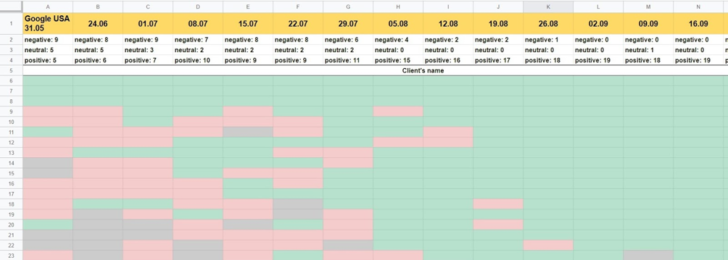
Reputation management spreadsheet identifying resources containing negative content

The color indicates the tonality of each resource relative to the individual in question. The names of sites were removed for the purposes of confidentiality.

Insights

One of the factors impacting how results are placed on a SERP is the age of the content. A new relevant piece of content can easily get a resource in the top 10, but just a week or two later, it can lose around 30 to 50 positions.

2. Posting mentions of the person on various websites

Undesirable information about the client was posted on large resources, one of them with 20 million monthly visitors. One of the obvious solutions was to overcome this negativity by posting positive content on even larger websites.

However, we couldn’t rely on this tool alone for two reasons:

A. High costs: The client would have to pay $4000 to $5000 per publication, and the actual budget was much lower.

B. Risk of repetitiveness: Google tries to vary its results, filling its SERPs with sites in different formats. Therefore, we decided to post content about our client on the following types of sites:

  1. News websites
  2. Blogging platforms
  3. Profiling sites
  4. Listings
  5. Video hostings
  6. Podcast sites
  7. Social networks
  8. Polls
  9. Interview-centered sites
  10. Client’s corporate pages
  11. Dropped domains
  12. Presentation hostings

3. Optimizing the client’s corporate site

Google prioritizes those sites that are most relevant to the search query. What do you see at the top of the list when googling the name of someone? Depending on the popularity, it can be a Wikipedia article, a corporate website, or a social media account.
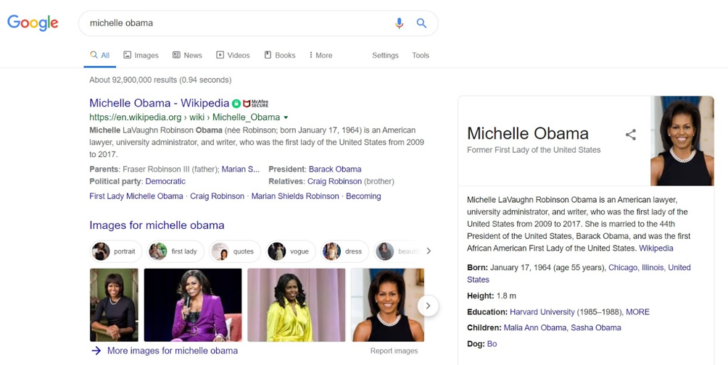
Example of optimizing client's corporate website

In our case, the client’s corporate website was among the top results already, but we wanted to strengthen its position. To do this, we optimized the Team page and created an additional page with the client’s bio.

As a result, these two pages ended up in Google’s top three in the US, pushing all the negativity down the list.

4. Using dropped domains

When time is limited and you need a quick result, you can benefit from dropped domains.

A drop is a domain that its owner decided not to pay for any longer and is now for sale. Some of these dropped domains are still indexed by Google, and you can get good results by publishing backlinks there.

After confirming this step with the client, we created a site based on a good dropped domain and published new content on that site. In just a month, the site was ranked among the top five on Google.

5. Pushing negativity out of Google Image Search

The image search also yielded some negative results, so we had to work not only on pushing individual websites out of the top 20 but specific images, too.

Since Google likes unique content, we made sure to use only unique images of the client in our publications and his social media accounts.

Advice

If you don’t have any fresh pictures available, you can edit some of the old ones, changing the background, size, or color profile. This will make Google see them as unique, showing them first.

By the way, changing just the size doesn’t work. Google views such pictures as identical, showing only the one with the best resolution.

Julia Herman
Julia Herman

PR and content

1. Identifying newsworthy materials

The client didn’t have any important news to share, so we had to create it ourselves. In particular, we watched the industry news closely – and as soon as we found something valuable, we confronted the event with our client’s expertise. Thanks to his status and extensive experience, he could provide commentary on the latest research and news for the media.

2. Publishing content

The technique described above provided us with publications on news websites – however, they would allow free coverage only for really important events. Working with niche websites was much easier: we used them to publish expert articles and interviews.

We only chose sites that fit the following three criteria:

  1. Relevance to the subject – wealth management, finance, and investment.
  2. The site had to contain a negative article about our client. Publishing fresh content on the same site would get the old article to rank lower.
  3. Importance – the site’s «weight», or authority, had to be higher or equal to that of the sites that contained negativity, helping to overcome it.

By weight we mean the level of Google’s trust in the resource. This trust is based on the number of visitors, the site’s age and level of optimization.

Advice

If you need quick results, you can get a lot of coverage fast by publishing your content on PR Newswire. Read our recent post on how to do this.

Insights

Our client’s name had to be mentioned in the title: -this helped articles rank much better for our search query.

However, our title headline didn’t always fit the editing guidelines of individual resources: some preferred to list the author at the very bottom of the piece. Such articles weren’t useful to us since they didn’t rank the way we would’ve liked.

We tested this headline theory many times. Even a publication on the gigantic Yahoo! Finance with one mention in the body of the text works worse than an article on a small website, but with the client’s name mentioned in the title, lead-in, and text body.

Svetlana Kopach
Svetlana Kopach

SMM

1. Creating and filling social media accounts

We created accounts for the client on Twitter, Linkedin, Facebook, and other platforms. We didn’t use those social networks that weren’t relevant to the client’s business — such as Pinterest, for example.

Linkedin yielded the best result: Our client’s profile on this platform still ranks as no. 1 in the search results, pushing out the old negative content. Xing, Tumblr, and Instagram didn’t produce any result at all: none of them got into the top 20.

We made sure to fill new social media pages with expert content – mostly pieces for the articles we wrote for the media. Naturally, we always adapted the text for social media. The posts were accompanied by photos of the client: we arranged special photoshoots for that purpose.

2. Posting podcasts and videos

Google prefers content to be varied. So it prioritizes not only fresh articles but also video and podcasts.

We started accounts on YouTube and Vimeo for our client and added several videos: some we created specifically to fit recent news, others were chosen among existing content.

We posted those videos not only on the client’s own accounts but also in other users’ profiles. By the way, it was a video posted on the page of another user that ended up in the top 10 of Google.

As for podcasts, they can work well, too – as long as you post them on popular platforms, such as iTunes or audioboom.com, which has over two million monthly users.

Daria Vechorko
Daria Vechorko

Project Manager’s comments

SERM, or search engine reputation management, combines such tools as SEO, PR, and SMM. In order to leverage this combination with maximum benefit, we utilize the following principles:

  1. Regular strategy updates – since both SERPs and relevant content change all the time, we have to monitor all changes and reassess our action plans when required.
  2. Analysis of the results – we constantly check what works and what doesn’t. This helps us work faster, better, and without wasting our resources.
  3. Daily contact with the client – this way we can quickly make strategic decisions and create fresh content.
  4. Generating relevant content – even though SERM is more about pushing negativity as far down as possible in the SERPs, we are also very serious about what we post – and so are our clients, of course. Content should also be relevant to the objective. In the case, we’ve described that meant niche articles, podcasts, and videos that accentuated the client’s expertise.

Bottomline
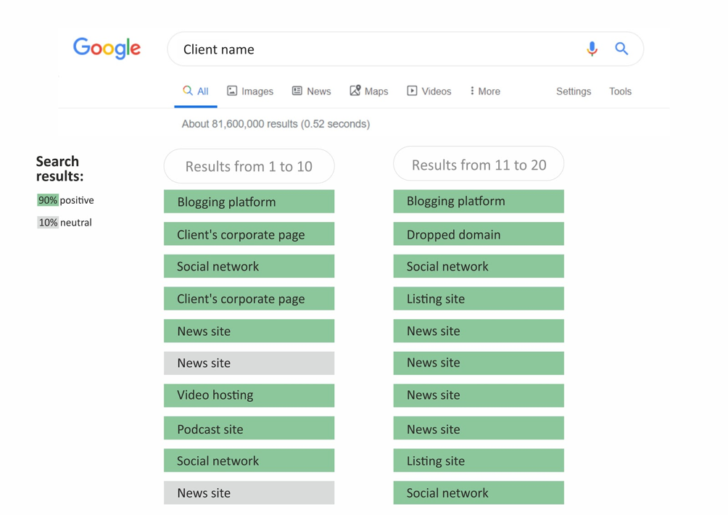
Positive reputation achieved for client

By using all these tools, we managed to radically transform the first two Google result pages.  90% of the top 20 were now positive, with the remaining 10% neutral.

Based on our experience with reputation management – and we’ve already worked with a Nobel laureate, several politicians, and CEO’s of financial institutions – your public image can have a tremendous impact on your business and career. By maintaining a good public image on a constant basis is much easier and cheaper than launching major reputation rehaul campaigns once every few years.

To maintain your reputation, make sure to monitor the search results for your name or brand. Select your key search queries and set up alerts: this way you’ll know what Google users see when they look for information about you and will be ready to react to any negativity.

The post Case Study: How BDCenter transformed a reputation from 48% negative on Google to neutral appeared first on Search Engine Watch.


from SEO – Search Engine Watch https://ift.tt/2w3Px07
via IFTTT

Monday, 10 February 2020

The Power of "Is": A Featured Snippet Case Study

Posted by EricSerdar

I’m not a literary scholar, but I believe it was Hamlet that said “to have a featured snippet or not to have a featured snippet?” Ever since featured snippets came onto the scene, sites have been trying to secure them.

My team and I wanted in on this craze. Throughout our journey of research, testing, failure, and success, we found some interesting pieces of information that we wanted to share with the community. I’ll walk you through what we did and show you some of our results (though can’t share traffic numbers).

It was Britney Muller’s webinar on Feature Snippet Essentials and the release of the featured snippets cheat sheet that inspired me to capture what we've learned.

What are featured snippets?

A featured snippet is the box that appears at the top of the search result page that provides information to succinctly and accurately answer your query and cites a website.

Why are featured snippets important?

A featured snippet is important because it represents an additional SERP feature that you can secure. Usually located at the very top of the results page, featured snippets offer you greater visibility to searchers and can boost brand recognition.

Our featured snippet plan of attack

  1. Research, research, and more research on how to pull this off
  2. Identify keywords we wanted to target
  3. Change how we structured our on-page content
  4. Measure, test, and repeat the process

1. Research, research, and more research

We spent a great deal of time researching featured snippets. We looked at different ways to find featured snippet opportunities and researched how to optimize our content for them. We also went and saw Kellie Gibson speak on featured snippets volatility.

Did we implement everything from what we learned during this discovery phase into our featured snippet strategy? No. Are we perfect at it now after a year and a half of practicing this? No, no, no. We are getting better at it, though.

2. Identify keywords we wanted to target

We originally started out focusing on big “head” keywords. These represented terms that had indeterminate searcher intent. The first head term that we focused on was HRIS. It stands for Human Resources Information System — sexy, right?

Note: Looking back on this, I wish we had focused on longer tail keywords when testing out this strategy. It's possible we could have refined our process faster focusing on long tail keywords instead of the large head terms.

3. Change how we structure our on-page content

We worked closely with our writing team to update how we lay out content on our blog. We changed how we used H2s, H3s (we actually used them now!), lists, and so on to help make our content easier to read for both users and robots.

In most of the content where we’re trying to rank for a featured snippet, we have an H2 in the form of a question. Immediately after the H2, we try and answer that question. We’ve found this to be highly successful (see pictures later on in the post). I wish I could say that we learned this tactic on our first try, but it took several months before this dawned on us.

4. Measure, test, and repeat

The first blog post that we tried this out on was our “What is an HRIS” article. Overall, this post was a success, it ranked for the head term that we were going for (HRIS), but we didn’t win a featured snippet. We deemed it a slight failure and went back to work.

This is where the fun started.

Featured snippet successes

We discovered a featured snippet trigger that we could capitalize on — mainly by accident. What was it?

Is.

Really. That was it. Just by adding that to some of our content, we started to pick up featured snippets. We started to do it more and more, and we were winning more and more featured snippets! I believe it was this strategic HR example that clued us onto the “is” trigger.

So we kept it up.

Featured snippet won for "employee orientation"
Featured snippet won for "hr business partner"
Featured snippet won for "employee development plan"

What did we learn?

I want to preface this by saying that all of this is anecdotal evidence. We haven’t looked at several million URLs, run it through any fancy number-crunching, or had a statistician look at the data. These are just a few examples that we’ve noticed that, when repeated, have worked for us.

  1. Blog/HR glossary - We found that it was easier for us to gain featured snippets from our blog or our glossary pages. It seemed like no matter what optimizations that we made on the product page, we weren’t able to make it happen.
  2. Is - No, not the clown from the Stephen King novel. “Is” seemed to be the big trigger word for winning featured snippets. During our audit, we did find some examples of list featured snippets, but the majority were paragraphs and the trigger word was "is."
  3. Definitions - We saw that definitions of the head term we were trying to go for was usually what got the definition. Our on-page copy would have the H2 with the keyword (e.g. What is Employee Orientation?) and then the paragraph copy would answer that question.
  4. Updating old posts - One surprising thing we learned is that when we went back to old posts and tried adding the “is” trigger word, we didn’t see a change — even if we added a good amount of new content to the page. We were only able to grab featured snippets with new content that we created. Also, when we updated large amounts of content on a few pages that had featured snippets, we lost them. We made sure to not touch the sections of the page that the snippet was pulling from, but we still lost the snippet (some have come back, but some are still gone).

Conclusion

A few final things to note:

  1. First, while these examples are anecdotal, I think that they show some practices that anyone wanting to capture featured snippets can do. 
  2. Second, this was process was over a 12–18 month period and we’re still evolving what we think is the best way for us and our content team. 
  3. Third, we had a lot of failures with this. I showed you one example, but we’ve had many (short-form content, long-form content, glossary terms, blog posts, etc.) that didn’t work. We just kept measuring, testing, and optimizing. 
  4. Lastly, I need to give a shout out to our writing team. We massively disrupted their process with this and they have been phenomenal to work with (effective interdepartmental relationships are crucial for any SEO project).

Let me know what's worked for you or if you have any questions by leaving a comment down below.

Note: On January 23, 2020 Google announced that featured snippets would no longer be listed twice on the first page. For more information, you can check out this thread from Google Search Liaison. This may change how valuable featured snippets are to companies and the amount of clicks a listing gets. Before you start to panic, remember it will be important to watch and measure how this affects your site before doing anything drastic. If you do decide to go nuclear and to remove your featured snippets from the results, check out this documentation.


Sign up for The Moz Top 10, a semimonthly mailer updating you on the top ten hottest pieces of SEO news, tips, and rad links uncovered by the Moz team. Think of it as your exclusive digest of stuff you don't have time to hunt down but want to read!


from The Moz Blog https://ift.tt/31I4BMF
via IFTTT

How to set up SEO on WordPress [Video]

When you create a website, the goal is to share your products, services, or information with as many people as possible. And to do that, you need people to visit your website and see what it has to offer. However, when you make a new website, it won’t automatically show up on the first page of Google results. You have to use SEO to get there, and we’re going to show you how to do that with WordPress.

Watch the 15-minute video here, or read the text below. In this video, you will learn how to setup WordPress SEO in 2020.

Why is SEO important?

SEO strategies take search engine algorithms into account, helping you build your website’s authority and visibility. SEO is a must-have for any successful digital marketing strategy, whether you are using WordPress or any other platform.

Is WordPress good for SEO?

WordPress has been one of the most popular website builders for many years. It started as a blogging platform, but in the last few years, it has become more and more popular as a website platform.

  • It offers customizable themes and a wide variety of tools, extensions, and widgets.
  • It has some great website building tools that make it very SEO-friendly.
  • It is also an affordable platform with excellent technical support and lots of resources available.

WordPress suffers in some aspects when it comes to SEO, though. It is very complicated on the back end. You might need an SEO expert and a pro web developer, and research to implement more advanced SEO.

However, most cases will not require an expert as SEO can be set up on the platform. You will only have to choose a plugin and learn how to use it.

WordPress websites can also be negatively affected by Google’s mobile-first indexing. If you’re trying to decide what platform to use for your new website, you can learn more about WordPress and many others right here.

Step-by-step WordPress SEO setup: How to do SEO yourself on WordPress

We created a free video course that explains everything, step-by-step:


WordPress can provide a strong foundation for good SEO, but there are many things you can do to make your website more visible to search engines. Here’s a step-by-step list of how we handle SEO on WordPress.

1. Optimize URL structure

You will need to choose the correct permalink structure from the start, or you may have SEO problems later on. A simple way to structure your URLs is like this: yourwebsite.com/category/sub-category/product-page.

This URL structure is called “pretty URL”, and you can enable it from – Settings > Permalink menu inside of WordPress

2. Choose between www or non-www

Do you want a website that appears as “www.xyz.com” or just “xyz.com”? This doesn’t usually affect SEO, but if both versions exist, it will get you in trouble with Google. It’s mainly a matter of personal preference, but it’s something you may want to give some thought to.

3. Set up your site’s SSL Certificate (HTTPS)

The next step is to set up an SSL certificate, which is now required if you want to show up in search engines. As much as 90% of page #1 search results on Google will be HTTPS secure. You can do this with a free Cloudflare account. If you have questions about this, check out this step-by-step tutorial video to learn everything you need to know.

4. Install the Yoast plugin

Earlier, we mentioned that WordPress comes with many useful plugins that can make your life a whole lot easier. Yoast is one of the best plugins that do a great job. Thanks to its easy-to-use tools, Yoast can help you a lot with SEO and content optimization on webpages and blogs.

5. Verify Google, Bing, and Yahoo

Next, you should submit your website to search engines (such as Google, Bing, and Yahoo) and verify your website ownership to them. This way, you can track your website performance, view keywords, get alerted to broken links and linkbacks, and get a whole lot of valuable data regarding these search engines.

6. Optimize your XML sitemap (exclude thin content pages)

This lets search engines know when your site has been updated. Yoast automatically configures *XML sitemaps, making things easy for you.

Optimize your Robots.txt file—This is a file placed on your site’s server to instruct the search engine robots on how to crawl and index files on your domain. There are two ways you can edit robots.txt on WordPress:

  1. Use Yoast > Tools > Editor to fix it.
  2. If not available, install the ‘Virtual Robots.txt’ plugin

Note: Make sure to add your XML sitemap in the robots file.

Create HTML sitemap

Many websites can benefit from an HTML sitemap in addition to an XML sitemap. The ‘Simple Sitemap’ plugin makes this easy.

7. Optimize your site for speed

A good website is a speedy website. These days, websites need to have high-quality images and design, but they still need to load almost instantly, or you’ll lose visitors. Loading speed affects your SEO both directly and indirectly. We recommend an image optimization plugin like Imagify and a cache plugin like WP Rocket or Autoptimize. Also, it is a good idea to change the settings for minification, lazy loading, and CDN delivery.

8. Install schema markup

If you operate a local business, online store, or you are an influencer, this is very important. It helps search engines deliver valuable results to visitors searching for you on Google. Here are some of the plugins we regularly use and suggest for basic schema markup: All In One Schema Rich Snippets, WP Review, snip – The Rich Snippets & Structured Data Plugin, and Schema.

Bottom line

There are many ways to set up SEO on WordPress and optimize it to your needs. As professionals in the field, these are our suggestions. However, SEO is ever-changing. If you want to stay in that coveted top slot of the Google search, you need to keep up with the changes and continually optimize. Check out our SEO Management service to get affordable, all-in-one SEO assistance for your business.

Mike is the co-founder of Zima Media, a digital marketing agency specializing in SEO and paid advertising.

The post How to set up SEO on WordPress [Video] appeared first on Search Engine Watch.


from SEO – Search Engine Watch https://ift.tt/2tQ6uKY
via IFTTT

Friday, 7 February 2020

Report: Future of search in 2020 according to SEO specialists

A survey of SEO specialists published at Best SEO Companies has revealed some interesting analysis on the state of the SEO industry and gives insights about the future of search in 2020 and beyond.

Nearly 500 digital marketing experts offered their responses to the survey, highlighting the tactics which they feel will be important within five years, as well as what factors they expect Google to look upon favorably as the search giant continues to update its algorithm.

Let’s take a look at some of their predictions.

1. Majority of SEOs think the practice is increasing in importance

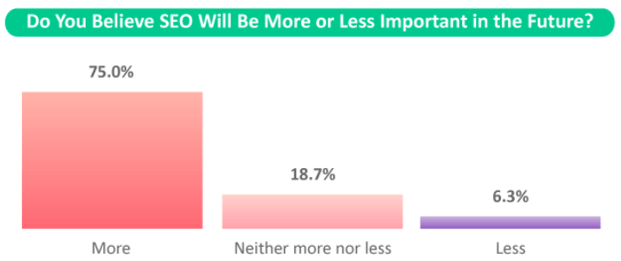
A significant 75% of respondents believe SEO will be more important in the future.

Future of search in 2020 practice

This isn’t surprising in and of itself, but some more granular detail is quite revealing about how changeable the industry is.

37% plan to stay in SEO for just one-to-three years and a sizeable 23% describe their jobs as precarious in light of Google’s algorithm changes.

Additionally, a massive 80% are concerned that algorithm changes will negatively impact their career. While respondents are broadly optimistic about the need for SEO, they are not universally confident that their own jobs in the sector are entirely permanent.

2. SEOs need to stay current

When it comes to reflecting on their outlook for the future, there is a wide range of strategies SEOs are planning to implement in order to keep abreast of industry changes.

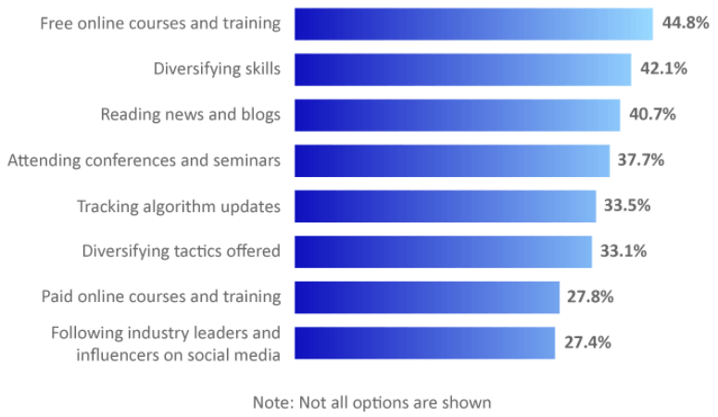
Stat showing SEOs being current for search in 2020

Free online courses and training were cited by 45% of respondents as the best method for SEOs to stay current while operating in this fast-paced and ever-changing industry.

42% plan to diversify their skills and 40.7% point to news/blogs as good ways to keep up-to-date.

38% say attending conferences and seminars will help them stay current and when asked if they will be attending any SEO conferences this year, 54% said they would be.

3. AI optimization is the key tactic for the future

Responses about the significance of specific SEO tactics within the next five years were a little more long-tail.

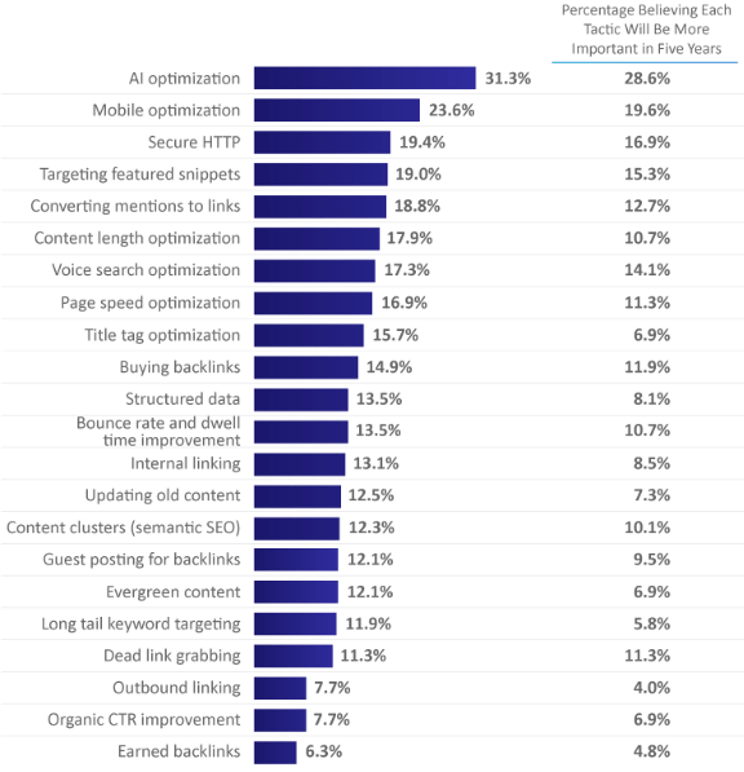
That said, 31% of respondents cite AI optimization as effective and worthwhile and 29% see this tactic as being important within the next five years.

AI optimization for search in 2020

Mobile remains a big potential growth area for SEOs. 20% see mobile optimization as gaining in importance over the next five years.

Voice search optimization and targeting featured snippets are also predicted to be increasingly important among SEOs in the future.

4. Most think quality content will be the biggest priority for Google

When SEOs are tasked with predicting areas that Google will increasingly take into consideration when ranking sites, content comes out on top.

Stat showing content as a priority for Google

46% of respondents said that the quality of content will be a priority for Google in the future. But, again, other factors were not far behind.

Social share, accessibility, and mobile-friendliness were all cited by more than 40% of those surveyed as being priority areas for the search giant.

5. SEO sentiment and ethics

The survey also highlights some interesting trends about general sentiment SEOs have towards working in the industry and questions of ethics.

69% of respondents reported job satisfaction, with “creative”, “engaging”, and “intelligent” being the top three descriptors cited for how they perceive the work they do.

Stat on SEO sentiment and ethics

The search industry can be frustrating, however. 44% cited short deadlines as a common frustration. Other process-orientated issues such as changing project scopes and, simply, frustrating clients were also cited as some of the more negative aspects working in SEO.

14% of SEOs also admitted to being frustrated by unethical competitors and, when asked directly, a significant 39% of respondents said that they themselves have used unethical – or black hat – SEO tactics.

Takeaways

While the digital marketing industry is broadly optimistic about the importance of SEO in the future, this research certainly highlights that the search community is more than wary of the need to be agile in an industry where key players such as Google can have as much impact on an individual’s job as emerging technologies and client/customer demands do too.

Factors like quality of content, mobile, and AI all appear to be top – or near top – of the list for SEOs when it comes to anticipating key areas of focus over the next few years. But there is actually great diversity in the ideas across the community as to which tactics will be the most important, and where Google will most likely place more weight when generating their rankings in the SERPs.

One key takeaway is that the SEO sector is as changeable as it ever was. It is still evolving. And still subject to disruption from new tech. But with 69% of those surveyed reporting that they are satisfied in their job, it is clearly a challenging and rewarding vertical to work in.

The post Report: Future of search in 2020 according to SEO specialists appeared first on Search Engine Watch.


from SEO – Search Engine Watch https://ift.tt/2S86jDY
via IFTTT

7 SEO Processes That Get Easier with Increased PageRank/Domain Authority - Whiteboard Friday

Posted by Cyrus-Shepard

A rising tide lifts all ships — and it's similar story with increased site authority. What factors are affected as you improve PageRank or Domain Authority, and how? In today's Whiteboard Friday, Cyrus details seven SEO processes that are made easier by a strong investment in link building and growing your authority.

Click on the whiteboard image above to open a high resolution version in a new tab!

Video Transcription

Howdy, Moz fans. Welcome to another edition of Whiteboard Friday. I'm Cyrus Shepard. Quick Whiteboard this week. I want to talk about links.

We know in SEO we love links. Everybody wants links. But why? What do links do for you? They do a surprising amount for you that we sometimes don't realize. So the title of today's Whiteboard, "7 SEO Processes That Get Easier with Increased PageRank and Domain Authority." So why did we choose PageRank and Domain Authority?

Well, these are both algorithms that measure link power, both the number of links and the quantity of links. PageRank being Google's algorithm to rank web pages based on popularity and importance. Domain Authority, which Google doesn't use, just to be clear, Domain Authority being a Moz algorithm that measures both link quantity and quality.

For our purposes, we can basically use them in the same conversation. We're talking about the power of your links. 

1. Ranking ability

The first thing that everybody knows about is links help you rank. They help you rank in many, many ways. You can get higher rankings. You can attack more keywords, but most importantly, you can attack more competitive keywords.

A good thing I like to do is, when I'm trying to see if I can rank for a keyword, simply Google it, check the Page Authority, which is a very similar metric, of all the top ranking pages, see what your Page Authority is for your top ranking keywords, and you can kind of have a pretty good idea if you have an ability to rank for that keyword. 

2. Crawl budget

But then we get into the nitty-gritty, the other benefits of having that link equity, one of the most important being crawl budget.

When you have more link equity, Google will crawl more of your pages. If you only have a handful of links and a million pages on your website, it's going to be very difficult to get Google to crawl and index all those million pages. If you're eBay or Amazon or Google or a site with like a 100 Domain Authority, yes, you might be able to attract Google to crawl those million pages.

3. Indexation speed

Google will also crawl them faster. You may get Google to crawl your pages with low Domain Authority, but it's going to take a while for Google to visit those again. So then we get into the idea of indexation speed. With a higher Domain Authority, Google is going to crawl and index your content typically much faster than they would without.

So if you have a page that you've updated recently, you're going to see Google update it quicker the more authority that page has. Also you're going to see this in the SERPs. If you have outdated title tags or meta descriptions, you can ask Google to crawl it via the Submit URL tool. But generally, the more authority a page has, the more incoming link power, you're going to see those things updated so much quicker than you would with low link equity.

4. More powerful links

This is my favorite one. With increased link equity, your own links become more powerful, and this gives you incredible ranking power because your internal links, that you're linking to yourself, become more powerful with that link equity. So it makes everything easier to rank. The best link building you can do when you have high authority is linking to yourself, and it's so easy.

But also the links that you link out to other people also become more valuable, which makes you a more attractive target. 

5. Insulation from bad links

My friend Everett Sizemore came up with that word "insulation." With better link equity, you're somewhat protected from a handful of bad links. Now if you have low link equity and you get a bunch of spam links to your site, your risk of penalization or being impacted by negative SEO increases pretty high.

But if you have a million links, a handful of bad links just aren't going to hurt you. A good way to think about this is ratios, because, of course, anybody can get penalized. Anybody can suffer the consequences of bad links. But if those bad links only make up a tiny portion, meaning a small ratio, then you are somewhat insulated by the impact of those bad links.

6. Less over-optimization

Now Google says they don't have an over-optimization penalty. But anecdotally, many SEOs understand that if you're a small site, you're just starting out, it's very easy to over-optimize for keywords with exact match anchor text and not rank. The key usually: in SEO, you want a lot of variety.

With a lot of links, that variety is much easier to get, and you have much less risk of over-optimization in linking internally with exact match anchor text. You can get away with a lot more with higher Domain Authority than you can with less Domain Authority. That's kind of the key to this whole thing. With higher Domain Authority, you just get away with a lot more. It's the idea of the rich getting richer. 

7. The flywheel effect

Rand Fishkin, our friend, likes to talk about the flywheel effect. When you have more links, everything gets easier. When you start ranking and people start seeing you in the SERPs, you're going to get more links from that content, and more links are going to equal more ranking and the wheel is just going to keep turning and turning.

More people want to link to you and amplify you and work with you. You're also going to get a lot more spam requests and link requests and things like that, so it isn't fun. But generally, the more Domain Authority you have, the more PageRank you have, the easier life is going to get, and you just want to start building it up day after day after day. So, like I said, a quick and easy Whiteboard Friday this week.

Hope you enjoyed it. We'll talk to you next time. Thanks, everybody.

Video transcription by Speechpad.com


Sign up for The Moz Top 10, a semimonthly mailer updating you on the top ten hottest pieces of SEO news, tips, and rad links uncovered by the Moz team. Think of it as your exclusive digest of stuff you don't have time to hunt down but want to read!


from The Moz Blog https://ift.tt/37bZgyA
via IFTTT

Wednesday, 5 February 2020

Position Zero Is Dead; Long Live Position Zero

Posted by Dr-Pete

In 2014, Google introduced the featured snippet, a promoted organic ranking that we affectionately (some days were more affectionate than others) referred to as "position zero" or "ranking #0." One of the benefits to being in position zero was that you got to double-dip, with your organic listing appearing in both the featured snippet and page-1 results (usually in the top 3–4). On January 23, Google announced a significant change (which rolled out globally on January 22) ...

"Declutters" sounds innocuous, but the impact to how we think about featured snippets and organic rankings is significant. So, let's dig deep into some examples and the implications for SEO.

What does this mean for Moz?

First, a product announcement. In the past, we treated Featured Snippets as stand-alone SERP features — they were identified in our "SERP Features" report but were not treated as organic due to the second listing. As of Saturday, January 25 (shout-out to many of our team for putting in a long weekend), we began rolling out data that treats the featured snippet as position #1. SERPs with featured snippets will continue to be tagged in SERP Features reporting, and we're working on ways to surface more data.

Here's a partial screenshot of our "SERP Features" report from one of my own experiments ...

At a glance, you can see which keywords displayed a featured snippet (the scissor icon), owned that featured snippet (highlighted in blue), as well as your organic ranking for those keywords. We're working on bringing more of this data into the Rankings report in the near future.

If you're a Moz Pro customer and would like to see this in action, you can jump directly to your SERP Features report using the button below (please let us know what you think about the update):

This change brings our data in line with Google's view that a featured snippet is a promoted organic result and also better aligns us with Google Search Console data. Hopefully, it also helps provide customers with more context about their featured snippets as organic entities.

How does Google count to 10?

Let's take a deeper look at the before and after of this change. Here are the desktop organic results (left-column only) from a search for "LCD vs LED" on January 21st ...

Pardon some big images, but I promise there's method to my madness. In the "before" screenshot above, we can clearly see that the featured snippet URL is duplicated as the #1 organic result (note: I've added the green box and removed a People Also Ask box). Ranking #1 wasn't always the case prior to January 22nd, but most featured snippet URLs appeared in the #1–#3 organic positions, and all of them came from page-one results.

Here's the same SERP from January 23rd ...

You can see that not only is the featured snippet URL missing from the #1 position, but it doesn't appear on page one at all. There's more to this puzzle, though. Look at the January 21st SERP again, but numbered ...

Notice that, even with the featured snippet, page one displays 10 full organic results. This was part of our rationale for treating the featured snippet as the #0 position and a special case, even though it came from organic results. We also debated whether duplicating data in rankings reports added value for customers or just created confusion.

Now, look at the numbered SERP from January 23rd ...

The duplicate URL hasn't been replaced — it's been removed entirely. So, we're only left with 10 total results, including the featured snippet itself. If we started with #0, we'd be left with a page-one SERP that goes from #0–#9.

What about double snippets?

In rare cases, Google may show two featured snippets in a row. If you haven't seen one of these in action, here's an example for the search "Irish names" from January 21st ...

I've highlighted the organic URLs to show that, prior to the update, both featured snippet URLs appeared on page one. A quick count will also show you that there are 10 traditional organic listings and 12 total listings (counting the two featured snippets).

Here's that same SERP from January 23rd, which I've numbered ...

In this case, both featured snippet URLs have been removed from the traditional organic listings, and we're left once again with 10 total page-one results. We see the same pattern with SERP features (such as Top Stories or Video carousels) that occupy an organic position. Whatever the combination in play, the featured snippet appears to count as one of the 10 results on page one after January 22nd.

What about right-hand side panels?

More recently, Google introduced a hybrid desktop result that looks like a Knowledge Panel but pulls information from organic results, like a Featured Snippet. Here's an example from January 21st (just the panel) ...

In the left-hand column, the same Wordstream URL ranked #3 in organic results (I've truncated the image below to save your scrolling finger) ...

After January 22nd, this URL was also treated as a duplicate, which was met with considerable public outcry. Unlike the prominent Featured Snippet placement, many people felt (including myself) that the panel-style UI was confusing and very likely to reduce click-through rate (CTR). In a fairly rare occurrence, Google backtracked on this decision ...

Our data set showed reversal kicking in on January 29th (a week after the initial change). Currently, while some featured snippets are still displayed in right-hand panels (about 30% of all featured snippets across MozCast's 10,000 keywords), those URLs once again appear in the organic listings.

Note that Google has said this is a multi-part project, and they're likely going to be moving these featured snippets back to the left-hand column in the near future. We don't currently know if that means they'll become traditional featured snippets or if they'll evolve into a new entity.

How do I block featured snippets?

Cool your jets, Starscream. Almost the moment Google announced this change, SEOs started talking about how to block featured snippets, including some folks asking publicly about de-optimizing content. "De-optimizing" sounds harmless, but it's really a euphemism for making your own content worse so that it ranks lower. In other words, you're going to take a CTR hit (the organic CTR curve drops off quickly as a power function) to avoid possibly taking a CTR hit. As Ford Prefect wisely said: "There's no point in driving yourself mad trying to stop yourself going mad. You might just as well give in and save your sanity for later."

More importantly, there are better options. The oldest currently available option is the meta-nosnippet directive. I'd generally consider this a last resort — as a recent experiment by Claire Carlile re-affirms, meta-nosnippet blocks all snippets/descriptions, including your organic snippet.

As of 2019, we have two more options to work with. The meta-max-snippet directive limits the character-length of search snippets (both featured snippets and organic snippets). It looks something like this ...

<meta name="robots" content="max-snippet:50">

Setting the max-snippet value to zero should function essentially the same as a nosnippet directive. However, by playing with intermediate values, you might be able to maintain your organic snippet while controlling or removing the featured snippet.

Another relatively new option is the data-nosnippet HTML attribute. This is a tag attribute that you can wrap around content you wish to block from snippets. It looks something like this ...

<span data-nosnippet>I will take this content to the grave!</span>

Ok, that was probably melodramatic, but the data-nosnippet attribute can be wrapped around specific content that you'd like to keep out of snippets (again, this impacts all snippets). This could be very useful if you've got information appearing from the wrong part of a page or even a snippet that just doesn't answer the question very well. Of course, keep in mind that Google could simply select another part of your page for the featured snippet.

One thing to keep in mind: in some cases, Featured snippet content drives voice answers. Danny Sullivan at Google confirmed that, if you block your snippets using one of the methods above, you also block your eligibility for voice answers ...

A featured snippet isn't guaranteed to drive voice answers (there are a few more layers to the Google Assistant algorithms), but if you're interested in ranking for voice, then you may want to proceed with caution. Also keep in mind that there's no position #2 in voice search.

How much should I freak out?

We expect these changes are here to stay, at least for a while, but we know very little about the impact of featured snippets on CTR after January 22nd. In early 2018, Moz did a major, internal CTR study and found the impact of featured snippets almost impossible to interpret, because the available data (whether click-stream or Google Search Console) provided no way to tell if clicks were going to the featured snippet or the duplicated organic URL.

My hunch, informed by that project, is that there are two realities. In one case, featured snippets definitively answer a question and negatively impact CTR. If a concise, self-contained answer is possible, expect some people not to click on the URL. You've given them what they need.

In the other case, though, a featured snippet acts as an incomplete teaser, naturally encouraging clicks (if the information is worthwhile). Consider this featured snippet for "science fair ideas" ...

The "More items..." indicator clearly suggests that this is just part of a much longer list, and I can tell you from my as a parent that I wouldn't stop at the featured snippet. Lists and instructional content are especially well-suited to this kind of teaser experience, as are questions that can't be answered easily in a paragraph.

All of this is to say that I wouldn't take a hatchet to your featured snippets. Answering the questions your visitors ask is a good thing, generally, and drives search visibility. As we learn more about the impact on CTR, it makes sense to be more strategic, but featured snippets are organic opportunities that are here to stay.


Sign up for The Moz Top 10, a semimonthly mailer updating you on the top ten hottest pieces of SEO news, tips, and rad links uncovered by the Moz team. Think of it as your exclusive digest of stuff you don't have time to hunt down but want to read!


from The Moz Blog https://ift.tt/31sLZAr
via IFTTT

Tuesday, 4 February 2020

Pay Attention to These SEO Trends in 2020 and Beyond

Posted by Suganthan-Mohanadasan

Without a doubt, it is our job as SEOs to keep an eye on the future and anticipate what Google is planning, testing, or looking to drop on our doorsteps. Over the past 12 months alone, we have seen several changes in Google Search — each impacting how we plan, implement, and report on campaigns.

In this article, I will take a look at what is in store for SEO in 2020 and how these factors will change the way we formulate strategies throughout the next year and beyond.

Artificial intelligence will continue to evolve

Over the past half-decade, artificial intelligence has become a pioneering force in the evolution of SEO.

In 2015, for example, we were introduced to RankBrain -- the machine-based search algorithm that helps Google push more relevant results to users. Although RankBrain is coming up on its fifth birthday, we are only now catching early glimpses into how artificial intelligence will dominate SEO in the coming years.

The most recent step in this progression of artificial learning is, of course, the introduction of Bidirectional Transformers for Language Understanding (BERT), which Google announced at the end of October. For those who missed it, BERT is Google’s neural network-based technique for natural language processing, and it’s important because it deals with the very fundamentals of how people search. Google itself says that the algorithm represents “the biggest leap forward in the past five years, and one of the biggest leaps forward in the history of Search.”

Affecting one in ten searches, BERT gives Google a better understanding of how language is used and helps it comprehend the context of individual words within searches. The important thing to know about BERT (and also RankBrain), is the fact that you cannot optimize for it.

But what does this mean for SEOs?

BERT is just one signal of how Google understands language, but it is one of the most important in the search engine’s arsenal. This means that now more than ever, webmasters and SEOs alike must focus their efforts on creating the most useful, natural, and highest-quality content. Quite simply, as Danny Sullivan says, “write content for users.”

It’s also worth understanding how BERT interprets questions, which you can find out more about in the Whiteboard Friday episode below.

Voice search is here to stay

It’s hard to imagine at the dawn of 2020, but when voice search was released in 2012 many assumed it would be just another project consigned to the ever-growing Google graveyard.

Today, however, we know so much more about the technology and, thanks to schema.org, where it is likely to go in the future. The adoption rate is slower than predicted, but it has nevertheless leaked into our lives, so we must not completely ignore voice search.

Schema markup

A new form of markup is released nearly every month, with one of the latest developments being markup for movies. Although this might seem insignificant, the fact that we are now seeing markup for films shows just how granular and far-reaching structured data has come.

With smart speakers now numbering 120 million in the US alone, webmasters should be taking the time to investigate where schema can be placed on their website so they can take advantage of the 35.6 million voice search demands taking place every month. What’s more, website markup has a monumental influence on featured snippets, which can be highly lucrative for any website. Take a look at this Moz guide for more information on how voice search influences featured snippets.

Speakable

If you’re in the US, it’s also worth noting that Speakable (BETA) is used by Google Assistant to answer people’s questions about specific topics. The assistant can return up to three relevant articles and provide audio playback using text-to-speech markup. Implementing such a markup can be highly lucrative for news sites, because when the assistant provides an answer, it also attributes the source and sends the full article URL to the user's mobile device. If you’re a news site that publishes in English but doesn’t yet have Speakable markup implemented, you can read up on both the technical considerations and content requirements necessary for eligibility.

Google Actions

Actions on Google, a development platform for Google Assistant, is also worth your consideration. It allows the third-party development of "actions" — applets for Google Assistant that provide extended functionality. Actions can be used to get things done by integrating your content and services with the Google Assistant.

Actions allow you to do a number of things:

  • Build Actions to ensure Google Assistant uses your apps
  • Allow users to search for and engage with your app
  • Provide your app as a recommendation for user queries

Check out this fantastic article by Andrea Vopini about how to optimize your content using Google assistant.

Google is heavily invested in using entities

Entities aren’t something that you hear SEOs talking about every day, but they are something Google is putting a lot of resources into. Put simply, Google itself states that entities are “a thing or concept that is singular, unique, well-defined, and distinguishable.”

Entities don’t have to be something physical, but can be something as vague as an idea or a color. As long as it is either singular, unique, distinguishable, or well-defined, it is an entity.

As you can see, Moz shows up in the knowledge panel because the company is an entity. If you search the Google Knowledge Graph API for the company name, you can see how Google understands them:

But what does this mean for SEOs?

In 2015, Google submitted a patent named “Ranking Search Results Based On Entity Metrics,” which is where the above entity description is sourced from. Although few patents are worth getting excited about, this one caused a stir in the technical SEO scene because it takes machine learning to an entirely new level and allows Google to accurately calculate the probability of user intent, thus giving it an understanding of both user language and tone. What’s more, entities place a reduced reliance on links as a ranking factor, and depending on what your SEO strategy is, that could result in the need for big campaign changes.

The most important aspect you will need to consider is how Google understands the entities on your website.

For example, if your site sells shoes, you need to think about how many different types, colors, sizes, brands, and concepts exist for your shoes. Each shoe will represent a different entity, which means you must consider how to frame each product so that it meets the expectations of users as well as the learning capabilities of Google — which is where we meet markup once again.

Sites themselves can also become entities, and that provides huge rewards as they appear in the Knowledge Panel, which I will discuss next.

The knowledge panel will be important for personalities and brands

Although Google’s Knowledge Graph was launched way back in 2012, its expansion since then means it is still a core part of the search matrix and one that will reach far into the next decade.

Closely tied with featured snippets and rich results, earlier last year Google began allowing entities to claim their own knowledge panel, giving them access to edit and control the information presented to users in search results. They can make specific requests, such as changing the featured image, panel title, and social profiles provided within the panel.

The benefits of claiming your knowledge panel are numerous. They help users gain quick access to your site, which thanks to the Knowledge Graph, displays trust and authority signals. Knowledge panels also provide brands and personalities with the ability to control what objective information is shown to users. However, there are still many brands that have yet to claim their own panels.

You can claim your business’s knowledge panel in a few easy steps:

  1. Ensure that your website is verified with Search Console.
  2. Update your panel by suggesting a change to Google.

But what does this mean for SEOs?

As you can see from the above examples, being in the Knowledge Graph can improve trust and add authenticity to your business or personal brand, as well as providing additional visibility. But it's easier said than done. 

Unless you're a recognized, famous person or brand, claiming space in the Knowledge Graph is going to be difficult. Having a Wikipedia page can be enough, but I don't recommend creating pages just to get there — it will get deleted and waste your effort. Instead, build brand mentions and authority around your name gradually. While having a wikidata page can be helpful, it’s not guaranteed. The goal is to get Google to recognize you as a notable person or brand.

Queryless proactive predictive search is getting better

Google Discover was released in June of 2017, prompting a new kind of search altogether — one that is queryless. Discover is an AI-driven content recommendation tool and claims 80 million active users.

Using the aforementioned Knowledge Graph, Google added an extra layer called the Topic Layer, which is engineered to understand how a user’s interest develops over time (this article by the University of Maryland offers an in-depth explanation of topic layers and models).

By understanding the many topics a user is interested in, Discover identifies the most accurate content to deliver from an array of websites.

But what does this mean for SEOs?

To appear in Discover, Google states that pages appear “if they are indexed by Google and meet Google News content policies. No special tags or structured data are required.” It ranks content based on an algorithm that inspects the quality of content alongside the interests of the user and the topic of the page in question. The exact formula is unknown, however, based on several studies and experiments we now have a pretty good idea of how it works.

This screenshot from a presentation by Kenichi Suzuki highlights some of the factors that help pages appear in Discover.

According to Google, there are two ways to boost the performance of your content within Discover:

  1. Post interesting content
  2. Use high-quality images

As ever, ensure that you generate high quality content that is unique and creates a great experience for users. If your site tends to publish clickbait articles, the chance of those articles appearing in Discover is low.

Other tips for appearing in Discover would be to arrange your content semantically so that Google finds it easier to understand your work, and ensure that your website is technically proficient.

Like any form of search, you can use Google Search Console to see how well your articles are performing in Discover. You can find Discover stats under the performance section.

Google Discover analytics data is fairly new, and therefore limited. There isn't currently a native way to segment this traffic inside Google Analytics. To track user behavior data, this article provides a technique to track it inside Google Analytics.

We have yet to see the biggest changes in visual image Search

It could be argued that the biggest change to image search happened in September 2018 when Google Lens rolled out. Not only did featured videos begin appearing in image search, but AMP stories and new ranking algorithms and tags were also released.

But while speaking at a Webmaster Meetup in New York last year, John Mueller shared that there will be major changes in image search in the coming year. Rather than merely viewing images, very soon people will use itto accomplish goals, purchase products, and learn new information.

Google has always said that images should be properly optimized and marked, so if you have not started to add such data or information to your images, now is definitely the time to start.

In the past six months alone we have seen Google introduce small changes such as removing the “view image” function, as well as colossal changes, such as totally revamping image search for Desktop.

Furthermore, people don’t even have to search within it to see images anymore. It's common for the SERP to present a universal search result, which encompasses images, videos, maps, news, and shopping listings. The opportunity to appear in a universal (or blended) result is just another reason why properly tagged and marked images are so important.

Finally, Google has added visual image search attributes to search results. The interesting thing with this update is that these attributes are now available as image carousels within the main search results.

But what does this mean for SEOs?

With so much to play with, webmasters and SEOs should consider how they can take advantage of such changes, which could prove potentially very lucrative for the right sites — especially when you consider that 35% of Google product searches return transactions in as little as five days.

E-A-T doesn’t apply to every site — but it still matters

E-A-T (Expertise, Authoritativeness, Trustworthiness) is something every SEO should know back to front, but remember:

  • E-A-T isn’t a ranking factor
  • E-A-T is critical for Your Money or Your Life (YMYL) topics and pages

Although these two statements might seem contradictory, they make more sense when you consider what Google defines as YMYL.

According to Google’s Rater Guidelines, YMYL is a page or topic that “could potentially impact a person’s future happiness, health, financial stability, or safety.” This means that if your page has information that could potentially change a person’s life, it is considered YMYL and offering E-A-T is important. If your site is merely your personal collection of cat pictures, then showcasing authority or expertise is less critical.

But what does this mean for SEOs?

The issue, however, is that the majority of websites (and certainly the ones invested in SEO) are generally going to have YMYL pages or topics, but Google is taking big steps to ensure that low quality or questionable YMYL content is weeded out. As you might know, you can’t optimize for E-A-T because it isn’t an algorithm, but you can implement changes to make sure your site sends the right kind of quality signals to Google. This Moz article by Ian Booth and this guide by Lily Ray offer great tips for how to do that.

Topics and semantics over keywords

Google is putting less priority on both links and keywords, which is where topic modeling and semantics come into the conversation.

Google has become very clever at understanding what a user is searching for based on just a few basic words. This is thanks, in part, to topic modeling (as Google itself admitted in September 2018 when it introduced its “topic layer”). Indeed, this algorithm has a deep understanding of semantics and yearns to provide users with deep troves of information.

But what does this mean for SEOs?

This means that it has never been more important to create high quality, in-depth, and meaningful content for users — but you also need to think about information structure.

For example, if your site sells running shoes, you could create long-form educational pieces about how to choose shoes for specific running environments, athletic diets for runners, or tech accessory reviews. These articles could then be clustered into various topics. By clustering your topics into compartments through your website architecture, both users and crawlers can easily navigate and understand the content provided.

Studies have also shown that Google’s crawlers prefer pages with semantic groupings and sites that are designed around topic modeling. This 2018 presentation by Dawn Anderson gives a brilliant insight into this. If you want to know more about topic modeling and semantic connectivity, check out this Whiteboard Friday by Rand Fishkin.

SERPs will continue to evolve

Over the past couple of years, we’ve seen search results evolve and transform like never before. In fact, they have changed so much that, in some cases, being placed first within the organic search results may not be the most lucrative position.

This is something that would have been unthinkable just a few short years ago (check out this Moz article from 2018) that works to quell the panic from zero position SERPs).

With the introduction of Voice Search, rich results, rich snippets, knowledge panels, Google My Business, and updated Image Search results, SEOs now need to consider a whole new range of technical marketing strategies to appear in a multitude of organic search results.

It’s hard to know where Google is taking SERPs in the next year, but it is fair to say the strategies we use today for the search environment will likely be outdated in as little as six months.

Take, for example, the recent addition and subsequent removal of favicons in the SERPs; after backlash, Google reversed the change, proving we can never predict which changes will stick and which are blips on the radar.

But what does this mean for SEOs?

Ensure that your strategies are flexible and constantly prepare for changes in both your business sector (if you do not work within SEO) and the constantly evolving search environment. Pay attention to the seasonality of searches and use tools such as Google Trends to cover any out-of-season deficit that you may encounter.

You can use tools like Moz Keyword Explorer to help plan ahead and to create campaigns and strategies that provide useful traffic and lucrative conversions.

Conclusion

SEOs need to move away from the ideology that links and traditional search results should be priorities for an organic campaign. Although both still carry weight, without investment in technical strategy or willingness to learn about entities or semantic connectivity, no SEO campaign can reach its full potential.

The world of SEO in 2020 is bright and exciting, but it will require more investment and intelligent strategy than ever before.


Sign up for The Moz Top 10, a semimonthly mailer updating you on the top ten hottest pieces of SEO news, tips, and rad links uncovered by the Moz team. Think of it as your exclusive digest of stuff you don't have time to hunt down but want to read!


from The Moz Blog https://ift.tt/2uiZyGj
via IFTTT

Social Media Today