Innovate not imitate!

Innovate not imitate!
Interested in the latest Growth hacks?

Welcome to our blog

Interested in the latest Growth hacks?

Welcome to our blog!

We want to help you start/manage and grow your business using innovative strategies and implementation. We have a passion for helping businesses and companies of various sizes see the same success that we have achieved.

Our skillsets are wide and varied, from business strategy, marketing, to online strategy. An increasing number of companies are turning to the internet and online media as a means to maximising their marketing reach and exposure. This is special area of focus for us and we do more than simple SEO strategies.

See our website for more: www.innovatetoaccelerate.com

Tuesday, 5 March 2019

Google RankBrain: Clearing up the myths and misconceptions

It’s been nearly 3½ years since Google first announced their usage of RankBrain (October 26th 2015, but it had started being rolled out early 2015, in multiple languages).

In that time, there’s been little in the way of details coming from G about what it is or how it works.

The result is that numerous SEOs have stepped up to fill that void with their own speculations and opinions, and in doing that, have caused all sorts of confusion.

This is my attempt to correct and clean up some of that mess.

(There is a TL:DR at the bottom if you want to skip the verbiage :D)

What does RankBrain do?

Though there isn’t much publicly available, what we do have is fairly specific:

If RankBrain sees a word or phrase it isn’t familiar with, the machine can make a guess as to what words or phrases might have a similar meaning and filter the result accordingly, making it more effective at handling never-before-seen search queries.

– Greg Corrado, from Bloomberg’s Google Turning Its Lucrative Web Search Over to AI Machines}

Or, if you want it more succinct than that;

“… Lemme try one last time: Rankbrain lets us understand queries better. …”

Gary Illyes (@methode), on Twitter

Google receives a fair percentage of queries per day that it hasn’t seen before: 15% at last check.

These may include misspellings and typos, elisions/omissions, unusual phrasing/syntactic structures, the wrong word(s) being used, negations (“not x”), things that have only just happened etc. etc. etc.

RB receives these weird, wonderful, and new searches, and attempts to identify existing searches and results that are probably suitable for the searcher’s query.

How does RankBrain work?

Again, we aren’t exactly given a guided tour by G on this, but there are a few bits and pieces.

“… RankBrain uses artificial intelligence to embed vast amounts of written language into mathematical entities — called vectors — that the computer can understand. If RankBrain sees a word or phrase it isn’t familiar with, the machine can make a guess as to what words or phrases might have a similar meaning and filter the result accordingly, making it more effective at handling never-before-seen search queries. …”

– Greg Corrado, from Bloomberg’s : Google Turning Its Lucrative Web Search Over to AI Machines

So, rather than looking at words and attempting to parse them and understand the semantics (traditional Natural Language Processing [NLP]), it converts them into numbers and plots them on a chart (with multiple dimensions, not just X and Y).

Items near each other possess some form of relationship. The type of relationship will be reflected by each term’s position and distance from its neighbors.

If that sounds vaguely familiar, that’s because it sounds very similar to Word2Vector.

So when G receives a query it doesn’t quite recognize, it can find semantically related pieces, and look at the results.

But, what if it’s wrong?

Well, that’s where Gary Illyes’s answer to a question on his recent Reddit AMA may come in:

“…

RankBrain is a PR-sexy machine learning ranking component that uses historical search data to predict what would a user most likely click on for a previously unseen query. It is a really cool piece of engineering that saved our butts countless times whenever traditional algos were like, e.g. “oh look a “not” in the query string! let’s ignore the hell out of it!”, but it’s generally just relying on (sometimes) months old data about what happened on the results page itself, not on the landing page. Dwell time, CTR, … those are generally made up crap. Search is much more simple than people think.

…”

– Gary Illyes (@methode), on Reddit

I’ve added the bold to draw your eye to the key part.

G may go back and look at what gets clicked for different searches, and check their performance. This can help the system learn what suggestions are suitable, and which ones are fails.

If you want something with a bit more meat, you may be wanting some patents?

If so, I was lucky enough to get some help from Bill Slawski, who pointed me to two potentially interesting patents:

The first patent (computing numeric…) was worked on by Greg Corrado, from the Bloomberg quote previously referenced.

If you don’t fancy suffering the trauma of reading the patents, Bill has two far nicer bits that get you the insights without the need for painkillers:

Example of what RankBrain may be doing

How about we walk through a simple demo of the type of thing that RB does?

Query: How Nemee 2020

Google receives that query, and has nothing that appears to be a match and little that seems above a weak relevance.

So, it needs to do some work.

  • It can identify the type of query by the use of “how”.
  • It can identify a time factor by “2020”.
  • Or it can identify several potentials for “nemee”, including “meme”.

The query is vectorized, and the nearest neighbors for those vectors are found.

Included in the results are vectors that represent:

  • “How to”
  • “how do I”
  • “how do people”
  • “create a meme”
  • “pronounce meme”
  • “say meme”

So we have two probable query types:

  1. A question of how to say …
  2. A question of how to make …

But we have a 3rd factor, the “2020”. When we look at the result groups, there are barely any pre-existing queries or results that include time with pronunciation, where are there are a moderate number of “how to” queries and results that do.

RB decides that the most likely results that match this query are those from the “how to make” queries, and so the results you would receive would match;

how to make a meme 2020”.

Does RankBrain use user experience signals?

No.

And that’s what this post is about clearing up all the baloney some people have been pushing about “Dwell Time” and “Click Through Rate” and “Bounces” etc.

RankBrain doesn’t use UX signals from your pages.

For quick confirmation;

“… Dwell time, CTR, … those are generally made up crap …”

That’s from Gary’s AMA response I quoted above.

But, you can use a little common sense yourself at this point.

Ask yourself the following question:

Why would a system that is built to try to encapsulate relationships between text-strings be looking at how long someone spent on a page, or how fast they left?

When you stop and look at it that way, and consider the example above, you can see how site based UX signals have no relevance for RankBrain.

The only such metric we know they may use are SERP-based clicks to identify what type of results appeared relevant to that type of query.

Can you optimize for RankBrain?

Yes.

Google has even told us that we can 😀

“…
Optimizing for RankBrain is actually super easy, and it is something we’ve probably been saying for fifteen years now, is – and the recommendation is – to write in natural language. Try to write content that sounds human. If you try to write like a machine then RankBrain will just get confused and probably just pushes you back. But if you have a content site, try to read out some of your articles or whatever you wrote, and ask people whether it sounds natural. If it sounds conversational, if it sounds like natural language that we would use in your day to day life, then sure, you are optimized for RankBrain. If it doesn’t, then you are “un-optimize
…”

– Gary Illyes (@methode), talking to TheSEMPost

I know — it’s a bit lame.

But, if you roll back a bit, G have actually spelled out how to optimize for RankBrain!

  • “… If RankBrain sees a word or phrase it isn’t familiar with …”
  • “… making it more effective at handling never-before-seen search queries …”
  • “… predict what would a user most likely click on for a previously unseen query …”

All you have to do is fly in the face of standard SEO practices, and aim for the exact opposite of what you would normally go for high search volume.

Instead, look at all the queries, and then generate variants that aren’t in the lists.

I know, that’s even lamer!

(But, be honest, you did want to know :D)

But there is more particularly for those that deal with time-relevant content; events and occurrences.

As these are “new”, the queries likely will be too (at least partially). To gain an advantage here, you might be able to look at similar searches yourself, and look at the patterns they possess. Once you have some samples and associated search volume data, you can pick and choose the ones you feel are most advantageous and relevant, and then weave them into your content.

If you want a little more insight into RB, and things like Association Rule Learning (delving deeper into the computing side of things), Dan Taylor has a previous article that may be of interest: Here’s how RankBrain does (and doesn’t) impact SEO

Does RankBrain influence rankings?

No — it’s a matter of inclusion.

Though Google has stated that RB is one of the most influential Ranking Factors, it’s not a typical SEO factor.

Unlike Titles or Link Text, it’s not a gradient or variable — it’s Boolean.

Either you are perceived as relevant, and included in the SERPs for a query — or you aren’t.

So you can optimize for RankBrain — but it isn’t a matter of ranking influence, it’s a matter of index inclusion.

TL;DR

What does RB do?

It attempts to answer unknown queries by looking at previous search data and the relationship of the terms used in those searches.

How does RB do that?

By converting words into numbers and plotting them into vector-space.  

It can then break a query into parts and look for similar terms in the vector space to try to understand the relationship and potential intent of the search.

Example:

Query : “how nemee 2020”

Convert query to vectors, find closest vectors, try to calculate probable matches.

Two distinct query types are surfaced; “create” and “say”.

“2020” associates more strongly with “create” than “say”.

RB will return SERPs for “how to make a meme 2020”.

Does RB use UX?

No.

It handles words and vectors.  

Things like Bounce Rate, Long Clicks etc. aren’t used.

Can you optimize for RB?

Yes.

By writing naturally and ensuring your content contains variations.

For some types of content (occurrences/events/news) you may be able to check similar searches and get ahead of the pack.

Does RankBrain influence rankings?

Not in the traditional SEO sense. It’s not about “position”, it’s about whether you show for that query or not.

The post Google RankBrain: Clearing up the myths and misconceptions appeared first on Search Engine Watch.


from SEO – Search Engine Watch https://ift.tt/2NHF5jT
via IFTTT

A Comprehensive Analysis of the New Domain Authority

Monday, 4 March 2019

March 1st Google Update: The Mysterious Case of the 19-Result SERPs

Eight shortcuts to find long tail keywords (and how to use them)

It’s tempting to go after broad, high-volume keywords with huge audiences (and equally huge competition). But there’s an equally large — albeit more distributed audience — to be reached by targeting lower-competition, long tail keywords.

Imagine comets flying through the SEO solar system, if the most popular keywords make up the head of the comets (‘running shoes’, for example), each comet is trailed by a tail of more specific keywords like ‘long distance trail running shoes 2018’ and ‘best running shoes for flat feet’, that are useful in niche marketing.

Strategically pursuing the right long tail keywords as part of your SEO strategy can deliver several advantages.

As they have lower search volumes, they are usually much less competitive, making it easier for your brand to rank highly in search engine results.

Also, the specificity of long tail keywords generally indicates that those web searchers are nearer to the action part of their customers’ journeys. As a result, these keywords tend to have higher conversion rates.

Therefore, long tail keywords offer the opportunity to be discovered by your target audience when they are near their crucial decision points.

If you deeply understand and satisfy their specific search intent by providing compelling information or offers, even large competitors might not stand in your way.

But knowing that you need a long tail SEO strategy is only half the battle won, you need to find those keywords which are not always obvious.

Here are eight simple techniques that will help you target and find long tail keywords that align with your business’ goals:

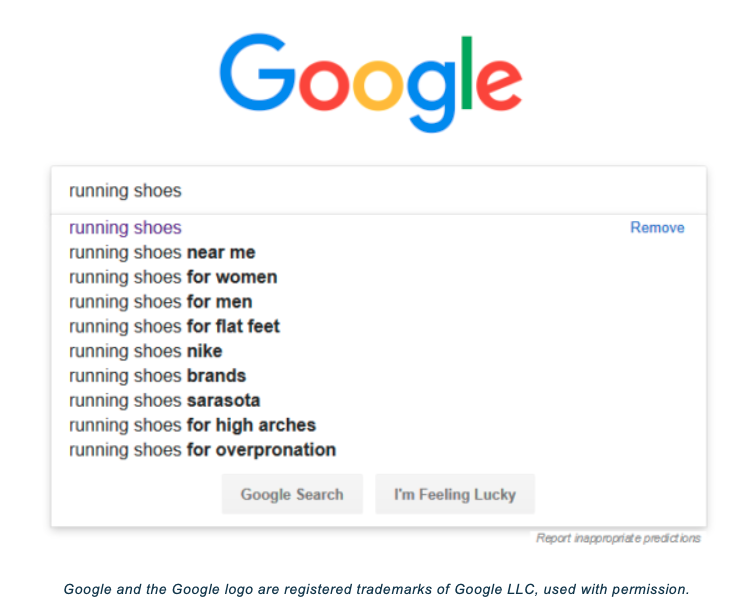
1. Let Google autofill suggest long tail keywords for you

This is as simple as it seems, type a broad search term into the Google search bar and you’ll see a list of long tail keywords tuned to fit popular searches by users.

Google autofill example

For further suggestions, you can then enter these phrases (or variations that they inspire) and view more long tail keywords to target with your SEO campaigns. For example, inputting ‘running shoes for women’ will generate a fresh list of Google auto-filled suggestions based around that (longer) keyword that get even longer tail still.

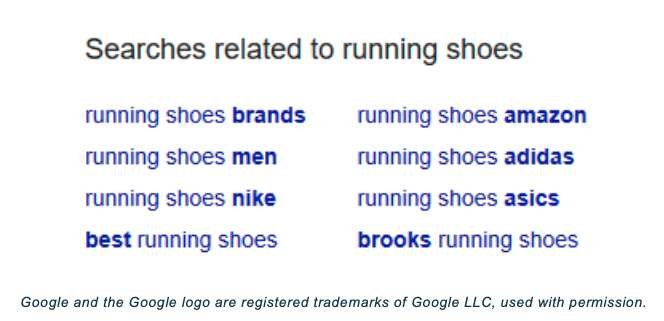
2. Leverage Google’s related searches

Similar to autofill, another completely free technique that leverages Google’s search engine is to look at Google’s related searches. Simply type any keyword and scroll to the bottom of the search results page to view useful long tail keyword suggestions.

Google's related searches example

3. Take suggestions from Ubersuggest

Ubersuggest is a tool you can use to find long tail keywords. Simply enter a term to receive a list of top suggestions.

Ubersuggest example

4. Generate suggestions with the LSIGraph keyword generator

While the LSIGraph keyword generator helps you discover latent semantic indexing (LSI) keywords for semantic SEO, most LSI keywords can double as long tail keywords once you know how to recognize them.

LSIGraph keyword generator example

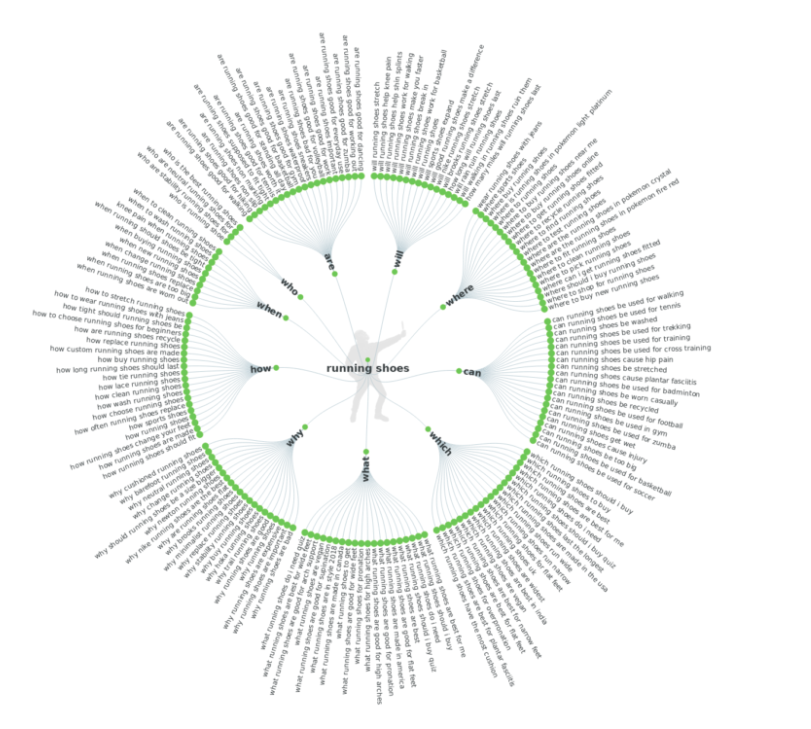
5. Find long tail keywords in question forms with Answer The Public

Answer The Public aggregates results from Google and Bing to provide the most commonly searched questions related to a given term, and in a rather compelling visual format. Because valuable long tail keywords often happen to be in the form of a question, your SEO can benefit by utilizing these targets and providing content that directly answers questions pertaining to your brand.

Answer the public example

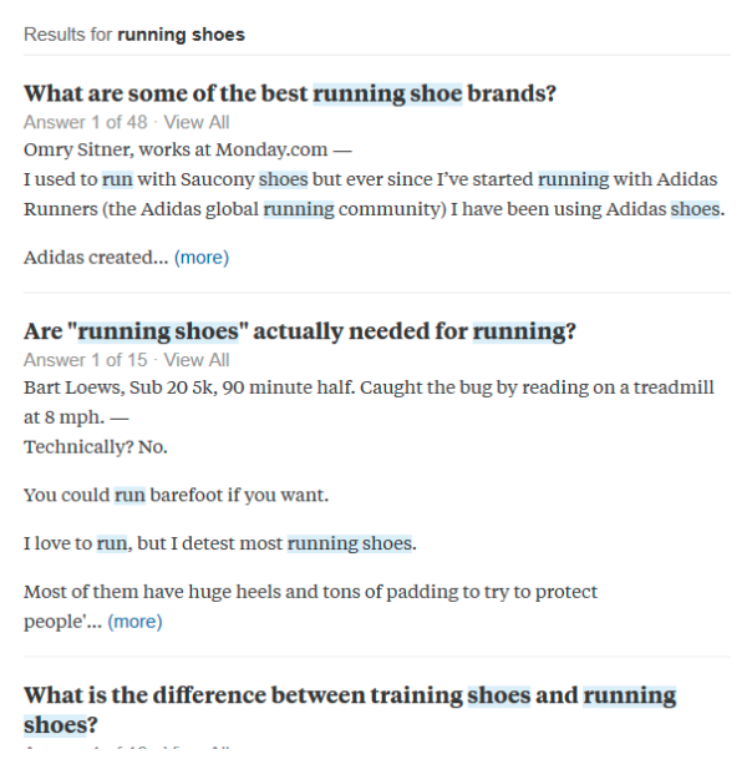
6. Search for relevant users’ questions on Quora

Another way to source long tail keywords in question formats is to take a look at what people are asking on Quora. For example, searching for the topic ‘running shoes’ will show questions that might be smart to target as long tail keywords (and answer with your content).

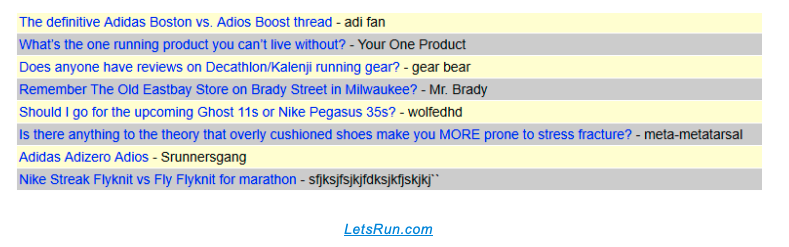
Quora example

7. Check out user discussions in online forums

Forums can also prove informative by offering yet another window into the questions and interests that potential customers are focused on. You can leverage these more specific topics as long tail keywords, and choose those that spark the most active conversations. To locate forums that cover a particular topic, search for [your broad search term] + forum’.

Online forums example

8. Use a Keyword Difficulty Tool

Inputting a targeted generic term into a Keyword Difficulty tool can yield numerous related-keyword opportunities, many of which will be long tail options.

Tools tracking keyword difficulty usually also provide useful metrics to help you decide which long tail keywords make the most sense to target.

These include relevance to the original keyword, the popularity of the search term, the level of competition you’ll need to overcome in order to rank for your new long tail terms, and whether that keyword competition is within your site’s competitive power.

Keyword Difficulty tool example

How to turn long tail keywords into SEO success?

Once you have a solid list of long tail keywords that are appropriate candidates to consider centering (or expanding) your SEO efforts around, you’ll need to vet them with research to ensure they possess the potential to deliver value. Ultimately, they must meet the two criteria that you need to keep top of mind:

  • Competition on the keywords must be low enough that you have a good chance to compete and succeed.
  • They must be popular and searched for frequently enough to be worth your time.

Once you’re sure the long tail keywords you’ve selected are the right ones, follow SEO best practices to include the targeted terms in your content, and help maximize the likelihood for each page to rank in search engine results for the respective terms.

SEO best practices include using the long tail keyword across the following page locations:

  • The post title and meta title
  • The page’s SEO meta description
  • The first paragraph of the content
  • Naturally throughout the content (Aim for a keyword density of around two percent)
  • In at least one subheading
  • Near the end of the content
  • As an image alt tag for one image on the page

It’s also a best practice to use three or four LSI keywords related to the long tail keyword within your content and to create links on other pages within your site that point to each new content page.

With generic search terms ever-more-competitive and less apt for driving targeted traffic, it’s wise to pursue a diversified strategy that also utilizes long tail keywords, offering focused content to reach an audience that knows more about what it wants and is ready to be converted into customers.

Kim Kosaka is the Director of Marketing at Alexa.com. 

The post Eight shortcuts to find long tail keywords (and how to use them) appeared first on Search Engine Watch.


from SEO – Search Engine Watch https://ift.tt/2TeykvN
via IFTTT

Friday, 1 March 2019

Rewriting the Beginner's Guide to SEO, Chapter 7: Measuring, Prioritizing, & Executing SEO

Link building with PR: Relevant links at scale

It is no secret that Google and other search engines like quality links and consider them as one of the top ranking factors. Search engines are getting smarter and better at identifying unnatural link building. Updated algorithms can assess the brand’s strength and content’s usefulness at a glance.

This results in higher requirements for the quality of links and content you use for your SEO. Fortunately, there is a way to create engaging content and build quality links from authority sites simultaneously. The solution is to align SEO efforts with PR. Public Relations puts a business in the spotlight, creating brand awareness and reputation through press coverage. Mentions about the company boost the quality of SEO as well.

I came up with this strategy based on a video Rand Fishkin had created on ‘The Marketing Flywheel.’  It’s an old Whiteboard Friday that still resonates today.

Rand’s video explains strategies that can impact and scale your link building. I had to find a solution as many of us are in our assigned positions, we are a team of one. So I had to make friends, and fast!

In this article, we will take a look at how scaling PR is one of the best link building strategies that can scale your efforts and brand your business fast.

What is an online PR strategy?

A highly cost-effective marketing technique, online PR is a way to spread a word about your brand on the web. A good PR strategy is really important in this modern age. It does not just help you start influencing people but also gains trust and reputation quickly.

I started reading books from Ryan Holiday, a successful marketer and American Eagle executive that has pulled a lot of crazy stunts to scale earned media.

He does not focus on SEO as he is more on branding and growth hacking, but his strategies are unconventional and allow you to think out of the box.

Connecting with quality influencers and journalists

You already do it with guest posting, why not do this by finding journalists and other influencers with blogs?

The payoff for building these relationships is organic backlinks. Connecting with high authority journalists and influencers in the industry or general media can work wonders for your SEO.

The key is to come up with something that can attract their attention, we used a scholarship mixed with a need and based on current priorities that the manufacturing industry had, this is how we recently landed a sweet article on IndustryWeek.

It is important to understand that there is no one-size-fits-all solution to using an online PR strategy for link building. You should develop a PR scaling plan that suits your company needs.

Here are some useful tips to do link building with PR for your business

1. Media relations

Public relations is different from guest blogging and is about developing healthy relations resulting in high-quality opportunities for the placement of content. Building relations with journalists, bloggers, publishers, and influencers is important.

Focus on quality rather than quantity and take time to build these relations. Begin by targeting a few people and nurture a relationship with them. Do some research and find writers, journalists, and influencers in your niche and start engaging with them. Know them and listen to what they say before asking them for links.

Like and comment on what they post on social media. Send some useful information to them, even if it is not about you. This will create a positive impression about you in their minds. This way, they will be ready to work with you when the time comes.

2. Priority of online reputation management (ORM)

Your online business reputation has to be on point. One suggestion to create fast, positive feedback is to email potential influencers in your industry with some free products and ask for feedback. Seven out of ten times, they will write about you on their blog or create a video endorsing your product. Bloggers love free stuff and this is a quick way to gain positive feedback and reviews on your brand and products.

Don’t make your own products? That’s okay! Gift cards work as well with a focus on asking for feedback on your user experience or app. It works both ways.

3. Use of press releases

Press releases have evolved over the years and a good press release which catches the attention of journalists gives a great opportunity for social media coverage and organic links.

Consider our example in introducing a scholarship program to bridge the skills gap in the manufacturing industry. This initiative helped us get some great PR and we built trust and reputation within the industry in a matter of a few months.

4. .EDU links help

It also helped us fuel our acquisition of .EDU Links. We targeted media and industry sites first and then with the trust in place, we contacted schools and universities offering manufacturing courses.

We pitched our scholarships and included these articles with links of the stories about the scholarship. The result we got from these efforts were awesome. In less than four months, we went from DA 17 to DA 30 and still growing with over 15 .EDUs and 1200 backlinks which we acquired in just a few weeks.

Rather than distributing the press release through syndicated websites with no-follow links, consider distributing it on social media and use some keywords that help influencers and journalists find it easily. You can make it appealing by sending it to influencers before releasing it.

5. Timely content

Try to tie your content to a current event to make it appealing to high-quality sites. Most SEO pros write a story around something timely and pitch it before their competitors do. This is also referred to as newsjacking, it works with the right pitch and data but may backfire if you get too controversial.

Doing this right requires that you stay updated on the local and national news and events, and always be ready to give the expert opinion. Such commentary comes with a mention and possibly a link. You can set up Google Alerts for topics and people in your niche to know whenever a big story is up.

6. Use of social media

Social media is one of the most powerful tools for public relations. Social media platforms such as Instagram and Facebook make it easy for brands to get introduced to influencers and build relations. By using social media to boost your SEO, you get more people to read your content. Always ensure you are visible where you should be and you don’t miss out on anything. Don’t share your content on social media just to get clicks.

Encourage the audience to share your content, comment on it, mention to their contacts and use other ways to spread it across the internet. This is how social media can help you generate new, organic links.

7. Buy your PR team some doughnuts

PR has a valuable place in SEO and vice versa. When the two industries work together, the results are amazing. As you can see here, there are numerous benefits of scaling PR with link building.

Links do matter but where you get them from is more important. Building relations and connections are imperative to success. With the bar of link quality going up at a constant rate, make sure you use PR strategies in your SEO campaigns to generate organic links from high-authority sites.

How would you use PR to boost your link building? Let us know in the comments section below.

Jonathan Alonso is Director of Digital Marketing at CNCMachines.Net. He can be found on Twitter at @jongeek.

The post Link building with PR: Relevant links at scale appeared first on Search Engine Watch.


from SEO – Search Engine Watch https://ift.tt/2IL2QbY
via IFTTT

7 Red Flags to Watch Out For When Auditing Your Link Profile - Whiteboard Friday

Social Media Today