Innovate not imitate!

Innovate not imitate!
Interested in the latest Growth hacks?

Welcome to our blog

Interested in the latest Growth hacks?

Welcome to our blog!

We want to help you start/manage and grow your business using innovative strategies and implementation. We have a passion for helping businesses and companies of various sizes see the same success that we have achieved.

Our skillsets are wide and varied, from business strategy, marketing, to online strategy. An increasing number of companies are turning to the internet and online media as a means to maximising their marketing reach and exposure. This is special area of focus for us and we do more than simple SEO strategies.

See our website for more: www.innovatetoaccelerate.com

Wednesday, 6 July 2016

Nine considerations for movie-based SEO outreach campaigns

Alien invasions have had their costs calculated by finance companies. Fashion boutiques care about superhero costumes. Travel firms researched where films were made, and retailers know which gadgets spies use…

As a blogger I receive infographics throughout the week which contain great movie related content. Only the best of them will be published and only the clever will earn a link.

Movie based outreach ideas, designed to boost SEO with some earned links, seem like a good idea but there are plenty of issues to get your head around.

Since being forewarned is forearmed; let’s take a look at some.

Ahoy! Thar be lawyers!

Compare the Market Batman V Supes

Most movies have no objections to free publicity but some SEO campaigns can cross the line.

Usually, if brands or agencies are making anything physical – anything with demonstrable value – of trademarked and protected intellectual property then there is a risk.

It is safer to stay digital although, better still, is to talk around the movie rather than directly about it, and anything you can do to avoid yet another infographic will be worthwhile.

For example, UK finance site Compare the Market teamed up with DC Entertainment to produce an actual superhero meerkat comic book. If any similar brand had attempted to print and publish their own unofficial Batman V Superman spin-off then it is likely legal teams would have been involved.

There is an upside, if the brand does land in hot water on the back of an unofficial movie tie-in and if their skin is thick enough you can turn that drama into a linkbait campaign.

If you are working with a brand large enough to work officially with a movie it is often worth asking in quarterly reviews whether there are any partnerships coming up. This is exactly the sort of opportunity that can be missed because no one thought to tell the agencies.

Find the signal in the noise

Pulsar reach

Data is important but it is no substitute for skill. You’ll find this distinction plays an important part in movie outreach.

Movies create a lot of buzz and can involve people with significance reach. This means you have to filter through a lot of noise. Is a movie popular with bloggers just because there is media attention?

Movie mentions may come from celebs or vloggers with no interest in the movie other than to interest their audience. You might even find actors who have appeared in the movie but have little chance of engaging in with your brand.

In either scenario, if you decide to approach these influencers you will want to do so individually and with cooperation with PR, sponsorship and branding teams in mind.

A better approach than qualifying with just one or two mentions to consider the true “Vocality” of the potential influencer – know how often are they talking about the movie or subjects related to it. The more often, the better. Also consider “Visibility” as a hybrid of reach and engagement. Both are important.

The danger with the single mention route is that an apparently large list of outreach targets is more likely to waste your time, mismanage expectations or get your content on low quality sites than help you connect with the type of blogger or influencer who will help ignite interest around your content.

On the flipside, working with just one fan community can supercharge your campaign.

Understand image sharing
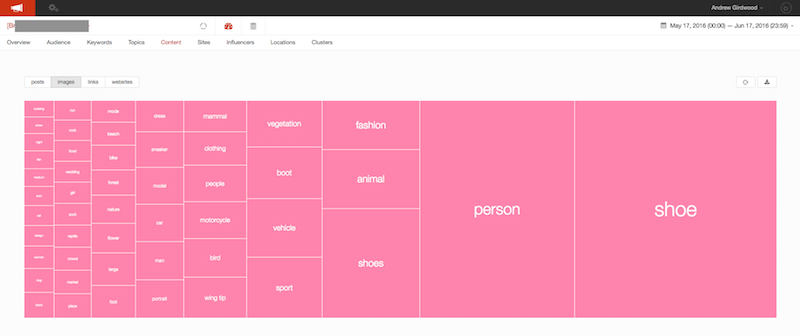
Pulsar Images

The overwhelming majority of movie inspired outreach and engagement campaigns – either for social or for SEO – lean heavily on highly visual content. Thankfully, visual doesn’t always mean infographic.

The leading influence analyzer platforms have the ability to study pictures as part of their research. This is worth doing. Finding a blogger with a tendency to share infographics, for example, is a valuable find.

Movies based on an established franchise, either a sequel or a movie of a comic book or game, will be accessible and researchable based on visuals long before they hit theatres. This is a tactical advantage should not be wasted.

Build on past successes

There are few occasions when an outreach and engagement campaign needs to begin from scratch and even fewer in which it should.

In most scenarios the brand or agency should already have relationships with bloggers and a strong idea of what content types are popular. This knowledge should be baked into the campaign. There’s no reason why key bloggers cannot be approached in advance, their input sought or even co-creation concepts explored.

For large, officially backed, movie campaigns relationships should be built in advance. Ideally no brand should be in the situation of having spent a considerable amount of money on a tie-in and content before an agency sees whether or not the influential bloggers on that topic are actually interested in it. Some dominant fan sites may even be offended if they’re not given the chance to be involved.

Pick a movie that suits your brand

Bluebeards

Some movies work better for outreach than others. Movies with a large community – geek, for example – are easier targets.

There are generally lots of clever ways to make a brand relevant for the movie’s audience too. Sell suspending ceiling panels? Look around, maybe there’s a haunted house movie coming up and that’ll give you the chance to talk about strange noises from the attic instead.

Sometimes there is a good connection between a brand and a movie but it won’t be one the brand enjoys. What if a smart character in the haunted house movie argues against the lunacy of splendid ceiling panels? You won’t know until after the movie is released and most outreach projects need to begin long before then.

There are times you just have to be careful.

Hipster-macho brand Bluebeard’s Revenge partnered with the Suicide Squad movie. There’s overlapping demographics in the audience. We also have a brand that sells straight razors partnering a movie with ‘Suicide’ in the title (and featuring The Joker, no less). This certainly doesn’t mean it is a bad partnership or there are no outreach potentials but it does mean some careful handling will be needed.

Build Anchors

An anchor is one half of a handshake in well designed outreach and engagement campaign. It is the reason why a blogger or other publisher would make an editorial decision to link back to your site.

Campaigns with no or weak anchors sometimes ask bloggers to link back to ‘credit the source’. This rarely works as publishers you care about know about nofollow.

Surveys inspired by movies a good example here. They’re easy to do, haven’t entirely jumped the shark and can be used to pitch some big media. Do they offer bloggers a reason to link back to the brand that paid for the survey? Not so much.

Your SEO mind has to come up with a reason, create something that wonderfully complements the survey data so that writers make the decision to reference it, therefore link, in their coverage.

Provide media assets

Media assets are the other half of the handshake in an SEO outreach campaign. These assets make it easier for bloggers to cover your campaign. Every movie inspired outreach and engagement campaign should have an image on offer, at least.

For example, take a look at this simple parallax from Grange on 007 cars. It was timely, out at the same time as the movie Spectre. Bloggers know to avoid thin content, writing nothing but sign-posts that direct readers elsewhere, and coming up with an angle to discuss an interactive like this requires time, energy and imagination.

Grange’s agency made sure a ‘full flat’ version of the infographic was available as a media asset to try and mitigate that problem. A sensible thing to do is to create some WordPress safe animated gifs (in terms of size, common theme width) of interactions on your interactive and make them available as assets to accompany your anchor.

Research international distribution plans

avengers assemble

Movies are not released on the same date across the world. For example, Disney’s Big Hero 6 was released in the United States on the 7th November in 2014 but after Christmas in the UK on the 30th of January 2015.

It’s far easier to do your outreach for big movies with similar release dates in your target markets and the good news is it’s easy enough to research schedules far in advance.

It’s not unheard of for movies to change names for international releases too. This can make building an outreach and engagement campaign around them. For example, the 2012 The Avengers movie was called Avengers Assemble in the UK as not to clash with a classic TV series. The added catch? Most UK bloggers called the movie The Avengers anyway.

Work with your Affiliates

In most cases your Affiliate marketing channel can be used to help assist your SEO and Social media activities as it will give you access to hundreds of publishers.

Take just a little time to see how many content affiliates you have in your program. This information may be easily discoverable if the affiliate team have done this work already.

It’ll certainly be worth emailing them directly and saving money preventing a second agency doing exactly the same thing. Even cashback and voucher code sites are worth tipping off; they may well want to do some marketing around the movie as well and this could be a great chance to score some extra promotion.

However, if you are experimenting with attribution models then be aware of how providing linkbait and clickbait headlines to your army of publishers will influence that study. You’ll help those sites lay claim to radically more sales touch points.

Andrew Girdwood is Head of Media Technology at Cello Signal and a contributor to Search Engine Watch. You can connect with Andrew on Twitter or Google+.


from SEO – Search Engine Watch http://ift.tt/29kplOA
via IFTTT

What do content marketers need to know about SEO?

The way that search marketing has evolved over the last few years has brought content marketing and SEO ever closer together

Content creation and SEO used to be very separate disciplines in the past, but now it’s hard to see how either can be practiced effectively without at least some knowledge of the other.

Which brings me to the question: what do content marketers need to know about SEO (and vice versa) to achieve the best results?

In this post I’ll make an attempt to answer that question, with the help of Kevin GibbonsMD at Blueglass and Sticky Content’s Content Director Dan Brotzel.

What do content marketers need to know about SEO?

Here are some of the tactics and skills, mainly associated with SEO, that content marketers need to be aware of.

I’ve not mentioned technical SEO here, though it is of course important as the foundations on which effective SEO (and content marketing) is built.

Keyword research

Keyword research enables SEOs to find gaps and opportunities to help target pages rank, by understanding the popularity of keywords.

For example, a site producing content around wedding dresses needs to understand the most popular terms used, and the range of terms they need to optimise their content around.

There are lots of useful SEO tools (many are free) which can help with keyword research. Google’s Keyword Planner and Trends are obvious ones (though Keyword Planner has just become less useful), while just typing terms into Google and seeing the suggested searches is another way.

One tool I’ve found useful recently is Answer the Public, which provides some great insight into the kinds of questions people have around a particular topic.

answer the public

Here are the results for ‘content marketing’. It provides some great insight into the kinds of questions people are asking around a topic, which should help content marketers to target more effectively, as well as generating some useful ideas.

answer the publicAccording to Dan Brotzel:

“Keywords and other SEO insights are a vital tool. They provide a useful (and often surprising) index of users’ preoccupations, and the words that they actually use to phrase their searches. Anyone in the business of generating ideas for content should see keyword research/data as a rich resource for understanding user intent and interest, and make it integral to their brainstorming process.”

Knowledge of user search behaviour

This is related to keyword research, as this provides insight into how people search, the language used etc. It’s more than that though…

Insights such as the seasonality of some searches can inform content planning, as can the way people view and interact with search results.

/IMG/542/320542/awr-ctr-study

Effective content marketing looks at the target audience’s questions and concerns and produces content to address their needs. Knowledge of how people search and what the search for provides plenty of insight to help with this goal.

Attracting authority links

Link building is a valuable tactic for SEOs and one which content marketers should be aware of.

They don’t necessarily have to actively build links, but can attract links by creating content that people want to link to and promoting in to relevant publications and channels.

Indeed, a 2016 link building study found that content based link building was by far the most effective method.

Link building tactics most effective

Proving the value of content

There are plenty of content marketing metrics to look at, and the SEO value of content should be part of the measurement applied to content efforts.

As Kevin Gibbons says, it can help to secure budget:

“Knowing the role SEO can play helps to prove the value of content. If you can forecast and report that your content will generate a monetary value in terms of organic traffic and revenue, this is when people can start to scale their investment towards building valuable content assets.”

There are several SEO-related metrics to look at – the organic traffic (and any related revenue) delivered by the content you produce, the links it attracts, and the success in securing organic search positions.

keyword

What do SEOs need do know about content marketing?

These are the tactics and skills normally associated with content production which are becoming ever more valuable to SEOs.

Many of these tactics are interchangeable. For example a focus on the target audience is essential for SEO and content marketing.

The importance of storytelling

Content creation requires a degree of creativity, which can also be valuable from an SEO perspective.

As Kevin Gibbons explains:

“The biggest thing SEO can learn from content marketing, in my opinion is around the importance of storytelling.

It’s vital that you get your message across, providing the best experience in the format that resonates with your target audience. SEOs can often be guilty of sticking to the tried and trusted campaigns that have worked in the past, great content marketers realise that it’s not about what we think, it’s about your audience.

Do your persona analysis, speak to your customers, find out what they really want to see and have a less is more approach towards driving and engagement through doing the best job possible to tell your story.”

storytelling

A focus on the audience/customer

An effective content strategy needs to address the needs of your target customer, and should also align with business goals. It’s not just about attracting traffic, rather it should aim to attract the right kind of customer.

If you address the needs of your target customer through content, the viewers of this content are likely to be your target audience.

For example, retailers can use content such as how-to guides to attract potential customers. So, Repair Clinic produces useful guides on appliance repair. This is useful content which also ties in closely with, and therefore helps to promote, its products.

It’s great for SEO too, as it helps them to target searchers with appliance-related problems, its target audience.

/IMG/728/333728/pressure-water-leask-water-rp

There are SEO tools and techniques which can help to answer these questions, but a broader understanding of the target customer can be gained by using a wide range of information.

This includes customer surveys and reviews, information from customer service interactions, and much more.

As Dan Brotzel says, this process requires creativity:

“Content marketers need to apply editorial initiative and imagination to generating ideas for content that can both address users’ needs and business requirements. They need to find ways to answer the question: What kind of content do our users care about? What counts as a good idea for them? What kind of ideas and content can we credibly produce from within our niche? How can we use content to support our goals?”

Importance of quality content

The old SEO techniques of churning out content for the sake of putting target keywords on a page is no longer effective.

Algorithm updates have forced SEOs to think more about the quality of the content they produce, and this is also the focus of effective content marketing.

As Dan Brotzel says, quality is what users want:

“The great thing about the evolution of SEO is that it is pushing content ever closer to the one criterion that users are ever likely to care about: quality. Yes, you want your content to surface high in results (and to be accessible and scannable, come to that), but there’s no point being easy to find and consume if what you’re offering users isn’t on reflection actually worth finding.”

Quality is, of course, a very subjective term, and is ultimately something for the end user to judge, but the aim should be to produce content that is valuable.

This can be measured to a certain extent in the way that users interact with it (on-page behaviour, actions taken after reading etc) but also in the way that search engines rank content.

Quality can also be a factor in search rankings. For example, if the content is answering the question that the searcher typed into Google, this helps it rank higher.

This is the ‘long click’ (as explained here by Bill Slawski). It’s similar to – but not the same as – bounce rates.

It’s essentially a measure of how long a user spends on a page before returning to the search results page. If they take time, or don’t return to search results, it tells Google that the content has satisfied the searcher, and is therefore relevant to the search query.

Over time, quality content which achieves this will rank well. It will also attract links and social shares, all of which help in terms of SEO.

This is why a focus on evergreen content can be a great tactic for content marketers and SEOs alike.

For example, a post on SEO basics (since updated) from 2014 has delivered traffic over a long period of time. There’s an initial spike after publication, but the traffic didn’t drop off totally, it continued to deliver visitors to this site. In fact it attracted more than 25,000 pageviews last month, more than two years after publication.

The reason is that this is useful content for searchers, and this has helped the article top Google for the term ‘SEO basics’ for some time. This ranking then helps to deliver more visits, attract links, and so on. It’s a virtuous circle.

/IMG/376/338376/seo-basics-stats

/IMG/377/338377/seo-basics-2

In summary

The reality is that no marketing discipline can exist in a vacuum. They all rely on skills and techniques normally associated with other disciplines.

Email marketers need some content skills to make their subject lines and email copy more effective, ecommerce sites rely on SEO techniques to attract customers, and so on.

For content marketing and SEO, its very important for practitioners to understand the importance of the tactics and skills of each.

In a nutshell, SEO requires good content to be really effective, while content producers need to use SEO to help with content planning, and to ensure that the content they work hard on can be found by their target audience.


from SEO – Search Engine Watch http://ift.tt/29xtoMc
via IFTTT

Bing Testing Rating Percentages in Search Results

Bing is running an interesting test in the search results, and for a minor change, it really stands out when I see it.  They have added the addition of a ratings and reviews percentage score, in bright orange to match the color of the stars. Here is an example for a reviews site: And here […]

The post Bing Testing Rating Percentages in Search Results appeared first on The SEM Post.


from The SEM Post http://ift.tt/29hPf55
http://ift.tt/eA8V8J via IFTTT

Is Google AMP a ranking signal?

So I’ve been working my backside off trying to implement Google’s Accelerated Pages, with limited amounts of success and bucket-loads of frustration and I’ve come to the point now where I have to ask… is it all really worth it?

Before we get to the wider picture of why AMP is so important, and why ultimately you probably do need to implement the thing. Let’s first answer the simple question stated in the headline…

Is Google AMP a ranking signal?

No.

Gary Illyes, Webmaster Trends Analyst at Google, stated during his SEJ Summit Chicago appearance that, “Currently, AMP is not a mobile ranking factor.”

But of course you can pull that “Currently” apart as much as you like, and read into it a high likelihood that Google will probably use it as a direct ranking factor one day soon.

As Danielle Antosz from SEJ reports, Illyes further pledged that Google will be expanding AMP vertices to include Google News, Google Now, Play Newsstand, Now On Tap, and in the near future it will likely expand to product pages for ecommerce sites like Amazon.

Which brings me to my next question…

But does it actually matter whether AMP is a ranking signal or not?

Well… (again)…  No.

As you will have read countless times in countless search engine related news sites (well 3 or 4 anyway), the world of search is a drastically different place to what it was a couple of years ago and it continues to evolve every day. Every element we describe as a ‘traditional ranking signal’ is oversimplifying that element greatly.

It’s all about context, content and… stop me if you’ve heard this one before… user experience.

And that’s the key thing with AMP, it improves the user experience.

Which brings us neatly to…

Why should I implement Google AMP?

Here’s a super-quick refresher on AMP in case you’re completely lost:

Google’s Accelerated Mobile Pages are an open source initiative which aims to improve the performance of the mobile web. stripped-down versions of web pages.

When you Google search for an article on a mobile, you may have spotted the ‘lightning’ symbol. This is to indicate that by clicking on it, you will experience a cleaner, faster, streamlined version of the article that downloads instantly.

amp news carousel


According to Kissmetrics, 40% of web users will abandon a page if it takes longer than three seconds to load, and that’s just on a desktop.

With mobile there are masses of other issues that can lead to abandonment – connection faults, poor formatting, non-mobile optimised content, badly placed links – so you can imagine why, if now more than 50% of searches take place on mobile, Google would want to improve the mobile web. It’s difficult to monetise a crappy experience.

According to Gary Illyes, AMP pages have a four times faster than average load time, 90% of publishers are seeing higher CTRs, 80% of publishers are getting more views, and the majority of publishers are seeing higher eCPMs.

So clearly AMP is working. Searchers are clicking through, they’re enjoying the experience, they’re seeking more AMP content to read… Wait. Hang on…

Of course AMP traffic is growing! For almost every content-related search I do on a mobile it’s difficult to get past the attractive, image-heavy carousel of AMP posts at the top of SERPs… of course the CTR is going to be a high! It’s basically a stacked deck.

Unfortunately if you’re (to continue the horrible analogy) in the game, you will need to sit at the table.

Implementing AMP is dead easy though right?

Uh…

Let’s just take a look at my Search Console AMP results for my own site right now. I have 258 pages with errors.

Search Console Accelerated Mobile Pages report

And this is after implementing all of Yoast’s recommendations and various plug-ins. Frustratingly I can see my AMP pages actually working, just by adding the /amp/ suffix to my URLs, yet I’m still seeng these errors.

But perhaps my own ultimate frustration lies in the fact there doesn’t seem to be much point in implementing AMP if my site doesn’t show up in Google News, as its the News carousel that provides all of the AMP content.

We already looked at why SEOs are so slow to implement AMP just a couple of months ago, and revealed that only 23% of SEOs are currently using AMP. It’s reasons such as the above that add to this general malaise.

There’s also the potential loss of revenue to consider…

As Rebecca Sentance reported in May, “Because AMP strips out a lot of the dynamic elements that slow down page loading time, search marketers have to do away with features that they depend on for business, such as comment systems, lead capture forms and other types of pop-up.”

Implementing AMP is obviously good for user experience, but of course Google is primarily a business…

Google launched three ad formats for AMP last month, intended to gain some ad share in mobile display advertising away from Facebook and other competitors.

AMP could be read as Google’s sly way to make you remove all your own ads in order to conform to its faster mobile web, then encouraging you to join up with it’s own ad exchange platform Doubleclick because you need to generate revenue somehow.

But then all of this could become horribly unstuck when every mobile web user on the planet decides they’ve truly had enough and downloads an ad-blocker.

Tl;dr: yeah you should probably implement AMP, Google has you right where it wants you anyway.

Or does it?


from SEO – Search Engine Watch http://ift.tt/29qk89K
via IFTTT

A 9-Part Client Management Manifesto Your Agency Should Steal

Posted by brianspatterson

It was my first day at my new gig as a federal government IT consultant in Washington, D.C. I was slogging through the typical onboarding paperwork when a senior partner dropped by, introduced himself, and handed me a paperback book.

“Read and implement this,” he said. The cover read The Trusted Advisor by David H. Maister, a book with a sole focus on “the ability to earn the trust and confidence of clients.”

“Client management must be important,” I thought.

This encounter occurred more than 10 years ago, in my previous profession. Before doing search marketing or SEO, I was a government IT consultant. I navigated bloated systems and untangled red tape. In the time I spent consulting at the FBI, ICE (U.S. Immigration and Customs Enforcement), and the CBP (U.S. Customs and Border Protection), I learned quite a few lessons that apply directly to the SEO industry.

The most important lessons I learned, perhaps, were about the art and science of effective client management. Many of those lessons learned have become standard operating procedure at Go Fish Digital. What follows is the codification of our client management approach. It isn’t a sexy new link building strategy or a mind-blowing algorithm update, but it's just as critical to the success of a project.

Overarching client management principles

To start, the following overarching principles help set team expectations. The three core areas that guide our client engagements are:

  1. Transparency: The majority of our tasks and communication take place in a project management tool (Basecamp) that the client has access to. We want them to see and participate in our discussions, questions, and decisions. By not having this process behind closed doors, we can always go back to when and why a decision was made within Basecamp.
  2. Continuous communication: We communicate at the pace the client prefers, but we err toward over-communicating. To a client, radio silence means no work is being done, even if that isn’t truly the case.
  3. Alignment: What are your client’s key performance indicators (KPIs)? What problems keep them up at night? We make sure to align our work and reporting with what is important to the client, rather than only pushing what we think is most important.

The following nine principles are built out of these three core areas, highlighting how you put these principles to work in day-to-day interactions with clients.

It should be noted that these aren’t hard and fast rules, but rather a philosophy to guide our team (and hopefully other agencies) on how to become trusted partners with your clients. It is hard to be perfect all the time (I sure as hell am not), but the more often these nine items are standard operating procedure, the better. So let's dive in, Star Wars-style.

1. Take the time to learn the industry

ll9jjQ8.jpg

I got the call from a team member to let me know a new referral had come our way. He was excited because it was a strong referral and very likely to become a client soon. I asked him about the project and what industry they were in. “Plastics machine manufacturing” was his response. Interesting... I knew next to nothing about that industry. Yet, we were very likely to have them as a client to help them market their products online. The first thing we needed to do was understand the industry, and we did this by diving in head first to learn everything we could about the plastics manufacturing lifecycle.

To make sure we have a solid foundation for a client’s niche, the team conducts a lot of discovery in the first month, such as:

  1. Reviewing the client’s website
  2. Identifying industry publications and blogs and reading them consistently
  3. Scheduling an in-person visit (if possible) to see how they work and meet the team
  4. Requesting any documentation they have about their products or services
  5. Watching online videos highlighting the industry, their products, and their team
  6. Building a lexicon document that includes jargon and definitions of words commonly used in their industry
  7. Purchasing and using the product or service ourselves (if reasonable and feasible)

As an SEO and marketing consultant, you will not be an expert in every client’s industry. But, it is important that you learn their space. This builds their confidence in you, helps you learn their language, and establishes trust.

2. Crush it on the kickoff call

ghReTMF.jpg

We were kicking off an online reputation management (ORM) project with a celebrity’s publicist and assistant. Prior to the call, we gathered everyone in the company that was a fan of this celeb and did a quick research session so we were all up to speed with his movies, causes, friends, and issues. For the kick-off call, we built a detailed agenda which contained specific topics and questions. The call left the client team feeling at ease that we understood the issue and how to fix it. As a team, we were pleased that all of our early legwork (and TMZ watching) paid off.

After the sales process, the project gets handed over to a client manager like myself. The first thing I do is get a kick-off call scheduled quickly with the client and anyone from their side who will be on the project. Since this is one of your earliest communications with the client, it sets the tone for the entire engagement, so you want to be organized and responsive in getting this meeting set up.

We include on the call anyone from our team who might touch the project. This way, they hear everything from the client at the start, and the client feels good because so many people are working hard on their project.

We always build an agenda for the kick-off call, and I make sure that there is at least one item that each person on our team can speak to. This allows each employee to demonstrate their expertise in the beginning and build a relationship with the client. If it's a phone call, the client may forget just how many people we have working on the account if only one or two people speak during the meeting.

3. Have open, visible tasks and team discussions

d3DvQ7V.jpg

We’ve been working with Amy for several years now, and she continually expresses her gratefulness for our transparency. Amy is a senior employee at a data security firm and is often traveling and working on other projects. By keeping track of every task on Basecamp and looping her into our work, she is able to quickly skim through completed tasks and see exactly where we stand on every project. She sees not only what we’ve accomplished in her absence, but also what’s on the horizon. Additionally, she can be directly emailed with any pertinent messages and chime in with a response to keep everything moving forward.

The goal here is to show everything except how the sausage is made. Why would you want to hide all of the time-consuming, difficult, and sometimes menial tasks you’re doing? Showing the client everything we are doing for them helps drive home the value of our service and keeps them from getting antsy about the occasional slow result.

The only place where we hold back a little is on drafts of deliverable reports. We keep those in our team Dropbox and simply reference the folder path when discussing them on Basecamp. We’ve found it keeps clients from getting hung up on things that we haven’t quite finished.

4. Respond within 24 hours

cjFT3xq.jpg

I was just breaking into online marketing when I heard something on the radio that caught my attention. My favorite show, The Sports Junkies in Washington, D.C., were looking to build a website for a new venture. They talked about how annoying it was to work with web designers because things always get difficult. In a moment of inspiration, I sent them a short pitch email that ended with, “Messages don’t sit around in my inbox. I respond immediately.” The next morning, someone from the show emailed me back, saying “I’m not sure why exactly, but I think I can work with you." I’ve worked closely with them ever since, and that relationship has helped springboard the Go Fish Digital brand in D.C.

From that original encounter on, I’ve always placed a high value on responsiveness. You know that person in your life who feels like you're late if you're on time? That’s how we are with this 24-hour response time rule. If you truly take 24 hours to acknowledge a client’s request, it may be within the time frame, but it isn’t honoring the spirit of the rule itself (37 pieces of flair, anyone?). It doesn’t take much to send a note saying, “We are on it”.

This is another area in which we err on the side of overdoing things. Even if the client sends an email that might not normally warrant a response, we still ping them back to let them know it was received.

One of the chief complaints about service-based companies is a lack of responsiveness. Counteract that by being committed to quick responses.

5. Be organized

Fi23z53.jpg

The director of marketing at a large financial organization likes to meet with our team weekly. We review the previous week’s progress and talk through our tasks for the next few days. This client is especially chatty, so without a formal agenda in place, there was the potential for the calls to devolve into a free-for-all, which would be inefficient for everyone. Because of situations like this, we always send a formal agenda ahead of time, which keeps us all on track and demonstrates to the client that we understand their goals and respect their time. Of course, we always allow our clients to ask questions or bring new things up. For the most part, though, we try to stick to the agenda.

Disorganization is frustrating. Sometimes you just have to deal with it. A spouse or child who misplaces everything, a friend who can’t remember an appointment, or a co-worker that never replies to important emails. While in these instances there is nothing you can do, a client who’s fed up with her vendor’s disorganization can simply get a new vendor. So we stress the importance of being ultra-organized on the project.

Have well thought-out agendas. Follow those up with meeting notes and action items if appropriate. Keep Basecamp organized with to-dos and messages. Communicate clearly. Always use calendar appointments. It’s the little things that show you are professional.

6. Be flexible and adaptable

xRluZx0.jpg

We work with a large car sales website that aggregates all car listings from across the web. When you're dealing with a site that has over 3 million pages, it's important to focus on optimization opportunities that scale. We identified site speed as one of these optimization opportunities. The site had been particularly laggy, and I was doing my best to get to the bottom of the issues with their CDN. Alas, I was stuck.

Fortunately, one of our other team members is Akamai certified and has configured CDNs for multiple large government websites. I looped him in; he started throwing around big words like “nodes” and “end points.” Some magic happened, I assume, and everything was fixed. The site was now blazing-fast and the client happy that his SEO team resolved an issue he didn’t even know they could help with.

No project is ever the same, which is great. How boring would it be if you applied the exact same strategy and principles to different projects, over and over?

We're always looking for ways to show additional value to the client. Whether it's by helping them with something out-of-scope or helping with deliverables that they have to pass on to senior management, there are always ways for us to contribute value. Although there's nothing wrong with up-selling, we don’t often like to say “that is out of scope” for a task that wouldn’t take us too long or be too difficult.

Additionally, we're very flexible in terms of how we work with a client. Is the client a phone person or email person? Are they hands-off, or intimately involved in the details? We try to get a good feel for this, and then adjust how we work with them based on their preferences.

7. Be in front of the technological curve, not behind it

8XSqlYl.jpg

Our new yacht charter client had just finished their first month with us and we were reviewing everything that had been done thus far. It was all very positive, and during the call, the CEO casually said, “I love the internal communication tool (Slack) so much that I’ve started using it at my other company.” Clients want to feel like you are doing things efficiently, effectively, and with the latest technology.

In our field, change is the norm. Every time Google launches an algorithm update, it can mean that a tactic that's worked for us for months or even years is suddenly obsolete. We’ve found that one of the best ways to avoid any surprises here is to stay ahead of the curve when it comes to strategies and tools.

I’ve mentioned our project management tool, Basecamp, a few times now. It may not have all the bells and whistles of others, but it’s dead simple to learn and our clients pick it up without any help from us.

We also use Slack both internally and with clients for brainstorming sessions. Slack provides quick access to the entire team, which is helpful for most of our day-to-day communication.

In addition to tools, we’ve found that everyone on the team needs to be comfortable with a core set of tech-savvy tasks:

  1. Reviewing and editing HTML and CSS
  2. Testing, installing, and configuring WordPress plugins
  3. Editing a WordPress theme
  4. Running ScreamingFrog against a site and reviewing the results
  5. Performing more advanced Excel functions like vLookups and pivot tables
  6. Examining a website’s DNS and understanding each element

Being tech-savvy in all areas of our business reinforces their trust that they are with the best team. Clients expect us to be tech-savvy, so we don’t want to let them down by looking like noobs.

8. Have an escalation path to turn to

zM4zb5N.jpg

While project work was underway for one of our financial sector clients, a reputation crisis popped up that went beyond our defined scope of work. We had worked with Google in the past to get certain defamatory web pages removed, but this particular case required some legal expertise. Luckily, we had a highly specialized ORM attorney in our network who was equipped to handle situations exactly like this. The client was grateful that we had a trusted expert on call and felt like their issue was being handled by an elite team that could deftly handle any issue that arose.

If things aren’t working, clients like when you have options to turn to. Bring in an expert from your team or even an outside consultant, but be sure to sell it as a unique offering or connection that you have. Being able to escalate situations to special people and processes when the initial solution doesn’t work keeps the project moving forward and prevents clients from seeking solutions from other agencies.

9. Show you care on a personal level

GSci7vM.jpg

Our client was having his first child, a baby girl. That is certainly a time to celebrate, so we made a nice card and sent it to his family along with an edible arrangement when his bundle of joy arrived. It went over great, both with the client and his wife.

I hesitate to call this a tactic, since caring should never be manipulative. Let's just call this a reminder to care. Small talk at the top of calls, for example, can go a long way in establishing a more personal connection than the robotic client/agency relationship. It's hard for introverts like me, but I force myself to do it because it gives the relationship more depth and meaning. At the end of the day, your reputation as a person is more important than building brands or making money.

Final thoughts

We do our best to instill these values in our organization and make it clear up front what our expectations are of every employee. Over time, these nine principles have evolved and will continue to do so as we work to continue building a good agency with a strong reputation.

Maintaining a positive relationship with the client is everything. Delivering on the results you sell and adhering to these nine principles will help both you and your client achieve success.

Do you disagree with any of these principles? Or are there others that are important to you, either as a provider or as a client? Let us know in the comments!


Sign up for The Moz Top 10, a semimonthly mailer updating you on the top ten hottest pieces of SEO news, tips, and rad links uncovered by the Moz team. Think of it as your exclusive digest of stuff you don't have time to hunt down but want to read!


from The Moz Blog http://ift.tt/29gpZMa
via IFTTT

Tuesday, 5 July 2016

​The MozCon 2016 Community Speakers Have Landed!

Posted by EricaMcGillivray

[Estimated read time: 6 minutes]

That's right! Please join us in congratulating the four community speakers for MozCon 2016 — September 12–14 in Seattle.

This year, we received 140 submissions. And while the overall number of submissions were down, the quality of submissions has gone up. Typically, we've been able to eliminate ~100 submissions for not meeting the minimum bar, but this year, it was more like ~20. Which only means competition for these four slots was harder than ever before.

For those wondering more about what makes a great MozCon pitch, I've included the pitches, plus a comment from a committee member. (With a bit of the information redacted, because surprises on stage are good.)

Please congratulate...clapping hands


Alex SteinAlex Stein

SEO Manager at Wayfair
@sonofadiplomat

Alex Stein is currently SEO Manager at Wayfair.com, an online home goods store. Follow him on Twitter @sonofadiplomat for all things SEO, and he is, in fact, the son of a diplomat.

Alex's pitch:

Boost Rankings by Removing Internal Links

A majority of SEO advice covers gaining high volumes of external links, but many site owners fail to pursue the low-hanging fruit by reducing the number of internal links to drive organic rankings. Listeners will learn easy ways to massively optimize internal authority flow to boost rankings, with case studies to demonstrate these wins in action.

Business cases that will be covered:

  1. Slimming down your header navigation: Using [X] data and [X] to remove links from header navigation, while increasing conversion.
  2. Slimming down your footer navigation: I’ll cover how we used A/B testing to prove footer links weren’t driving qualified visits, just "tourist visits."
  3. For smaller sites, I’ll cover common mistakes with [X] that increase the total number of links on every single page.
  4. Reducing links on your most valuable pages: I’ll cover two concrete examples of how Wayfair reduced the number of links on product browse pages and drove additional visits.
  5. I’ll share a "Link Value Calculator"
  6. Lastly, I’ll also cover our formula for evaluating the dollar value of an internal link.

Felicia's notes: Sounds very actionable. I like the straightforward, traditional simplicity of the topic, and am intrigued by the "link value calculator"/"evaluating the dollar value of an internal link" ideas. If not a finalist, this would make a great blog post.


Emma StillEmma Still

Marketing Lead at Seer Interactive
@mmstll

Emma Still leads all marketing efforts for Seer Interactive. Prior to that, she led a team of SEO professionals at Seer, where she leveraged her digital marketing skills to recruit team members to build stronger, more successful digital teams.

Emma's pitch:

What if digital marketers thought about recruiting in the exact same way they thought about [smart] link building?

The highest commodity in our industry is human capital: the people on the teams, doing the work, getting. shit. done. Yet so many companies are desperate to find and recruit the talent they need.

The ironic thing is that the answer to their recruiting woes has been under their noses the whole time.

Using tools like [X] to find people who share content that aligns with your company’s mission or philosophy? Boom — list of candidate prospects.

All of those advanced search queries you’ve refined for identifying link prospects? You can easily use those for prospecting potential candidates. For example, [X query string]

Know someone who would be an ideal candidate but isn’t ready to make the leap to a new role? Use [X's] feature to find people they’re closely connected to and you’ve got a whole new set of prospects.

Digital marketers have all the tools and resources they need to find and recruit other talented digital marketers; all it requires is a change in perspective.

Christy's notes: Really interesting topic that tackles a pervasive problem in the marketing industry. Pitch is solid.


Robyn WinnerRobyn Winner

SEO Manager at Hornblower Cruises and Events
@robyn_winner

Robyn Winner is a passionate SEOer with a deep love for data analytics, user experience optimization, content strategy development, and her two adorable cats who fill her life with joy and fur...on everything.

Robyn's pitch:

I'd love to present on Navigation Optimization. It's a pretty meaty topic, and I could honestly talk for two hours on it, but in the 15 minutes I'd like to cover the key components that go into improving a site's navigation structure. These components include: Understanding the buying funnel for both B2B and B2C, utilizing [X] to provide a guideline to the navigation structure, stepping away from narcissistic menuing (i.e. [X]), incorporating calls to action, the basic elements all b2b and b2c navigations should have, and ensuring each page is its own unique URL! No more of this one-page website with anchor text.

I've worked with a lot of clients just on this, and each time we've seen massive success because what we inevitably do is improve UX by bringing relevant pages higher in the funnel. We then see improved ranks for those pages because they're naturally accessed more via the nav. Most importantly, we're able to identify gaps in content once we whiteboard the new navigation structure based on [X, X, and X] (which inevitably leads to more ranks!).

Ronell's notes: Highly relevant to EVERYONE.


Samuel ScottSamuel Scott

Director of Marketing and Communications at Logz.io
@samueljscott

Samuel Scott is a global marketing speaker and Director of Marketing and Communications for log analysis platform Logz.io, as well as a contributor to TechCrunch and Moz.

Samuel's pitch:

The 8 Things You Need to Check in Server Log Files in Technical SEO Audits

Server log files contain the only data that is 100% accurate in terms of how search engines crawl your website. Here's what to check and how to fix any related problems.

Crawl budget and volume. If the number of times that a search engine is visiting your site suddenly drops, check your [X], [X], and [X].

Response code errors. Every single server log entry contains a response code. Group URLs by response code to look into those problems easily and in bulk.

Temporary redirects. Every log entry with a 302 response code is a temporary redirect. Those should be changed to 301 (permanent) redirects.

Crawl priority. Which parts of your website get the most attention from search engines? Does that match [X]?

Last crawl date. If an update page is not appearing in the SERPs, check when Google last visited the page. Try submitting that URL directly in Google Search Console.

Crawl budget waste. [X]

Matt's notes: I like it. It's a source of data that I think intimidates a lot of folks, and I'd love to see it made accessible. If he can make it short and simple, I think it'd be good.


Thanks to everyone who tossed in their hat this year! It's a brave thing to even try.

Treat yo self!

Finally, I'd like to thank this year's community speaker selection committee – Chiaryn Miranda, Christy Correll, Felicia Crawford, James Daugherty, Matt Roney, Ronell Smith, and Sam Weber.

Cheer on community speakers and buy your MozCon ticket today!


Sign up for The Moz Top 10, a semimonthly mailer updating you on the top ten hottest pieces of SEO news, tips, and rad links uncovered by the Moz team. Think of it as your exclusive digest of stuff you don't have time to hunt down but want to read!


from The Moz Blog http://ift.tt/29nzqMi
via IFTTT

Google Podium Posts Expands to Regular Search Results

Google Posts – a feature Google had initially launched for political candidates in the US – has no expanded to other areas of the search results.  Dr. Pete Meyers spotted Google testing it for a non-political search in the search results, this time for a charter school in New York. Here is how it appears […]

The post Google Podium Posts Expands to Regular Search Results appeared first on The SEM Post.


from The SEM Post http://ift.tt/29L77XB
http://ift.tt/eA8V8J via IFTTT

Social Media Today